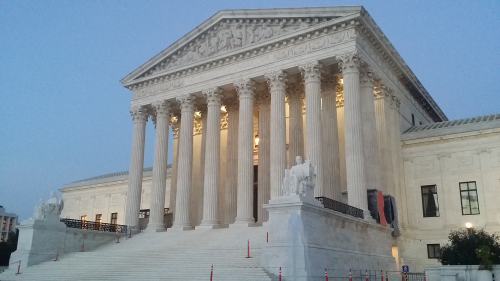
20181002_154246_HDR (1)

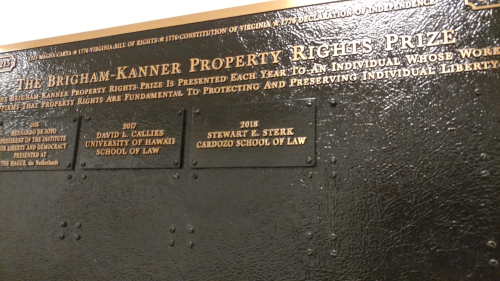
Last week, the 15th Annual Brigham-Kanner Property Rights Conference saw the gathering of legal scholars, judges, lawyers, and law students at the William and Mary Law School to award the B-K Property Rights Prize to Cardozo lawprof Stewart Sterk, followed by a day-long conference focusing on Professor Sterk’s work and the latest developments in property rights law.

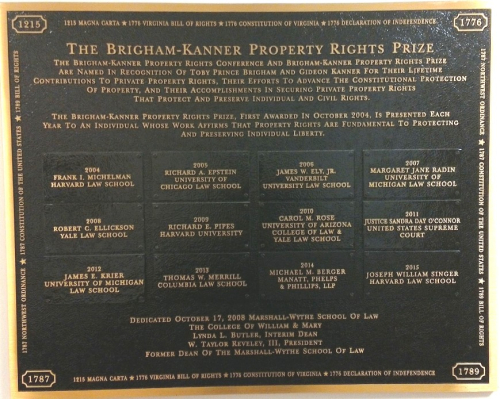
Professor Sterk joins the pantheon of property law scholars (and a judge and a practitioner) who have been awarded the Prize. Pretty impressive:
WIN_20151002_13_15_51_Pro

As always, the program starts off with a candlelight dinner and award presentation in the historic Wren Building, definitely a highlight of the Conference. More about the Conference here

And there’s nothing like spending the following day addressing some of the most pressing issues in our area, along with the brightest minds in the business (below is the final panel of the day, with Professor John Echeverria

Continue Reading 2018 Brigham-Kanner Property Rights Conference Report: Emerging Issues
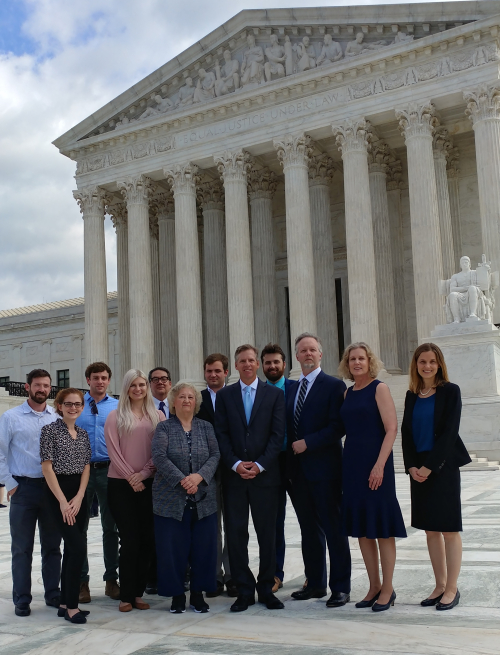
20181003_114518_HDR

Seeking A Cause of Action

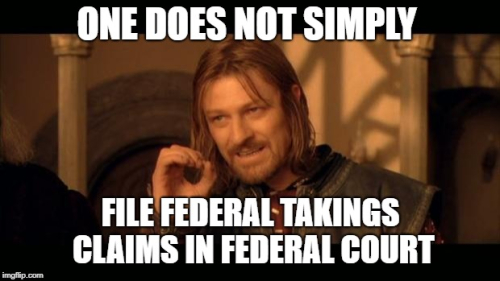
It has been just under a century since the U.S. Supreme Court first recognized (in the modern era, that is) the regulatory takings doctrine. You might think that the intervening decades would be enough time to allow the Justices, collectively, to have figured out what a cause of action looks like. You know, just enough to get by a motion to dismiss for failure to state a claim under Rule 12(b)(6).

Unfortunately, yesterday’s oral arguments in Knick v. Township of Scott, No. 17-647 (transcript here, and below), would not confirm that belief.

Our major impression from the argument is that no more than three Justices clearly understand the major difference between an affirmative exercise of the eminent domain power to take private property, and an inverse condemnation action in which a property owner asserts that the exercise of a power other than

Continue Reading Oranges And Tangerines – The Difference Between Eminent Domain And Inverse Condemnation: Deconstructing The Knick Oral Arguments

20170918_192854

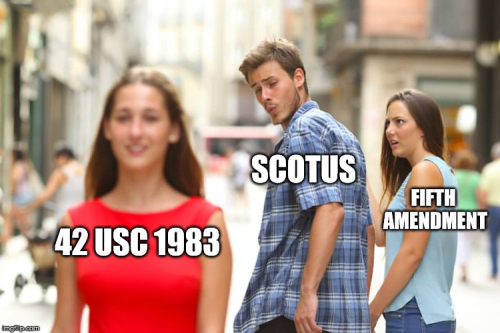
Just out of the Knick arguments. Full report to come later. But for now, these thoughts:

College of Surgeons – D.O.A. I think there’s a consensus to overrule the case to the extent it allows municipalities to remove takings cases to federal court. 

San Remo – On life support. I think also that there may be enough votes to overrule the Catch-22 aspects of that case and the preclusion/full faith and credit trap. 

Here’s the federal government’s position, in a nutshell:

2j7vra

Justice Kagan, like us, found that distinction hard to swallow. 

Justice Bryer quote of the day: “why not let sleeping dogs lie?” (Asking about stare decisis.)

As for the “big” issue of whether the Court will overrule Williamson County? Too close to call. We didn’t see an obvious majority forming around anything but overruling Chicago and San Remo. No Justice seemed to like Williamson County too much (except

Continue Reading Meanwhile Back At 1 First Street … Hot Take On The Knick Arguments

6a00d83451707369e20223c85004e4200c-800wi

I’m not going to do an in-depth preview of tomorrow’s Supreme Court oral arguments in Knick v. Township of Scott, No. 17-647 for several reasons.

First, a lot of others have summarized the issues already, far better than I can. See the list below.

Second, I filed an amicus brief in the case in support of Ms. Knick, and that brief pretty much sums up my thinking about the case. Williamson County ripeness is something I’ve railed on for a while, and there’s no need for me to say it once again.

Finally, I’m attending the arguments tomorrow with my William and Mary Law class, (they get to see the sausage being made!) and am keeping my powder dry for a post-argument report from the scene. 

First, the previews, followed by some brief thoughts:

  • Read the merits and amici briefs (all 21 of them!) here 


Continue Reading Knick Preview: Reevaluating Williamson County Ripeness With An Eight-Justice Court – Just How Badly Can SCOTUS Screw Up Takings Law?

Our colleague and co-planning chair Joe Waldo was in town yesterday, so we walked through historic Williamsburg, Virginia (cradle of the Constitution and the Bill of Rights), to invite you to join us for the 36th Annual ALI-CLE Eminent Domain & Land Valuation Litigation Conference (January 24-26, 2019, in Palm Springs, California).

As we wrote in this post, the Conference will feature the nation’s best eminent domain faculty, presenting on the topics we love.

Register now here. Early registration and group discounts available. The 2018 Conference in Charleston sold out, so be sure to sign up now so you don’t miss out. Continue Reading Join Us For The 36th Annual ALI-CLE Eminent Domain & Land Valuation Litigation Conference In Palm Springs (Jan 24-26, 2019)

BK header

Come join us for one of the best conferences on property rights and property law at the 2018 Brigham-Kanner Property Rights Conference, October 4-5, 2018 at the William and Mary Law School in Williamsburg, Virginia.

Register here

We’ve attended and presented at the Conference in past years, including when it went international in Beijing and at the World Court in The Hague. This year it is back home, and will focus on the work of the 2018 B-K Prize winner, Professor Stewart Sterk of Cardozo Law School

The B-K Prize is awarded to a legal scholar, judge, or practicing lawyer who “has advanced the cause of property rights and has contributed to the overall awareness of the important role property rights occupy in the broader scheme of individual liberty.” The list of past prize winners is a pantheon of property law greats. 

We will be speaking

Continue Reading 2018 Brigham-Kanner Property Rights Conference: Williamsburg, Oct. 4-5, 2018

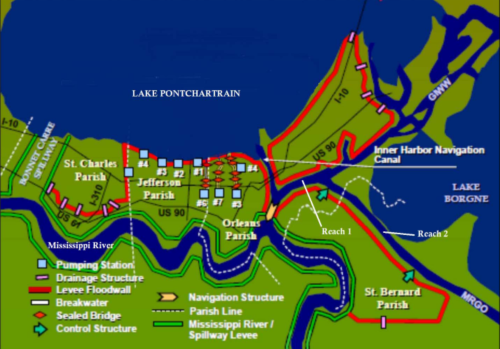
MRGO

Here’s the cert petition we’ve been waiting to drop in a case we’ve been following closely

Last we checked in, the Federal Circuit (any guess on which judge?) held that the catastropic Katrina flooding — caused mostly by the federal government’s construction and maintenance of a navigation project, the Mississippi River Gulf-Outlet canal (known as MR-GO) — could only result in tort liability, for which the federal government has already been determined to be immune. MR-GO was an attempt to improve navigation, and it obviously wasn’t the sole cause of the flooding, but by all accounts (and the proof in the Court of Federal Claims) it ended up worsening dramatically and magnifying the effect of Katrina. The CFC concluded this was a taking, and awarded just compensation.

Now, St Bernard Parish has asked the Supreme Court to step in. Here are the Questions Presented:

In

Continue Reading New Cert Petition (MR-GO Katrina Case): Can Government *Inaction* Lead To A Taking?

After a short hiatus to allow Clint to set up at his new firm, the Eminent Domain Podcast is back. 

Clint was kind enough to ask me to be his first second-time guest, and we had a wide-ranging discussion: everything from this semester’s teaching assignment at the William & Mary Law School, the will-they-or-won’t-they-overturn-Williamson-County case to be argued in early October Knick v. Township of Scott, to the upcoming Brigham-Kanner Conference, the ALI-CLE Eminent Domain and Land Valuation Litigation Conference in Palm Springs, Elvis, and … Kevin Bacon (again).  

Adhering to the same format, including the fun “lightning round” style Cross-Examination, the podcast is a great (and easy) way to keep up on the issues. And at just under an hour, its the perfect length for your commute, also.

We look forward to Clint’s lineup of interesting and insightful guests and topicsContinue Reading Clint Schumacher’s Eminent Domain Podcast Is Back – Six Degrees Of Williamson County Ripeness … And Elvis

20180126_111558_HDR

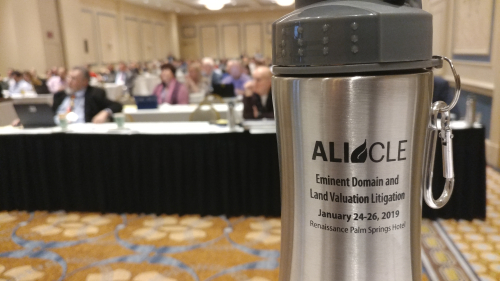
You’ve known for a while that Palm Springs, California, specifically the Renaissance Palm Springs Hotel (a resort facility, but right in town, so you will have many options for “off campus” activities like art museums, the aerial tram, golf, and whatever suits your fancy, and close-in to the Palm Springs Airport), is the venue for our 2019 ALI-CLE Eminent Domain and Land Valuation Litigation, January 24 through 26, 2019.

Of course, you also knew that the programming would be the usual spread of topical and cutting-edge topics, presented by some of the nation’s experts. But we didn’t give you the details. So here are some of the programs we’re having: 

  • Keynote Address: “Property Rights: Foundation for a Free Society” – Taylor Revley, most recently the past President of the College of William and Mary, and also former law school Dean (as well as a


Continue Reading ALI-CLE 2019 Eminent Domain And Land Valuation Litigation Conference, Palm Springs Agenda – Register Now!

Kearney had her property taken. The school district doing the taking said it wanted to put a septic system on the property, and so commissioned a percolation study. But then it decided that instead, it would connect to a sewer system. The state court jury believed neither side’s appraiser completely, rejecting both Kearney’s appraisal ($1.4 million), and the district’s ($850k), and instead settled on $953,000. 

After trial, Kearny learned about the percolation study. For whatever reason, the district hadn’t disclosed the results, something that Kearney apparently believes was critical to value. On that basis, she sought a new trial, and when the Superior Court denied it, sought and was denied relief in the Court of Appeal (that court essentially put the blame on her, noting “that Kearney should have more timely and thoroughly pursued discovering the test results before trial”).

Finding no relief in state court, she went across the street

Continue Reading Ninth Circuit: New Trial Motion, Not Federal Lawsuit, Is Condemnee’s Only Chance To Show Suppressed Evidence Affected Compensation Award