We think you should pay attention to the South Carolina Supreme Court’s opinion in South Carolina DOT v. Powell, No. 2016-000594 (Aug. 8, 2018). Indeed, it is a short opinion, and worth a read in its entirety. The reason why we think it is important is that it analyzes an issue that confuses many: the partial loss of access as the result of a condemnation.    

Quick facts: DOT’s highway project resulted in the taking of a part of Powell’s commercially-zoned, undeveloped property. The parcel has “easy access” to the adjacent US Highway 17 via an intersection. DOT’s appraiser thrice valued the 0.183 acres that DOT was taking from Powell between $68k and $71k.

But right before trial, DOT amended its plans, which resulted in a loss of easy access, even though the roads which directly abut Powell’s property were not altered or closed. “Travelers on the Bypass could reach
Continue Reading South Carolina: No Segmenting A Taking – Once Condemnor Takes Property, Loss Of Indirect Access Is Compensable

IMG_20170726_134028

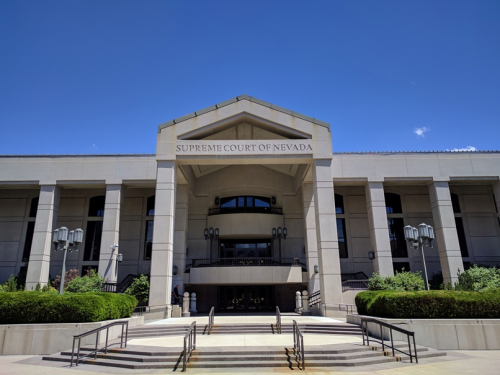
A quick one from the Nevada Supreme Court (pictured above).

In Clark County v. HQ Metro, LLC, No. 71877 (Aug. 2, 2018), the unanimous court concluded that the owner of property at the time the condemnor obtained an order of possession (in Nevada, the term apparently is “order of occupation”) is the party entitled to compensation, and not the party owning the property when the condemnor actually entered the property. 

Quick facts: to build a power line, Nevada Power Company condemned property owned by HQ Metro, and leased to Clark County. Nevada power got an order of occupation entitling it to enter the land to construct the line. But before it actually entered, HQ sold the land to Clark County. 

The question: who gets compensation? The parties agreed that when the taking occurred was the dispositive legal question. Did it occur when the court granted the order allowing physical

Continue Reading Nevada: “Taking” Occurs Upon “Substantial Government Interference” With Property Rights

20180717_135234_HDR

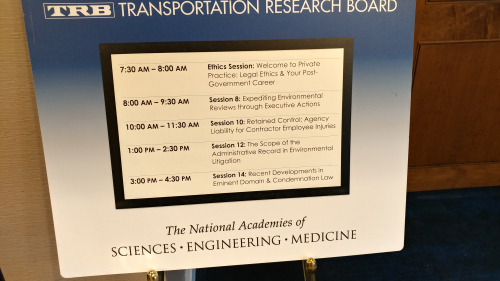
Here are the cases and other items I either spoke about or mentioned at today’s Transportation Research Board‘s 57th Annual Workshop on Transportation Law in Cambridge, Massachusetts:


Continue Reading Links And Materials From Today’s Transportation Research Board Session

A metro-area transit district condemned a portion of a residential lot for a light-rail line. The property was owned by a LLC, which in turn was owned by a family trust. The condemnor offered $19k as compensation, but the trust thought it was worth a lot more: $280k.

One of the big issues contributing to the difference was the loss of parking which would result from the taking. The condemnor wanted to introduce evidence that the family trust which owned the LLC, also owned adjacent and nearby parcels. Thus, the argument went, these parcels were in “common ownership,” and the loss of parking caused by the taking “could more easily obtain right to access [an area] that could be used for on-site parking.” 

The trial court kept out that evidence via an in limine ruling. No “unity of use,” and therefore the parcels should not be considered as one. After the

Continue Reading Oregon Appeals Court Reminds Condemnors: Eminent Domain Valuation Is Focused On What The Market Would Have Paid For The Taken Property

A short, but published, opinion from the U.S. Court of Appeals for the Fifth Circuit.

In Archbold-Garrett v. New Orleans, No. 17-30692 (June 22, 2018), the court held that the plaintiffs’ Fourth Amendment, Fifth Amendment, and Fourteenth Amendment claims (search and seizure, compensation, and procedural due process) were ripe for federal court, even though the plaintiffs had not sought compensation in a Louisiana court under Louisiana law. 

Quick background: the city demolished a building the plaintiffs owned which they had purchased from the city at a lien sale. The prior owner had racked up a bunch of code enforcement fines, and the city claimed the building was dangerous and should come down. But after the sale to the plaintiffs and days before the demolition, the city cancelled the code enforcement lien. Predictably, the city sent the new owners a bill for the demolition. They sued in federal court, arguing

Continue Reading Fifth Circuit: Williamson County Doesn’t Require District Court Dismiss Due Process Or Takings Claim

Here’s the latest in a case we’ve been tracking, the City of Missoula, Montana’s takeover of a privately-owned water system. In 2016, the Montana Supreme Court held that the city could exercise its power of eminent domain to take the property for a “more necessary” public use. The court allowed the city to take the company, and on remand, the lower court determined compensation. There was also a follow up case on who pays property taxes on land while it is being condemned (the owner, although it may eventually have a claim for a refund from the city once the condemnation is completed and title transfers). 

In City of Missoula v. Mountain Water Co., No. DA-17-0272 (June 5, 2018), the Montana Supreme Court considered the payment of attorneys’ fees and costs. After the owners–the water company itself and its “upstream” owner–rejected the city’s offer of $50 million, the condemnation

Continue Reading Montana: When An Eminent Domain Case Is Complex And Requires Out-Of-Town Talent, A Statutory Cap On Attorneys’ Fees May Not Apply

Lebronremoval

The main point we’re trying to make in the amici brief we are filing today on behalf of Citizens’ Alliance for Property Rights Legal Fund in Knick v. Township of Scott, No. 17-647 (cert. granted Mar. 5, 2018), is that the average property owner simply cannot fathom why—if a state or local government has taken property in violation of the Fifth Amendment—he cannot bring a takings claim in federal court until he has first pursued and lost an inverse condemnation claim in state court.

Other cases arising under the Constitution get the keys to the federal courthouse door, no questions asked. But not takings. 

Yes, this is the case in which the “exhaustion of state remedies” requirement from Williamson County Regional Planning Comm’n v. Hamilton Bank, 473 U.S. 172 (1985) is finally being directly reviewed. The last time the Supreme Court considered Williamson County in an argued case was

Continue Reading Our Knick Amicus Brief: Monkey Selfies Can Get To Federal Court, But Not Fifth Amendment Takings?

IMG_20180322_100645

Here’s some of the things we’re reading or reviewing today, focused on the legal scholars and takings (with the last one being of general interest):

  • Michael Pollack, Taking Data, 86 U. Chi. L. Rev. ___ (2018) (“This Article proposes a new approach to regulating government investigations of data that has been shared with ISPs — one that is inspired by a legal tool that is designed to achieve the very balance between public benefits and private burdens that has thus far proven elusive. This tool is the Takings Clause.”). 
  • Meron Werkneh, Retaking Mecca: Healing Harlem through Restorative Just Compensation, 51 Colum. J. L. & Soc. Probs, 225 (2018) (just compensation does not account for “the loss of the community as a unit, or the dignitary harm suffered due to forcible displacements in the name of ‘revitalization.'”). 
  • Katrina M. Wyman, Limiting the National Right to Exclude, 72 U.


Continue Reading Thursday Reading, Law Review Edition

The Virginia Supreme Court once famously noted that some things were so obvious, you didn’t need to cite any authority for the proposition. See Goldstein v. Old Dominion Peanut Corp., 177 Va. 716, 722, 15 S.E.2d 103, 105 (Va. 1941) (“We have so often said this that no citation for its verity is needed,” referring to the rule that facts determined by a jury are generally accepted as true by a reviewing court).

Well, it looks like the court thinks pretty much the same thing when it comes to appraisal testimony in eminent domain. An appraiser can testify to the value of property he did not actually value, but about which he made assumptions based on his “experience.” Res ipsa loquitur.

Get ready for a longer post, with some detail — we think this is an important case, mostly because the court got some of the eminent domain

Continue Reading Of Ipse Dixits And Bootstrapping: Virginia Supreme Court Adopts “I Know Because I Know” Theory Of Admissibility Of Appraisal Opinion Testimony

Thanks to colleague Chris Kramer, we’ll be speaking later this week (Friday, May 4, 2018) in Phoenix at the 22nd Condemnation Summit at the Arizona Biltmore.

Our session will cover “Condemnation Trends: Nationwide & Arizona.” The rest of the day’s agenda looks mighty good too, with session on valuation of easements, paying for transportation infrastructure, airport takings, and a presentation by Justice Lopez of the Arizona Supreme Court. Well worth the very affordable $129 registration cost.

Sign up here.

See you there!Continue Reading Arizona Takings: Condemnation Summit XXII