The South Dakota Supreme Court’s opinion in Montana-Dakota Utilities Co. v. Parkshill Farms, LLC, No. 28174 (Dec. 13, 2017), resolved both a public use question, and one of compensation. In other words, something for every takings maven, no matter your interest. Read on!

This was a taking of permanent easements by publicly-regulated but privately-owned utilities. The owner asserted that just compensation and damages was $840,000. The condemnors valued the take at “only $73,097.” Slip op. at 3. The jury awarded $95,046.

The power-to-take question was whether the condemnation of private property by the power companies was “for public use” because the land taken was not going to be open to the public, nor were the transmission lines. Under South Dakota law, a taking is for public use when the property itself is going to be used by the public. But this was not as simple as the property owners
Continue Reading Taking Of Power Line Easement Is For Public Use Because Public Has Right To Use The Electricity

DRCKziGVoAAr-Em

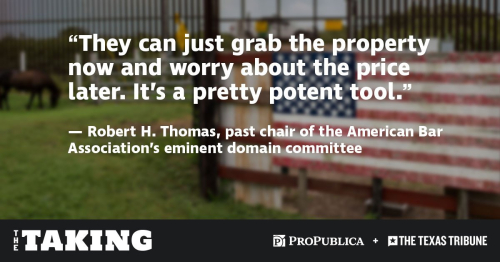
Here’s a story on which we’ve been waiting a while. ProPublica, which holds itself out as “an independent, nonprofit newsroom that produces investigative journalism with moral force,” has published a series of stories on eminent domain, focused on the border wall. As the above blurb notes, we served as one of the story’s sources.

The first piece in the series, “The Taking,” is a tour-de-force. It quickly traces the history of eminent domain (stretching back to Magna Carta, even), and rightly focuses on how the power of eminent domain has been used to take property from the politically powerless, detailing James Baldwin’s famous comment to U.S. Attorney General Robert Kennedy in the 1960’s that “blight removal” was in fact “negro removal.” Kelo is there, of course, as are the post-Kelo reforms. Even the Yellow Book gets a shout out.

But the focus of this series is

Continue Reading “Abuse, Mistakes and Unfairness” In Border Wall Eminent Domain (But It’s Not Just Happening There)

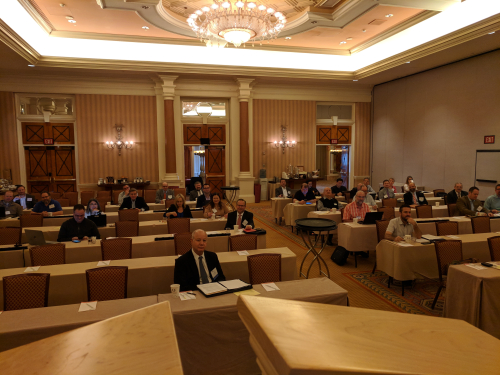
IMG_20171211_090714This photo of the view from the lectern at the start of the day
proves we really
were in the room and not distracted by all the distractions
possible in Las Vegas

Here are the materials and cases which I spoke about earlier today at the CLE International Eminent Domain Conference in Las Vegas. I had the lead off session on updates, and my talk focused on cases that I didn’t cover in the written materials:


Continue Reading Links And Materials From Today’s Las Vegas Eminent Domain Conference

An interesting read from the South Dakota Supreme Court, on the often fine line between tort liability and inverse condemnation claims.

A big rain, just weeks after the State completed a highway improvement project which included drainage culverts originally installed in 1949, which could not adequately drain an 8-year rain event. Nearby private property flooded. And you know what that means: inverse condemnation, against both the State, and the City of Sioux Falls. The City eventually settled, and the State cross-claimed against the City seeking indemnity if the City was deemed liable to the property owners.

The trial court bifurcated liability and damages, and eventually concluded the State was liable in inverse condemnation for the flooding. The court also dismissed the cross claim against the City, concluding that the City’s permitting nearby development did not contribute to the run-off which flooded the plaintiffs’ land. The jury got the damage issue, and

Continue Reading The Difference Between Tort And Inverse Condemnation

You should be following along with Clint Schumacher’s Eminent Domain Podcast on your own, but in case you missed this one in your feed, be sure to check out the latest episode, which features U. Virginia Law School prof Molly Brady talking about “damage clauses” in state constitutions.

The podcast and links to the materials and cases discussed are posted here

There’s also a short segment on Brott v. United States, currently at the cert stage in SCOTUS. That’s the one about Article III judges, and juries in inverse cases against the federal government (which under the Tucker Act, you don’t get in the Article I Court of Federal Claims). This case presents the issue we’ve focused on for a while: whether the self-executing nature of the just compensation requirement is subject to the power of Congress, and needs a waiver of sovereign immunity in order

Continue Reading Eminent Domain Podcast, Episode XI – State Damaging Clauses, Jury Trials In Federal Inverse Cases?

We’re in court today (so blogging about lawyering must yield to the actual practice of lawyering) so we’re going to just post this here, and let you consider it. And maybe wait for our New York City colleagues (who just happen to represent the property owner), to weigh in via their eminent domain blog

The New York Appellate Division’s opinion in City of New York v. Baycrest Manor, Inc., No. D59668 (Nov. 15, 2017) is an eminent domain case which involves the valuation of wetlands on Staten Island, and Palazzolo‘s holding that long-existing restrictive regulations are not baked into a parcel’s value.

The City claimed that the condemned property was not worth a whole lot because the wetlands regulations predated the condemnee’s purchase. The owner, by contrast, argued that it had a pretty good shot at prevailing on a regulatory takings claim, because the Supreme Court in 

Continue Reading Staten Island Wetlands Regulations Are A Penn Central Taking. A Penn Central Taking!

IMG_20171028_065248

Tomorrow, Saturday, November 11, 2017, is the 100th anniversary of the death of Hawaii’s last monarch, Liliuokalani. The Honolulu Star-Advertiser has a story about the commemoration events

But here’s a historical tidbit about her which our readers might find interesting: did you know that after she was deposed, and after Hawaii became a U.S. territory, the former queen sued the United States in what was then the U.S. Claims Court (now the U.S. Court of Federal Claims)? 

Her complaint wasn’t quite a “takings” case (sorry for the clickbaity headline),** but a claim that the federal government owed her in the neighborhood of $450,000 (what today would be about $11 million) for what looks like an accounting and constructive trust for the rents for the “crown lands,” land formerly owned in fee simple by the monarch personally, but which at the time of the overthrow had become

Continue Reading Queen: Feds Took** Our Crown Lands!

We’re looking forward to a good crowd at the upcoming ALI-CLE Eminent Domain and Land Valuation Litigation Conference, when we shall converge on Charleston, SC, January 25-27, 2018. We’ve received word that our main conference hotel, the Francis Marion, has sold out.

But if you haven’t reserved your space yet, don’t despair. The conference organizers have made arrangements at a hotel that is very nearby, the Marriott Courtyard, for a special conference rate. That hotel is just across the park from the Francis Marion. ALI is also making arrangements for conference room blocks in two other nearby hotels. Details on all of these alternatives are posted here.  

One more thing that we didn’t mention in our preview: there will also be a special sneak preview of the movie about Kelo v. City of New LondonLittle Pink House. If you joined us in Austin in

Continue Reading ALI-CLE Eminent Domain Conference Hotel Block Selling Out – Overflow Available

Here’s the cert petition which has just been filed in a case we’ve been following since it was instituted in the District Court, Brott v. United States.

The case presents the deceptively simple question of whether property owners who sue the federal government for a taking are entitled to both an Article III forum, and to have the issues determined by a jury.

This is a rails-to-trails case, and as followers of this blog know, these claims, when they exceed $10,000, must be raised in the Article I Court of Federal Claims, where you get the case tried by a judge, and not a jury. The jurisdiction of the CFC was conferred by Congress in the Tucker Act.

Brott is challenging that scheme (complaint here), arguing that the self-executing nature of the Fifth Amendment’s Just Compensation Clause requires both an Article III court, and a jury. 

Continue Reading New Cert Petition: Property Owners Entitled To Jury & Article III Judge In Federal Inverse Cases

20170918_190120
No soup for you!

Update: our colleague Bryan Wenter has his take on one of the cases denied review here (“U.S. Supreme Court Again Declines to Consider Important Property Rights Issue Regarding the Unconstitutional Conditions Doctrine“) (“Because the current composition of the U.S. Supreme Court leans ideologically conservative by any traditional measure and it takes only four of nine Justices to grant certiorari, on the surface it is surprising that the Court has yet to take up a case, such as CBIA or 616 Croft Ave., that would finally resolve this distinction between sweeping legislative takings and particularized administrative takings. The surprise is enhanced to a degree by the fact that the Court considered both cases in conference four times, which suggests a serious interest in the issue.”).

* * * *

To bring you up to speed on cases of interest in the Supreme Court’s cert pipeline

Continue Reading Cert Denied, Denied, Denied, Denied In Property Cases (But Don’t Give Up The Ship Just Yet)