We’ve been receiving a lot of visits lately from folks looking for information on inverse condemnation liability after the recent Northern California wildfires, and the flooding in Houston. In addition to the news stories (see SF Chronicle wildfire story here, and the Texas Tribune flood story here) which we’ve already posted, here are other links which may be useful:


Continue Reading More On Inverse Condemnation Liability For Fires And Floods
Update: Forbes is covering this story, here: Nick Sibilla, “Landowner’s Bill Of Rights Are Not ‘Suggested Guidelines,’ Georgia Supreme Court Rules

* * * *

Here’s a decision which we’ve been waiting for in a case we’ve been following since it was decided in the intermediate appellate court, involving Georgia’s “landowner bill of rights.” 

In City of Marietta v. Summerour, No. S17G0057 (Oct. 30, 2017), the Georgia Supreme Court concluded that when a statute says “before the initiation of negotiations” with a property owner, the condemnor must “establish and amount it believes to be just compensation,” and “shall make a prompt offer” of that amount to the owner, and that the agency “shall provide” the owner a written statement of how it determined that amount — that it means just that. “Shall” means must, and “before” means before. So the failure of the agency to provide

Continue Reading Georgia’s Eminent Domain Requirements Are Not The Pirate’s Code: “Before” Means “Before,” And Bad Faith Need Not Be Shown When Condemnor Didn’t Strictly Comply With The Statute

Here are the final two amici briefs in in Jarreau v. South LaFourche Levee District, No. 17-163 (cert. petition filed July 31, 2017), the case asking the Court to consider whether a property owner whose business is destroyed due to an exercise of eminent domain is entitled to just compensation for business losses under the Fifth Amendment’s Just Compensation Clause.  Our amici brief in the case is available here. (sidebar: it’s pronounced “lafoosh”).


Continue Reading Amici Briefs In SCOTUS Just Comp Case: Does Fifth Amendment Allow Categorical No-Comp Rule For “Business Losses?”

Here’s the Reply Brief and Brief in Opposition in Jarreau v. South LaFourche Levee District, No. 17-163 (cert. petition filed July 31, 2017), the case asking the Court to consider whether a property owner whose business is destroyed due to an exercise of eminent domain is entitled to just compensation for business losses.

The issue goes back at least to Kimball Laundry Co. v. United States, 338 U.S. 1 (1949), where the Court held that “an exercise of the power of eminent domain which has the inevitable effect of depriving the owner of the going-concern value of his business is a compensable ‘taking’ of property.” But the Louisiana Supreme Court held no, the condemnor only had to pay for the land. The dissenting Justice there noted:

Defendant is in the dirt business and owns land from which he digs and sells dirt. The government is entitled to “appropriate&rdquo

Continue Reading Reply Brief And BIO In SCOTUS Just Comp Case: “Real And Serious” Split On Whether Condemnor Can Just Pay For Land, But Not Businesses, Destroyed By Eminent Domain

The complete agenda and faculty list has now been posted on the ALI-CLE website, and early registration is open! Go now and reserve your spot. 

We paid a visit to Charleston recently, the venue for our January 2018 conference, to scout it out. We can report that we’re going to have a great time, for sure. When we polled you last year, you selected Charleston as your first choice (a new city for the Conference), and it is shaping up to be a very good selection. In addition to the usual lineup of CLE programming, there are a ton of things to see and do in the area. We recorded a short video down at the “four corners of law” (the intersection of Meeting Street and Broad Street), to give you a preview (the weather was much better than in our 2016 preview video, too).

As an added

Continue Reading 2018 ALI-CLE Eminent Domain Conference – Agenda And Faculty Now Posted

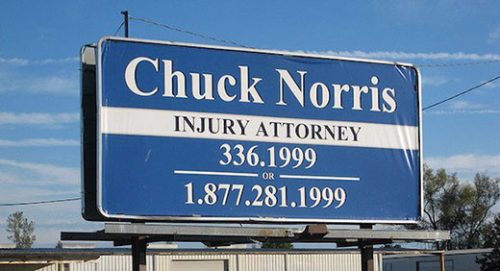
Chucknorris
No, this isn’t the billboard.

As the title of Dep’t of Transportation v. Adams Outdoor Advertising of Charlotte LP, No. 206PA16 (Sep. 29, 2017) might indicate, this is a condemnation case involving billboard valuation in North Carolina. But the issues in the case go much deeper, we think.

On the surface, the North Carolina Supreme Court resolved a question of which state statute applies when the DOT acquires land on which an income-generating billboard is located: a statute which requires DOT to pay “fair market value of the property at the time of the taking” when it takes property for highway purposes (Article 9), or a statute which requires inclusion of the “value of the outdoor advertising” in compensation when certain prohibited billboards on leased land are condemned (Article 11) in order to remove them. The billboard was one of those now-prohibited billboards (it was a nonconforming use, since

Continue Reading NC: Evidence Of Rental Income From A Billboard Is Admissible In Just Comp Trial

ALI-CLE2018

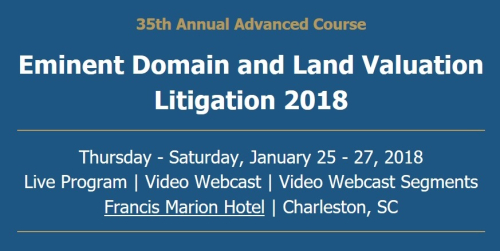
It’s not too early to reserve your spot at the 35th Annual ALI-CLE Eminent Domain and Land Valuation Litigation Conference, to be held at the Francis Marion Hotel in historic downtown Charleston, South Carolina, January 25-27, 2018. 

We’re finalizing the Conference details, but can report that the program will, as usual, feature expert presenters from across the nation, and both an in-depth update on the subjects we love, and a “101” track for those new to the field or who would appreciate a refresher. Check out some of the topics:

  • Takings and Damaging by Flood: Case Selection Advice For Savvy Practitioners
  • Quarterbacking the Case: Blocking Defenses, Controlling the Witnesses, and Converting for Verdicts
  • We’ve Been Working on the Railroad: Utility Crossing Disputes
  • Protecting Your Record,and Anticipating Appeals
  • Lucas 25 Years Later: Property Rights in the Age of Global Warming
  • Building and Growing Your Eminent Domain Practice With


Continue Reading 2018 ALI-CLE Eminent Domain Conference: Early-Bird Registration Discount Now Posted

20170918_171304_Richtone(HDR)

Here’s the amici brief we’re filing today in a case we’ve been following, Jarreau v. South LaFourche Levee District, No. 17-163.

As the name of the case indicates, this one is out of Louisiana and the Question Presented asks whether the Fifth Amendment’s Just Compensation Clause requires that an owner be made economically whole when her business is destroyed as the consequence of an exercise of eminent domain.

There’s a lower court split, and the U.S. Supreme Court has weighed in on the subject in the famous case of Kimball Laundry Co. v. United States, 338 U.S. 1 (1949), in which the Court held that the owner was entitled to so-called “business losses” when the government took the laundry. Many lower courts have distinguished Kimball Laundry, however, holding that it only applies when the government actually takes the business involved, and was not deciding that the Just Compensation

Continue Reading New Amici Brief: “The reality is that “just compensation” is, in application, often neither just nor results in compensation.”

Here’s a recently-filed cert petition involving property in the Florida Keys. The city allegedly downzoned the property to virtual worthlessness, but the lower courts concluded that it was not a Lucas take because the owners could still camp on the land, and the city gave them something called “ROGO points.” 

Which reminds of us the science-fiction trope of “credits” instead of money.  You can see why we find the case interesting, no? 

Here are the Questions Presented:

When Gordon and Molly Beyer purchased the nearly nine-acre Bamboo Key in Monroe County, Florida, zoning rules allowed them to put one residential home on each acre. In 1996, the local government adopted a Comprehensive Plan that deemed Bamboo Key a “bird rookery.” The only allowable use for the property became temporary camping. The Beyers challenged the application of this zoning change to their property; the courts concluded no taking occurred because

Continue Reading New Cert Petition: Is It Just Compensation To Be Paid In Space Bucks?

As we head into the long holiday weekend (although some of us may be working), we offer this for your hammock reading, a forthcoming article by University of Virginia Law School lawprof Molly Brady, about a subject we’re all familiar with, but which we bet most of us have never given much thought, “The Damagings Clauses” in state constitutions. 

A majority of state constitutions (our own included) have provisions prohibiting the “damaging” or injuring of property. As Professor Brady’s article starts:

Twenty-seven state constitutions contain a clause prohibiting the “damaging” or “injuring” of property for public use without just compensation. Yet when compared to its relative, the Takings Clause of the federal constitution—which says that private property cannot be “taken” for public use without just compensation—the ways in which state courts interpret and apply their “damagings clauses” have remained opaque and virtually unstudied.

This Article provides the first comprehensive analysis of state damagings clauses. It traces the clauses to the threats to private property posed at the turn of the twentieth century as a result of rapid infrastructural improvement. These state constitutional provisions were meant to fix perceived inequities resulting from strict application of takings law: many jurisdictions would not recognize a right to compensation when public works affected use rights and drastically devalued property but did not physically invade or appropriate it. Drafters envisioned the damagings clauses as a powerful bulwark for property owners whose livelihoods and homes were affected yet not touched by public works. However, as state courts were tasked with the brunt of the interpretive work, their rulings coalesced around a variety of doctrinal limitations that severely undercut the clauses’ potency. As a result, modern interpretations of the clauses mainly provide coverage in a variety of contexts where the offending activity would already qualify as a physical-invasion taking under most federal precedents.

This Article argues that the damagings clauses deserve broader applications in condemnation law. Damagings comprise a more limited and historically supported category than regulatory takings, for which courts have long awarded compensation. Moreover, courts already try to mandate compensation for some of these types of injuries by manipulating ordinary takings law, leading to unnecessary doctrinal confusion. As a new wave of infrastructural growth looms, it is time for professors and practitioners to return their attention to these forgotten provisions of the state constitutions.

This is a vitally important topic. We’ve argued recently that state constitutional analysis —  and not so much the Fifth Amendment — could be the center of gravity in takings cases, and Professor Brady’s article gives structure to the argument.

Go to SSRN, print it out, pour yourself a cold lemonade* and hit the hammock. 

—————–

* Here’s my legal lemonade story: many years ago, I was privileged to have spent time with Professor Charles Black after he retired from teaching at Yale and was serving as an emeritus lawprof at Columbia. We would sit outside the toaster (the law school building on 116th Street, so named because of its brutalist architecture; as the New York Times put it, “…the law school building, a structure likened both to a toaster and a penitentiary…”) so he could smoke his pipe, and I could nurse a coffee. The talk, invariably, was about constitutional law, one of his specialties, and how many terms in that document were subject to a range of interpretations. Topic this day was the “natural-born Citizen” clause, a provision that in those days had not reached the public prominence it would two-plus decades later. We went back and forth debating the possible meanings, but in the end, Prof Black remarked that the only other time he heard the phrase “natural-born” was back in the days of his Texas roots, when, on one hot summer’s day, his companion quaffed a cool glass of lemonade and remarked “that’s the best natural born lemonade I’ve ever had.” Seemed as good a definition as any. 

Continue Reading For Your Holiday Reading: Molly Brady, “The Damagings Clauses,” 104 Va. L. Rev. ___ (forthcoming 2018)