


Those of you who represent property owners on the business end of eminent domain who practice in Florida and the few other states which allow recovery of attorneys’ fees, consider yourselves lucky: the rest of us poor slobs who practice in places where they are not permitted — either as a component of a constitutional command of just compensation, or by legislative grace — are envious.

We understand that to force a property owner to bear its own fees and costs to recover just compensation — compensation which the condemnor should have offered in the first place — effectively denies just compensation, and allows a condemnor to get away with an inadequate offer simply because it may make little economic sense for the property owner to fight back with a lawyer. Each dollar spent on attorneys is a dollar less the owner gets for her property.   

But even if
Continue Reading Florida: When Govt Excessively Litigates An Eminent Domain Case, “Full Compensation” Requires Payment Of Attorneys Fees

We’ve had the Kansas Supreme Court’s opinion in Kansas City Power & Light Co. v. Strong, No. 110573 (Aug. 28, 2015) in the hopper for a while, but never quite got around to posting it. Something else always seemed to take precedence, and it’s just one of those decisions that doesn’t really reach out and grab you. [Unless you focus on the difference between the court-appointed appraisers’ valuation ($96,465) and that of the jury ($1,922,559). Lowball watch! material, but that’s not why we’re posting it.]

The opinion analyzes the condemnor’s three arguments that the trial court should have kept from the jury evidence offered by the property owners. Kansas has a statute which sets out the “formula” (the court’s words, not ours) for how valuation is calculated in a partial taking. The court notes it is a “simple” formula: the “before” value of the property less the value

Continue Reading Kansas: We’re Pretty Much Not Going To Second-Guess The Jury When It Comes To Compensation

ALI-CLE-2016-masthead

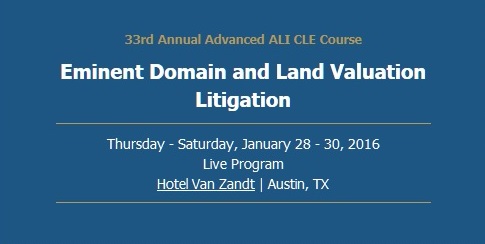
Here’s the full agenda for the 2016 Eminent Domain and Land Valuation Litigation / Condemnation 101 Conference, January 28-30, 2016, in Austin, Texas. 

Together with our friend and colleague Joe Waldo, we think we’re put together a pretty good program that covers a lot of ground. This is the first time the conference has been to Austin, and we’re starting off with a talk by Austin Mayor Steve Adler, who in his former life was an eminent domain lawyer. Other highlights:

  • Professor Ilya Somin will speak about his recently-published book in a segment entitled “The Impact of Kelo and the Limits of Eminent Domain.”
  • Pipelines and Energy Corridors: Valuation Perspectives of Condemnors and Condemnees” with the lawyers on the front lines of one of the hottest topics in eminent domain law nationwide.
  • Retired Minnesota Supreme Court Justice Paul H. Anderson will give us his tips


Continue Reading It’s Here – 2016 ALI-CLE Eminent Domain Conference: Complete Agenda, Faculty, Registration Information

A short one from the Federal Circuit, Rasmuson v. United States, No. 14-5089 (Oct. 5, 2015), that comes out of a rails-to-trails case, but has wider applicability. 

The case involved the usual: plaintiffs owned lands over which the railroad had rights of way, and when the railroad ceased operating and the Surface Transportation Board issued a Notice of Interim Trail Use, the owners’ takings claim ripened because but for the issuance of the NITU, under Iowa law the land otherwise would have reverted back to the owners. So far, so good. 

In the valuation trial, the Court of Federal Claims applied the “before and after” method, and concluded that the “before” condition of the land was as it existed before the trails easements, but that the appraisers should “ignore any physical remnants of the railway’s use, which would have remained if the railway easement had been permitted to lapse.

Continue Reading Federal Circuit: “Before” Condition Must Account For Railroad Junk That Would Have Been Left Behind

Check this out, a story in the September 28, 2015 edition of the New York Times, “Owner of Grand Central Sues Developer and City for $1.1 Billion Over Air Rights.”

Reminds us of this obscure Supreme Court case we heard about…

The Times reports that the current owner of Grand Central Terminal is, with the counsel of uberlawyers, suing New York City in federal court, alleging a taking and related. So what’s this all about (we thought this was “old, unhappy, far-off things, And battles long ago”)?

Apparently, the city granted a Grand Central neighbor permission to build a massive 1500 feet high office tower, and in doing so, took Grand Central’s property (its air rights) without compensation:

On Monday, Mr. Penson filed a $1.1 billion lawsuit in United States District Court in Manhattan that argued that the administration of Mayor Bill de Blasio, a Democrat

Continue Reading Penn Central, Part Deux? A New Complaint Alleges A Taking Of Grand Central Air Rights

We’re not exactly sure why, but the facts in State of Texas v. Treeline Partners, Ltd., No. from the Texas Court of Appeals just crack us up.

First, the court comes up with a definition of “lowball” —

In attempting to ask potential jurors whether they believe that the State “lowballs,” the State’s attorney properly inquired about whether the venire members held a preexisting bias or prejudice that the State underestimates property values. See WEBSTER’S NEW WORLD COLLEGE DICTIONARY 801 (3d ed. 1996) (defining “lowball” as a verb meaning “to give an understated price, estimate, etc. to (someone), esp. without intending to honor it” or “to so understate (a price, etc.)”).

Slip op. at 7. Save that one for your briefwriting databank.

The case involved the State’s attempt to ask potential jurors and make arguments about whether they believed that the State lowballs eminent domain valuations. Now the

Continue Reading Condemnor Entitled To Ask Jurors Whether They Believe DOT “Lowballs,” If Condemnor Hints It Does

In those states with a commission process in condemnation, any guess where an appellate court comprised of judges will come down on who gets to make the final call about what evidence is admissible — a judge or the commissioners?

Well, if you guessed the judge, you’d be right. In Regional Transportation Dist. v. 750 W. 48th Ave., LLC, No. 14SC64 (Sep. 14, 2015), the Colorado Supreme Court summed up the applicable rule of law succinctly: “commissioners have some implicit authority to make evidentiary rulings without the oversight of the trial judge,” but “the judge is still the judge,” and she gets the final call. Slip op. at 11. So the commissioners cannot “overrule” or “reconsider” a judge’s earlier ruling that evidence is admissible, nor can they ignore a judge’s instruction that they disregard other evidence.

It shouldn’t have been too hard to presage that judges would conclude that judges have the final say (judges, not lay commissioners, are

Continue Reading Colorado: Judicial Evidentiary Rulings, Not Commission’s, Control In Eminent Domain Valuation Hearings

Our colleague William Wade, in addition to being an economist, is a prolific author on the topic we find fascinating, takings. He looks at the issues with an economists’ perspective, and we’ve found his articles very helpful. We’ve even posted a few over the years:

Bill has graciously sent us a guest post, a preview of what may be his next article.

He focuses on the impact of the Texas Supreme Court’s landmark decision in Edwards Aquifer Authority v. Day, 369 S.W.3d 814, 832 (Tex. 2012), in which the court held that land ownership

Continue Reading Guest Post – Liquid Gold, or Water For Pecans: Valuation of Texas Water

We’re in Chicago this week participating in the ABA Annual Meeting. While we really are looking forward to a slate of thrilling committee meetings, what we’re really anticipating is the CLE programming. Here are what we think are the highlights:

  • Looming Land Use Constitutional Issues –  Friday, July 31, 2:45 – 4:15 pm, Westin Chicago River North Grand Ballroom B –  Four hot land use issues: land use aspects of medical marijuana legislation; takings and exactions in San Francisco’s requirement for owners to pay departing tenants huge sums; Horne and takingsNew Jersey’s dune program. With Tony Della Pelle and Stephen Schwartz (one of the counsel for the Hornes), among others. 
  • The 2014 Supreme Court Term in Review – Friday, July 31, 2015, 10am – noon, Westin Chicago River North Promenade Ballroom C – “This panel of noted legal professionals, academics and journalists provides an overview of the Supreme Court


Continue Reading ABA Annual Meeting Programming: Takings, Land Use, Supreme Court, Election Law, Appellate Traps

We’ve covered this topic before (see here, here, and here), but we haven’t heard much about it lately. But thanks to this new article by colleague Dwight H. Merriam, we can get back up to speed.

In “Eminent Domain for Underwater Mortgages: Already on the Way to the Bottom of the Sea of Bad Ideas,” from the Virginia State Bar’s Real Property Section’s journal, The Fee Simple (Spring 2015), Dwight discusses “the foreclosure crisis and how so many homeowners became victims of bad lending practices and a deep economic recession. Many are stuck in their homes, which are underwater with a value far below what was owed on them.” The article explores the question: can eminent domain bail out underwater mortgages?

Short answer: no.

To learn more, click here to view the article.

And what’s the latest that Richmond, California, which was leading the

Continue Reading New Article: “Eminent Domain for Underwater Mortgages: Already on the Way to the Bottom of the Sea of Bad Ideas”