20150422_112618
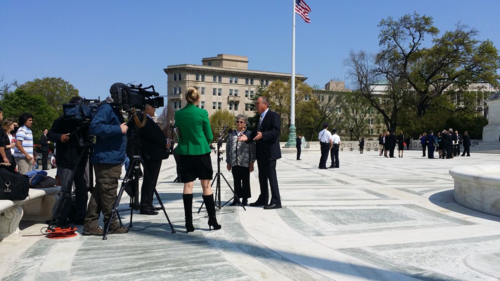
The Hornes outside the Supreme Court

“Separate educational facilities are inherently unequal.”
Chief Justice Earl Warren,
Brown v. Board of Education

“The Fourteenth Amendment does not enact
Mr. Herbert Spencer’s Social Statics.”
Justice Oliver Wendell Holmes,
dissenting in Lochner v. New York

“…prejudice against discrete and insular minorities…”
Justice Harlan Fiske Stone, in footnote 4,
United States v. Carolene Products Co.

“Raisins … are a healthy snack.”
Chief Justice John G. Roberts,
Horne v. Dep’t of Agriculture

A Supreme Court win is a win, particularly by a margin of 8-1, so we’re not going to complain too much about the Court’s opinion in Horne v. Department of Agriculture, No. 14-275 (U.S. June 22, 2015), holding that the USDA’s requirement that raisin producers physically turn over a percentage of their yearly crops to the government without being provided compensation is a taking in violation of the Fifth Amendment.

I

Continue Reading Horne v. USDA: Way More Than Silly Raisin Jokes
In North Carolina, a property owner has a right to direct access to adjacent highways, and “[i]f the State’s action eliminates all direct access to the abutting road, then the action is ‘a taking as a matter of law.'” Dep’t of Transportation v. Harkey, 301 S.E.2d 64, 71 (N.C. 1983). And it doesn’t matter if the parcel has alternative access to the road. Id. at 65.

Unless the abutting highway moves, according to the North Carolina Court of Appeals in Dep’t of Transportation v. BB&R, LLC, No. 14-1185 (July 7, 2015). 

In that case, there was no dispute that the DOT’s road project took a portion of BB&R’s land on which a convenience store/gas station was located, and that before the taking, the property enjoyed direct access to Dowdle Mountain Road along the property’s northern side.

However, the court concluded the DOT was not liable for a

Continue Reading NC App: No Taking Even Though DOT Cut Off All Of Property’s Northern Access Because Parcel Gained Eastern Acess

ALI-CLE-2016-masthead

ALI-CLE has posted the registration page for the 2016 ALI-CLE Eminent Domain and Land Valuation Conference, in Austin. Register now for a $200 discount off the tuition. Or you can sign up for notification when the full brochure is published. 

Save the spot on your calendar so you can join us in Austin. 

We’re still working on the agenda and faculty, but here are the details thus far:

Date: January 28-30, 2016 (Thursday – Saturday)

Location: Hotel Van Zandt, Austin Texas

Reserve your hotel room here. [link updated 7/8/2015]

More about the annual conferences — the premiere CLE programming on the subject, in our opinion — here

Stay tuned for more information. We’ll continue to keep you posted. 

Continue Reading 2016 ALI-CLE Eminent Domain Conference (Austin) Early Registration Available

LUI header

The Land Use Institute, a program that for many years has been planned by co-chairs Frank Schnidman and Gideon Kanner, has found a new home with the American Bar Association’s Section of State and Local Government Law as the main sponsor. It also has a new Planning co-chair, Dean Patty Salkin of Touro Law School, who has stepped in for Professor Kanner.

This program is designed for attorneys, professional planners, and government officials involved in land use planning, zoning, permitting, property development, conservation and environmental protection, and related litigation. It not only addresses and analyzes the state-of-the-art efforts by government to manage land use and development, but also presents the key issues faced by property owners and developers in obtaining necessary governmental approvals.

This year, the one-day program is being held in conjunction with the ABA Annual Meeting in Chicago. It will be held on Thursday, July 30, 2015

Continue Reading Land Use Institute: Planning, Regulation, Litigation, Eminent Domain, and Compensation – 31st Annual Conference, Chicago, July 30, 2015

20150205_072910

The hotel reservations link for the 2016 ALI-CLE Eminent Domain and Land Valuation and Condemnation 101 Conference is now live.

Reserve your hotel room now, via this link to ensure that you have a spot in the conference hotel. [note: link updated 7/8/2015]

We’re still working on the agenda and faculty, but here are the details thus far:

Date: January 28-30, 2016 (Thursday – Saturday)

Location: Hotel Van Zandt, Austin Texas

The Hotel Van Zandt is a new hotel (not even opened as of the date of this post), but our Austin sources tell us that it’s centrally located, close to everything that Austin is known for. More about the annual conferences — the premiere CLE programming on the subject, in our opinion — here

Stay tuned for more information. We’ll continue to keep you posted, and when the registration page at ALI-CLE is up and ready to

Continue Reading 2016 ALI-CLE Eminent Domain Conference, Austin: Hotel Now Taking Reservations

We are distracted today so haven’t had the time to write up our initial thoughts about Horne v. Dep’t of Agriculture, No. 14-275 (June 22, 2015), the California raisins takings case which the Supreme Court decided yesterday.

So instead we did this video, a take off on those goofy tech “unboxing” videos.

We’ll have more in the traditional format once we have a chance to write something down.  Continue Reading Unboxing Video: Horne v. Dep’t of Agriculture

In case you somehow missed it, takings junkies, today, June 23, 2015, is the tenth anniversary of the U.S. Supreme Court’s excreable 5-4 decision in Kelo v. City of New London, 545 U.S. 469 (2005), and just about anyone who is anyone in our field has weighed in with a retrospective. We don’t have much to add, since wiser minds than ours have some very cogent thoughts.

But here’s how we view the decision, ten years on:

  • Still stinks. A decade has not lessened the odor.
  • We filed an amicus brief in Kelo explaining why economic development wasn’t enough to support New London’s taking of a perfectly good home, and we still think we’re right. 
  • Many states and local jurisdictions reacted and adopted legislative reforms. Some helpful, many not. Guess which state did nothing, despite several proposals made over several legislative sessions? Hawaii, where we say we like the little


Continue Reading Kelo At 10: Still Stinks, And A Decade Has Not Lessened The Odor

… look no further than the above report from The Daily Show.

Yeah, it’s satire and does at times make light of a serious case, but the USDA was trying to defend a regulation that branded the Hornes as “raisin outlaws,” going so far as to hire a private security firm to “investigate the product” that the Hornes were defrauding the government of (dried fruit).

Top off “the world’s most outdated law” with the Ninth Circuit’s ridiculous avoidance after the Supreme Court’s earlier remand (the Takings Clause does not apply with equal force to personal property as it does to land) , and you have the recipe for success and an 8-1 ruling. 


Continue Reading Here’s Why The Supreme Court Held The Raisin Marketing Order Was Unconstitutional…

Update: here’s more Horne talk, in addition to our own initial thoughts in the above video and this post (“Magna Raisins: 8-1 SCOTUS Says There’s A Taking, But Not All Agree On Remedy“):


Continue Reading Raisin Round-Up

Here’s the podcast of our recent talk to the American Bar Association’s Section of State and Local Government Law about the (then) upcoming decision in Horne v. Dep’t of Agriculture, No. 14-275. Transcript here, if you’d prefer to read it.

This is a preview of the decision. But since we made some predictions — several of which bore fruit in today’s opinions — we thought we’d post it while we digest the Court’s opinions. 

As you may know, the Court today issued its opinions, with eight justices concluding that the raisin marketing order is a physical taking of property, rejecting the Ninth Circuit’s holding that the physical takings rules do not apply when personal property is involved.

We’ll have more analysis shortly, including a round-up of how other commentators view the case. Stay tuned. 


Continue Reading Podcast: Leviathan Shrugged? The Supreme Court’s Raisin Takings Case