


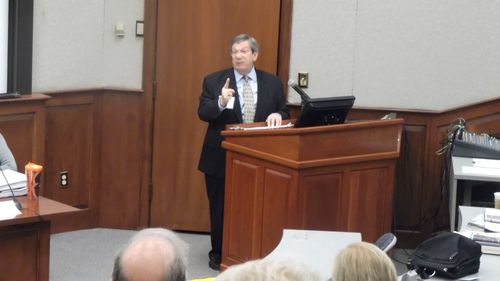
DSCF2208

You can’t have rights without advocates.”

                              – Michael Berger

We’re at the William and Mary Law School in Williamsburg, Virginia today for the 11th Brigham-Kanner Property Rights Conference. As we’ve noted earlier, Michael Berger is this year’s B-K Prize honoree, for his career contributions to property law and his “scholarly work and accomplishments [which] affirm that property rights are fundamental to protecting individual and civil rights.”

The list of past recipients is an All-Star roster of property scholars and jurists, including lawprofs Frank Michelman, Richard Epstein, James Ely, Carol Rose, Thomas Merrill, and Supreme Court Justice Sandra Day O’Connor (the latter perhaps more for where she ended up in her Supreme Court career than where she started). See the plaque on the Law School’s wall for the complete list of

Continue Reading 2014 Brigham-Kanner Property Rights Conference Report: Honoring Michael Berger

Banner

If you haven’t already, please mark you calendars: the agendas and faculty lists for the February 5-7, 2015 ALI-CLE eminent domain programs in San Francisco have been finalized. Registration is ongoing, and there’s even a few more days left for the early registration discount. Substantial group discounts are also available. 

We’re talking, of course, about Eminent Domain and Land Valuation Litigation (the “masters” program, now in its 32nd year), and Condemnation 101: How to Prepare and Present an Eminent Domain Case (the boot camp or refesher course on eminent domain fundamentals).  We’re the co-Planning Chair of the Eminent Domain and Land Valuation Litigation program along with Joe Waldo, and we think we’ve assembled an exciting agenda, presented by a faculty comprised of the nation’s best-of-the-best in our field of law.

Some highlights:

  • Eminent Domain National Law Update – Amy Brigham Boulris, Gunster, Yoakley & Stewart, P.A.,


Continue Reading ALI-CLE 2015 Eminent Domain and Land Valuation Litigation & Condemnation 101 Agendas And Faculty Announced

As we all understand, when valuing property in eminent domain, the highest and best use of not limited to the property’s existing use or its current zoning. The owner is entitled to prove that she could reasonably make a more intensive use of the property.

Rodman v. Commonwealth, No. 12-P-223 (Oct. 7, 2014) involved a partial taking of partially developed land (part of it was used as temporary parking lot for the Patriots’ stadium, across Route 1 from the property) for a road expansion by the Massachusetts Department of Highways. When at trial the property owner attempted to show that the land could be developed much more intensely before the taking than after, the court refused to let the jury hear evidence of the owner’s development plans, and evidence of the development approach to value. “Ultimately, the jury awarded damages of $600,800, the exact amount the Commonwealth’s expert testified

Continue Reading Mass App: Eminent Domain Jury Entitled To Consider Evidence Of Potential Development

We didn’t think the issue of whether a property owner is competent to testify about the value of his or her own property was unsettled, but apparently an Alaska trial court did. In an inverse condemnation action which claimed that the operation of a nearby airport diminished Mr. Briggs’ property value, the court granted the City summary judgment “because the property owner failed to submit any expert testimony regarding damages.” 

The Alaska Supreme Court reversed. In Briggs v. City of Palmer, No. S-14969 (Sep. 12, 2014), the court concluded that an inverse condemnation plaintiff does not need expert testimony to prove the value of damages, relying on established Alaska law. The court cited several of its own earlier decision which hold that property owners are competent to testify about the value of their own property. 

Given that precedent, what gives? What would make the trial court conclude otherwise? Maybe

Continue Reading Alaska: Owner Can Testify About Value Of Their Own Property

We like the Texas Supreme Court, because (among other things) it livestreams oral arguments, and once completed, archives them for those who can’t be there in person, or watch live. So even though we couldn’t make it to Austin for the arguments earlier this month in Texas v. Clear Channel Outdoor, Inc. (a case which we posted about here), we were able to follow along with the archived video

The case presents two questions: first, whether a billboard owner is entitled to just compensation when the land on which it sits is taken by eminent domain because it may be possible to relocate the billboard, and second, what method of valuation can be used to measure compensation, if so. We filed an amicus brief in the case arguing that “[b]illboards are not designed to be moved. And the most valuable part of a billboard is not steel

Continue Reading Oral Argument Video In Texas Supreme Court Condemnation Case: Is A Billboard Moveable Property?

Like love, takings claims can often be found in some very unusual places. And (like love) unfortunately, those claims are not always successful.

When we think of “takings,” things like eminent domain condemning land, inverse condemnation (of land) by flood waters, and cases like that spring to mind first. Even when regulatory takings are involved, the conventional view at least starts with claims about land, and although the Supreme Court hasn’t come out and said it, the argument has been made that the takings and exaction/unconstitutional conditions doctrines are reserved for claims involving land. 

But not always so. 

Here are three recent decisions where property rights and takings came up in situations you might not have expected.

Takings and Labor Law

The first is from the U.S. Court of Appeals for the Seventh Circuit. In Sweeney v. Pence, No. 13-1264 (7th Cir. Sep. 2, 2014), the court held that

Continue Reading Lookin For Takings In All The Wrong(?) Places

A reminder: the 11th annual Brigham-Kanner Property Rights Conference is coming up on October 30-31, 2014, at the William and Mary Law School in Williamsburg, Virginia. As we noted earlier, Michael Berger will receive the Brigham-Kanner Prize, so this one is special – he’s the first practitioner to receive the Prize.

More here, from W&M, including agenda and registration information. Here’s the flyer.

We’re going – hope to see you there. 

11th Annual Brigham-Kanner Property Rights Conference – Oct 30-31, 2014 – Michael Berger

Continue Reading October 30-31, 2014: Brigham-Kanner Property Rights Conference @ William & Mary Law

Here’s our latest article, from the upcoming edition of The Practical Real Estate Lawyer, via ALI-CLE.

Despite its grand title, “A Full and Perfect Equivalent for Just Compensation: The Historical Context and Practice,” its just a short piece that asks whether just compensation is the next big thing, identifies three issues in just compensation in eminent domain that may be on the horizon, and urges the Supreme Court to provide some guidance on this issue.   

Continue Reading New Article: “A Full and Perfect Equivalent for Just Compensation: The Historical Context and Practice”

Here’s an opinion from the California Court of Appeal, issued last month but unpublished, which was recently ordered published by the court. It’s a lengthy (38 pages) and somewhat detailed opinion, but for those of you who do eminent domain, it’s a worthy read because it covers many bases, and covers them well.

First, the bottom line of San Diego Gas & Elec.Co. v. Schmidt, No. D062671 (July 21, 2014, published Aug. 13, 2014). Condemnor’s just compensation deposit: $712,200. The jury’s award: $8,034,000. That’s over an eleven-fold difference. Lowball Watch alert! 

The case involved the taking of an easement for power lines, and the issues revolved around the highest and best use of the property (the jury agreed with the owner that mining was the highest and best use, and rejected SDG&E’s claim that residential development or habitat mitigation was the highest and best use), the method of valuation

Continue Reading Cal App: Highest And Best Use Isn’t Limited To Current Uses

Last week, we posted our amici brief in Texas v. Clear Channel Outdoor, Inc., a case in which the Texas Supreme Court is considering two questions: first, whether a billboard owner is entitled to just compensation when the land on which it sits is taken by eminent domain, and second, what method of valuation can be used to measure compensation, if so. Here are the rest of the briefs in the case. 

Texas needed to widen a freeway, and condemned the land on which the billboards were located. It refused to pay just compensation on the grounds that the billboards were personal property and not “realty,” and thus the owner could simply move them. The State issued a removal order. In response, the owner filed an inverse condemnation action to recover just compensation for the billboard takings. 

The court concluded the billboards are not moveable property, but are fixed

Continue Reading Briefs In Texas Supreme Court: Is A Billboard Moveable Property?