Here’s a quick one from the Indiana Court of Appeals, about when a party must object to an appraiser’s report, and the reaction to that objection by the condemnor.

In Clark County Bd of Aviation Commissioners v. Dreyer, No. 10A01-1206-PL-288 (Mar. 21, 2013), the property owner did not object to the report of three court-appointed appraisers valuing its property at $201,000 within the 21 days allowed under Indiana eminent domain procedures, but the condemor did not object, so the trial went forward. The jury awarded $865,000 as compensation, and the court awarded the owner $24,000 in attorney fees.

The condemnor appealed, arguing that the trial court should not have admitted evidence of the highest and best use of the property that the condemnor alleged was inconsistent with the property’s current use. The Court of Appeals rejected the argument and even though it noted that the property owner had not

Continue Reading Indiana App: Timing Of Objection To Appraiser’s Report Is Not A “Real” Jurisdictional Problem

Cle-logoThose of you on the east coast (or, who wouldn’t mind a visit to a very beautiful part of Virginia), mark your calendars: on April 25 and 26, 2013, CLE International is presenting the 7th Annual Virginia Eminent Domain Conference – Local, State, and National Trends at the Tides Inn in Irvington, Virginia.

My Owner’s Counsel of America colleague Joe Waldo, the Planning Chair for the conference, has kindly asked me to deliver the Keynote Presentation to speak about “Virginia’s Place in National Eminent Domain Trends.” The following day, I’ll also be presenting a one-hour session on “Tough Takings Questions: Regulatory Takings, Zoning Issues and Judicial Takings” featuring the latest updates in those areas.

Joe and colleagues have assembled a talented and varied faculty, so please join us for two days worth of great CLE. Download the full brochure or the short version postcard, or, for complete

Continue Reading 7th Annual Virginia Eminent Domain Conference (April 25-26, 2013)

Grab a Tim Hortons double double and get ready to read an interesting opinion.

What we call “eminent domain” Canada calls “expropriation.” But that’s not the only thing different about the takings law of the U.S. and that our neighbors in the Great White North.

Generally, under the law of most U.S. states, lost business goodwill is not recoverable as just compensation even when the losses are incurred by the owner whose land is taken. Some jurisdictions such as California allow compensation when the affected business is conducted on the property taken, or on the remainder if the property is part of a larger parcel. But even those jurisdictions do not allow a property owner whose business is impacted by a taking, but whose property is not actually taken, to recover. 

It looks like Canada takes a different approach. In Antrim Truck Centre Ltd. v. Ontario (Transportation), No 34413

Continue Reading O Canada! Supreme Court Affirms Compensation For Causing Business Losses

Bulldozersatyourdoorstep

Our Owners’ Counsel of America colleague Michael Rikon and his law firm have launched a new blog, “Bulldozers at Your Doorstep – A National Blog on Eminent Domain.”

The blog will give us Michael’s and his colleagues’ view of eminent domain and condemnation issues from their unique New York perspective, from lawyers who specialize in eminent domain defense.

Recent posts include a discussion of corridor valuation, the introduction of a bill in North Carolina to limit Kelo‘s impact, and how the U.S.’s energy independence may result in an upswing in the exercise of eminent domain.

Definitely worth following. Continue Reading New Eminent Domain Blog – “Bulldozers at Your Doorstep”

Marinerscoveneworleans

In United States v. 0.073 Acres of Land, No. 11-31167 (Jan. 28, 2013), the U.S. Court of Appeals for the Fifth Circuit held that a townhome association’s right to collect maintenance assessments from its members was property under Louisiana law, but was not compensable property in an eminent domain action.

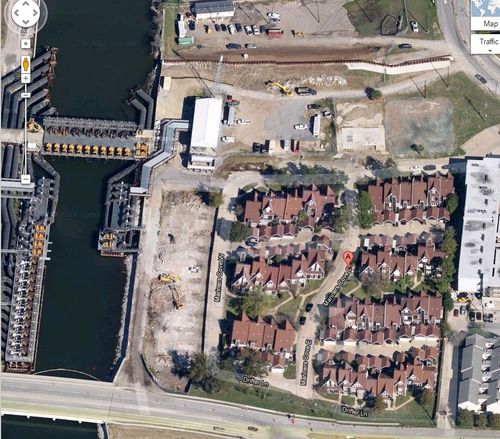
The case involved a 58-townhome community next to Lake Pontchartain in New Orleans. The area was damaged in Hurricane Katrina after the 17th Street Canal was breached, flooding the Lakeview neighborhood. As part of the recovery efforts, the Corps of Engineers began improving the adjacent pumping station, and to facilitate its access to the site, it condemned 14 of the townhomes. (We assume that’s the vacant spot between the remaining townhomes and the pumping station/canal in the above photo.)

The Mariner’s Cove Townhomes Association had the right to collect assessments from its members for maintenance and whatnot. This right

Continue Reading 5th Cir: Right To Collect Assessment Is “Property,” But It Isn’t “Compensable” Property

Earlier, we posted the opinion of New York’s Appellate Division in New York Central Lines, LLC v. State of New York, No. 2011-03494 (Dec. 19, 2012), in which the court determined how to value a rail corridor when it is taken by eminent domain.

The court’s opinion was somewhat cryptic, so we thought we would post the briefs to help understand the arguments better. If this is your game, check them out:

These briefs come to us by way of Jonathan Houghton, counsel for the prevailing property owner. Jonathan is the partner of our Owners’ Counsel of America colleague Mike Rikon. Two more kudos: Jonathan recently became a named partner of the firm, which has recently moved back into its permanent offices in Manhattan after being displaced by Hurricane Sandy. Congratulations on all Continue Reading Briefs In NY Rail Corridor Valuation Case

One for you just compensation mavens. In City of Wichita v. Denton, No. 97952 (Kan. Jan. 4, 2013), the Kansas Supreme Court held that the city owed no compensation for the value of a billboard or the advertising income it produced for its owner when the city condemned the land on which the billboard was located. The court concluded that as a matter of law, the billboard was the personal property of its owner, not part of the taken land, and thus not a compensable item, and evidence of its value must be withheld from the jury.

The court started with the “undivided fee” rule (aka the “unit rule”), under which the court values the property taken as if it were owned by a single entity, even though it is not (more on that here).

Because the current case is an appeal from the valuation stage of the

Continue Reading Kansas: Billboard Is Personal Property, Not Compensable

LgoIt’s time for the annual ALI-CLE (fka ALI-ABA) eminent domain conferences, to be held January 24-26, 2013 in Miami Beach, Florida.

In the “advanced” course, Eminent Domain and Land Valuation Litigation, we’ll be covering topics such as “Condemning Underwater Mortgages,” “An Engineer’s Role in Damage,” “How To Develop and Implement a Business Plan for an Eminent Domain Practice,” and “Condemnor Beware: What Activities Will Make You Liable for Pre-Condemnation Damages.” Along with Pacific Legal Foundation’s Jim Burling and Cornell lawprof Robert Hockett, I’ll be speaking on the panel about underwater mortgages. More details on the agenda and the faculty here.

The companion course, Condemnation 101: How to Prepare an Eminent Domain Case, covers the basics of eminent domain law, and although designed as an overview of condemnation law for the beginner or general practitioner, it’s a great refresher course for the seasoned eminent domain lawyer. More

Continue Reading Upcoming ALI-CLE Eminent Domain Conferences

DrhouseA quick one from the California Court of Appeal (Third District), holding that a trial court in an eminent domain case should not have granted the condemnor’s motion in limine, but should have allowed the property owner’s appraisal expert to testify regarding comparble sales. County of Glenn v. Foley, No. C068750 (Nov. 26, 2012, published Dec. 21, 2012).

Our friends over at the California Eminent Domain Report have a great write-up on the opinion here, so instead of doing our own analysis, we commend it to you.

Be sure to read the opinion and check out the name of the property owner’s appraiser. Pretty appropriate for a property appraiser.

Continue Reading Cal App: Court Should Not Have Excluded Evidence Of Comparable Sales