Check out New York Central Lines, LLC v. State of New York, No. 2011-03494 (Dec. 19, 2012), a short opinion from the New York Supreme Court Appellate Division (Second Department) (if you didn’t know that in New York, the trial court of general jurisdiction is the “Supreme Court,” and the intermediate court of appeals is the “Appellate Division” of the Supreme Court, you have not been watching enough Law & Order).

Both the state’s and the property owner’s valuation experts testified that the highest and best use of the property was its current use, a rail corridor. But the two experts differed on the proper method of valuation.

The State’s expert advocated a cost, or reproduction cost less depreciation, approach to valuation, which is employed in valuing “specialty” properties (see generally Matter of Allied Corp. v Town of Camillus, 80 NY2d 351, 357; Matter of Al

Continue Reading NY Appellate: How To Value A Rail Corridor

Well, this is unusual, althought it should not be. 

In this short order, the Supreme Court of Ohio has held the state’s Department of Natural Resources in contempt for not moving fast enough to compensate property owners whose land had been flooded. (In California, that would be called “normal planning delay.”)

In Ohio, what would be called an inverse condemnation or regulatory takings claim in other jurisdictions takes the form of a mandamus petition to compel the government to institute eminent domain. Several property owners instituted a mandamus action after their lands were flooded because the state did not draw down the level of a lake, despite its ability to do so. In 2011, the Ohio Supreme Court issued the writ, ordering the Department to institute eminent domain proceedings “immediately” amd tale steps to compensate the owners. See State ex rel. Doner v. Zody, 958 N.E.2d

Continue Reading Ohio Supreme Court Finds Dep’t of Natural Resources In Contempt For Dragging Its Feet In Compensation

In California, a property owner whose business suffers when the land is taken is entitled to goodwill under the state’s eminent domain code, and has the right to have a jury determine the amount of goodwill. But who makes the call when there’s a dispute about whether there’s any goodwill at all?

According to the Court of Appeal in People ex rel. Dep’t of Transportation v. Dry Canyon Enterprises, No. B234198 (Nov. 28, 2012), it’s the judge’s decision, not the jury’s. According to the opinion, “no court has squarely addressed this question.” Slip op. at 1. Now one has. The court based its conclusion on the language of the statute, and because “it makes no sense to hold a jury trial on the amount of goodwill lost if there was no goodwill to lose.” Slip op. at 5 (emphasis original).

The court also held that the trial court had

Continue Reading Cal App: Jury Determines The Amount Of Goodwill, Not Whether There Is Goodwill

nailhouseThis photo of a “nail house” in Wenling, People’s Republic of China is making the rounds on the internet. The reports (see also here for higher res photos) say that the homeowners refused to take the offers to sell, so the developer built the road around their house. “They are called “nail houses” because the homeowners refuse to be hammered down.”

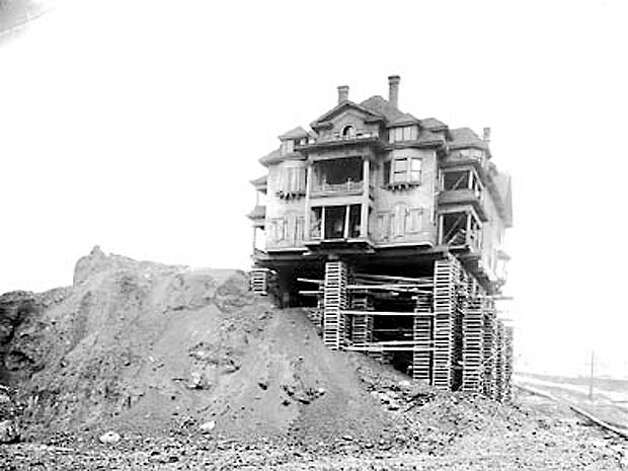
We’ve covered similar circumstances before (here, the “calvacade of homeowner holdouts,” and famous nail houses for example). Indeed, this is not a recent  phenomenon. See Seattle’s Denny regrade, for example. More photos from the Seattle Post-Intelligencer.

dennyregrade

Homeowners who didn’t go along with the Denny regrade project had the hill dug out around them. Photo: Seattlepi.com File / Seattle Post-Intelligencer

Reminds us of the Warner Bros. classic “Homeless Hare,” where Bugs Bunny objects to a developer’s efforts to evict him from his

Continue Reading When All You Have Is A Hammer, Everything Looks Like A Nail House

text

Download LA COA Monteleone

case that originated with a taking in 1987 by the DOT.  In State of Louisiana, et al v. Monteleone, et al, the Court of Appeals affirmed an award of $1,631,000.50 ($214,534.14 as just compensation for the taking + $1,416,466.40 in severance damages) + $1,584,442.54 in interest + $173,030.00 and legal interest in costs +  $900,000.00 and legal interest in attorneys fees and remanded for further determination of attorneys fees due to the landowner for the appeal.  Including all interest calculations, the award totals approximately $6 Million and represents an increase 129 times greater than the initial deposit of $46,558.00

Congratulations to OCA colleague Randy Smith for this win.

Louisiana v. Monteleone, No. 11-CA-1013 (Nov. 13, 2012)Continue Reading La App:

Here are my remarks from last week’s Brigham-Kanner Property Rights Conference at the William & Mary Law School in Williamsburg, Virginia. Our panel spoke on “Property Rights in Times of Economic Crisis,” and included lawprofs James W. Ely (Vanderbilt), William Fischel, (Dartmouth), and Eric Kades (William & Mary). See the complete faculty list and agenda here.

+++++++++++++++++++++++++++++++++++++++

Aloha, I bring you greetings from the land of Midkiff, the land of Lingle.

I practice in the jurisdiction that believed it would cure our economic ills to use eminent domain to bust up the legacy land trusts, and make sure that everyone who owns a home could also own the fee simple interest.

Which they may now do, provided they can afford our median price for a single-family residence, $637,000.

I practice in the jurisdiction that believed that it would be a good idea to try and bring

Continue Reading Professor Ely, You Magnificent Bastard, I Read Your Book!

Ever since the U.S. Supreme Court’s infamous decision in Kelo v. City of New London, 545 U.S. 469 (2005), the focus of eminent domain scholarship and the public have been on the public use side of the condemnation equation.

However interesting those issues are (and they truly are), practitioners of eminent domain law understand that a vast majority of the issues in litigation still revolve around just compensation and valuation. The Supreme Court has even shown an interest, with the Justices asking questions about compensation in at least two oral arguments where the issue was not directly presented (here and here for example). While the ABA has recently published books about eminent domain generally (see here and here), it has not produced one devoted to just compensation.

But it soon will. The section on State and Local Government Law has decided to publish a book on current

Continue Reading Call For Authors: American Bar Association Book On Just Compensation Issues

The Oyez Project has posted the recording in Arkansas Game & Fish Comm’n v. United States, No. 11-597 (cert. granted Apr. 2, 2012), the takings case argued earlier this week in the U.S. Supreme Court.

Check it out here. We posted our summary of the petitioner’s arguments here, and will be posting our thoughts on the government’s arguments shortly. But in the meantime, listen along. Continue Reading Oral Argument Recording In SCOTUS Flood Takings Case

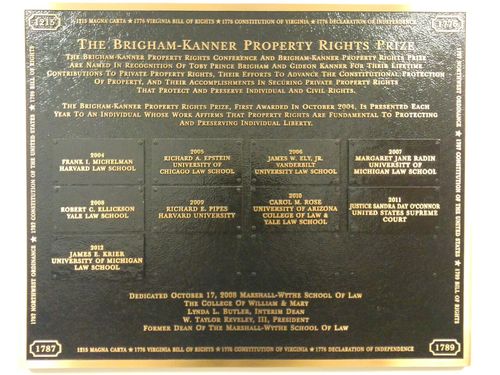
There’s still time to join us later this week at William & Mary Law School in Williamsburg, Virginia for the 2012 Brigham-Kanner Property Rights Conference, and the award of the B-K Prize to University of Michigan lawprof James Krier for his lifetime contributions to property law scholarship.

The Conference includes a day-long series of discussions on property rights, featuring leading scholars and practitioners. Topics include “The Impact of a Leading Property Scholar,” “The Judiciary’s Role in Shaping Constitutionally Protected Property,” “Property Rights in Times of Economic Crisis,” and “Property’s Moral Dimension.” The day will wrap with a roundtable discussion, “How Fundamental are Property Rights?” The complete agenda is available here.

I will be speaking on the panel about “Property Rights in Times of Economic Crisis,” discussing why property rights are even more important when times are tight.

Register on-line here. If you can’t join us, I will

Continue Reading 2012 Brigham-Kanner Property Rights Conference