The topic of the “self-executing” nature of Just Compensation is in the news these days, with the Supreme Court’s agreeing to review Devillier v. Texas.

But we’ve been on that issue for quite a while, and in a recent episode of Clint Schumacher’s Eminent Domain Podcast (if you are not already subscribed, why not?), our Pacific Legal Foundation colleague Deborah La Fetra joins Clint to discuss the issue, including a recent case we did together involving the intersection of property rights and the federal government’s bankruptcy power.

As the program notes note:

Deborah La Fetra of the Pacific Legal Foundation joins us to talk about the case of Financial Oversight and Management Board for Puerto Rico v. Cooperativa de Ahorro y Credito Abraham Rosa, a unique case where the boundaries of just compensation and governmental restructuring collide. Deborah and PLF served as counsel for several of the unpaid

Continue Reading Deb La Fetra Guests On Clint Schumacher’s Eminent Domain Podcast On Self-Executing Just Compensation

HSBA 10-2023

Yesterday, during the Annual Meeting of the Hawaii State Bar Association, we participated in a program sponsored by the Real Property and Financial Services Section, “Inverse Condemnation & Paying for Disasters.”

As you can see above, we joined lawprofs Shelley Saxer and David Callies to share thoughts about inverse claims, and the difference between these property arguments and tort negligence claims.

Here are some of the key cases and materials which we mentioned (or should have):


Continue Reading Links And Materials From “Inverse Condemnation & Paying for Disasters”

A really quick one from the U.S. Court of Appeals for the Seventh Circuit.

In Willow Way, LLC v. Village of Lyons, No. 22-1775 (Oct. 5, 2023), the panel held that the plaintiff/property owner did not sufficiently plead federal diversity of citizenship jurisdiction over his state law takings claim.

After providing notice, the Village demolished Willow’s dilapidated house, which the Village deemed a nuisance. Willow instituted a federal court lawsuit, alleging violation of the U.S. Constitution’s Due Process Clause, and an Illinois law inverse condemnation claim. Federal subject matter jurisdiction was based on a federal question (due process) and supplemental (Illinois takings claim). The district court dismissed the due process claim, and declined to continue to exercise supplemental jurisdiction over the state law takings claim.

What about diversity of citizenship jurisdiction?, Willow argued at the Seventh Circuit oral argument. Sure, why not, responded the panel. The court “invited Willow

Continue Reading CA7: When Pleading A Diversity-of-Citizenship State Takings Claim In Federal Court, It Helps To Allege The Plaintiff’s Citizenship

The Sixth Circuit these days. Lots of property and takings-related stuff being decided in that court. See here, here, here, here, here, and here for some examples.

The latest is O’Connor v. Eubanks, No. 22-1780 (Oct. 6, 2023), in which an unsigned panel opinion (with concurrence of Judge Thapar in the result, but not in the reasoning), held that state officials sued in their individual capacities have qualified immunity from takings claims which seek just compensation. But are not similarly immune from procedural due process claims.

Short story: O’Connor was the payee on two checks that were delivered to his property. Apparently he got neither, so the payors turned the checks over to the State of Michigan, which treated them as unclaimed property.

Michigan’s unclaimed property statute moves fast. It requires that the State, after first publishing notice, to sell or liquidate the property

Continue Reading Backing Into Williamson County Again – CA6: We Already Said That State Officials Sued Individually For Compensation Have Qualified Immunity

Here’s what we’re reading about the Supreme Court’s property rights docket — some good, some disappointing — this day.

  • Niina Farah, “Supreme Court flooding case could ripple across the energy sector (E & E News / Energywire) – About the Devillier case (which we summarized here), in which we were quoted: “The Supreme Court decision to hear the Devillier case comes after a concerted effort in recent years to convince the court to address procedural maneuvers that have made it challenging for property owners to bring their claims to court, said Robert Thomas, director of property rights litigation at the Pacific Legal Foundation. The nonprofit is among the groups that has asked the court to address takings cases and has lent its support for the property owners in Devillier in a ‘friend of the court‘ brief. ‘There’s a lot of gamesmanship going on


Continue Reading Supreme Court Property Rights Round-Up

092923zr_q8l1_Page_1
I’ll take ‘Words I Like to See’ for $800, Alex.

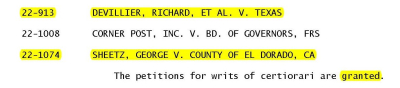
In this Order, the U.S. Supreme Court agreed to hear two important property rights cases (are there any other kind?). Both are cases we’ve been following — and indeed are now playing a part in.

The first is Devillier v. Texas (the second is Sheetz v. El Dorado County which we’ve posted about here).

After what can only be described as a weird Fifth Circuit panel opinion, followed by an even more unusual post-cert petition en banc denial (complete with concurrals and dissentals), the Supreme Court granted the cert petition.

The Question Presented:

In First English Evangelical Lutheran Church v. County of Los Angeles, this Court recognized that the Fifth Amendment’s Takings Clause was “self-executing” and that “[s]tatutory recognition was not necessary” for claims for just compensation because they “are grounded in

Continue Reading Cert Granted #1 – You Don’t Need The Government’s Permission To Obtain Just Compensation, Do You?

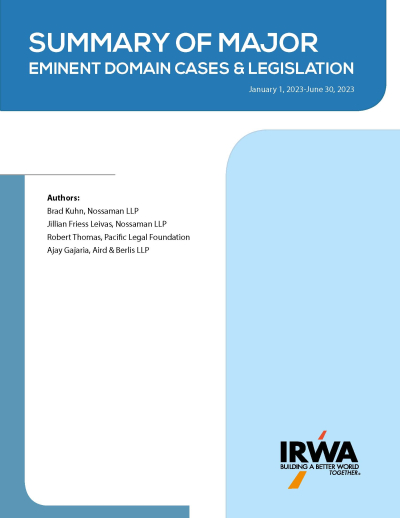
IRWA 6-2023 summary jpg

Thanks to our co-authors for the latest issue of this recurring update.

The International Right of Way Association’s Real Estate Law Committee produces twice-a-year reports “which contain summaries of eminent domain decisions and legislation within the United States.” (This is the “international” right of way association, so that last qualifier is important.)

And what is really nice is that they make the report available.

The laboring oars on this are really Brad Kuhn and Jullian Friess Leivas (both from the Nossaman firm), but they were kind enough to include us. Brad and Jillian wrote up more at the California Eminent Domain Report:

We recently had the pleasure of collaborating with Robert Thomas and Ajay Gajaria once again for the International Right of Way Association’s (IRWA) biannual report covering numerous eminent domain cases at local, state and federal levels from January through the end of June 2023. This


Continue Reading Just Published – IRWA’s “Summary of Major Eminent Domain Cases & Legislation: Jan 1, 2023 – June 30, 2023”

Here’s a follow up to the issue resolved by the Supreme Court in Tyler v. Hennepin County. Recall that in that case, the core question was whether state law exclusively defined the “property” which Ms. Tyler claimed – the monies remaining after the foreclosure and sale of her home to satisfy her outstanding property tax obligation. The Supreme Court unanimously held no, that a state’s law of property is “one important source,” but “cannot be the only source” of what constitutes private property for purposes of the U.S. Constitution.

In Freed v. Thomas, No. 21-1248 (Sep. 6, 2023), the U.S. Court of Appeals followed up on that question. The court addressed the measure of just compensation in these home equity takings. To do so, the court focused on what “property” was taken – was it the home, or was it the excess proceeds after foreclosure and sale?

The

Continue Reading CA6: In Home Equity Theft Taking, Just Compensation Is The Excess The Government Kept, Not The Value Of The Foreclosed Home

Why is it, you ask, that the ALI-CLE Eminent Domain & Land Valuation Litigation Conference (scheduled next February 1-3, 2024, in New Orleans) is an event that seems to be growing in popularity and attendance. In recent years, we have standing room only in the Conference halls, and have sold out the hotel block. After all, this is a pretty niche area of law. So what gives?

When we were in Austin earlier this year, we thought it might be nice to try and answer that question. We asked Conference participants why they come, year-after-year (and in Austin, despite massive travel disruptions). Yes, it is the various venues (Nashville, Austin, Scottsdale, Palm Springs, to name a few recent locations), and yes, it is the excellent and useful programming.

But as we suspected it is more than that. As the above video notes

Continue Reading ALI-CLE’s Eminent Domain & Land Valuation Litigation Conference (Feb 1-3, 2024, New Orleans): Why Attend? Here’s Why.

Screenshot 2023-08-26 at 10-33-05 Brigham-Kanner Property Rights Conference

Heads-up: the registration page for the 20th Brigham-Kanner Property Rights Conference, October 26-27, 2023, at the William and Mary Law School in Williamsburg, Virginia, is now up.

Early registration is a good thing because space is limited, especially at the Wren Building banquet on the 26th, at which the 2023 B-K Property Rights Prize will be presented to Prof. Gregory Alexander.

So please don’t miss out.

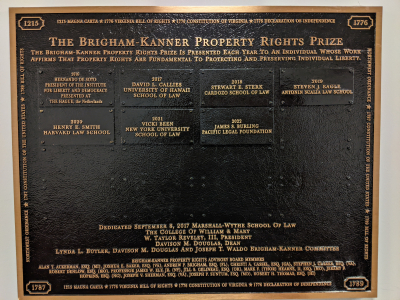
2022 BK plaque
The Property Rights Hall of Fame (second plaque)

If you are not already familiar with the Conference, it is (in our opinion) the best one-day event on property and property rights theory and practice. Expressly designed to bring together the legal academy and the practicing dirt law bar, the conference is where we discuss the burning property and property rights issues of the day. Here’s the 2023 Program:

  • Property and Propriety (or a Well-Ordered Society): A Tribute to Gregory S.


Continue Reading Register Now For The 20th Brigham-Kanner Property Rights Conference, Oct. 26-27, 2023