12.WATHIWe’ve just finalized the agenda and faculty for the Hawaii Water Law conference, to be held in Honolulu on January 11, 2012. I am the planning co-chair along with Jesse Souki, Director of the State of Hawaii Office of Planning.

In addition to Jesse and me, we’ve assembled a diverse and talented faculty: UH lawprof David Callies will speak with Elijah Yip (Cades) on the latest developments in water law and public trust litigation. State Water Commissioner Lawrence Miike will update us on the latest goings-on at the Commission. My Damon Key partner Greg Kugle is speaking with Leo Asuncion, the Manager of the Coastal Zone Management Program at the State Office of Planning on coastal issues.

After lunch, we have a special guest, Ed Thomas (a lawyer and President of the National Hazard Mitigation Association, and a nationaly known expert in floodplain management and disaster

Continue Reading Mark Your Calendars: Hawaii Water Law Conference (Jan. 11, 2012)
Next week, power adapters and internet connectivity permitting, we’ll be blogging from the Brigham-Kanner Property Rights Conference at the Tsinghua University School of Law in Beijing, People’s Republic of China.

Admin note: We’ve added “Brigham-Kanner Conference” as a separate category to catalog the posts related to the Conference. In order to read all of the posts under this topic, go here.

A property rights conference in the PRC? Should be interesting.

Here‘s the agenda and the list of sessions.

The honoree this year is Justice Sandra Day O’Connor. The speakers include the past winners of the B-K prize, Frank Michelman, Richard Epstein, James Ely, Margaret Jane Radin, Robert Ellickson, Richard Pipes, and Carol Rose. In addition to these luminaries in the property law and property rights field, the speakers include the top property law scholars and practitioners in the U.S. (Alan Ackerman, Andy Brigham, Jim Burling, David Callies

Continue Reading Blogging From Beijing: The Brigham-Kanner Property Rights Conference

Here are the latest briefs in a case we’ve been following. In Colony Cove Properties, LLC v. City of Carson, 640 F.3d 948 (9th Cir. 2011), the Ninth Circuit affirmed the dismissal of a property owner’s claim that the city’s mobilehome rent control ordinance is a taking. The district court dismissed the facial takings claim because it was filed outside the statute of limitations, and the as-applied takings challenge as unripe.

The cert petition is asking the Suprme Court to revist and discard the ripeness rules of Williamson County Regional Planning Comm’n v. Hamilton Bank of Johnson City, 473 U.S. 172 (1985). It poses two Questions Presented:

1. Should Williamson County be overruled, to the extent that it arbitrarily denies a federal forum to regulatory takings claimants seeking just compensation for the violation of their rights under the Fifth Amendment, contrary to the intention of Congress in

Continue Reading More Cert Briefs In Williamson County Challenge (Colony Cove)

It can be difficult to piece together the full scope of the issues and arguments in an appeal from the oral arguments alone. Most often, arguments cover narrow issues of concern to the judges, and the advocates do not have the opportunity to cover every argument in the time allotted (that’s what the briefs are for). And although oral arguments in the Hawaii Supreme Court and the Intermediate Court of Appeals are usually scheduled at 30 minutes per side which allows for a wider range of issues and a more in-depth discussion, the briefs are the best guide for what the arguments are.

With that prologue, we wanted to focus your attention on an appeal that was argued last week in the ICA, Goo v. Tavares, No. 30142. The case involves a multitude of land use-related issues, including how “height” is measured, vested rights and estoppel, and the private

Continue Reading HAWICA Oral Arguments In Appeal About From Where “Height” Is Measured

Thanks to the Rocky Mountain Appellate Blog for pointing out the Colorado Supreme Court’s recent opinion in The Glenelk Ass’n, Inc. v. Lewis, No. 10SC275 (Sep. 12, 2011), an important decision about the standard of proof in private-way-of-necessity condemnations. The court concluded that a property owner who claimed to be “landlocked” could not condemn a private access corridor over a neighbor’s land without proof of a “concrete development proposal” showing that the access corridor is necessary.

Lewis owned a 334 acre ag-zoned parcel, and had the right to build one dwelling per 10 acres. Other access options were apparently not feasible, so Lewis and his neighbor Glenelk negotiated for purchase of an easement but failed to reach an agreement. Under Colorado law (like the law of many other jurisdictions) one private landowner may institute a condemnation action against a neighbor if necessary to gain access to a landlocked parcel

Continue Reading Colorado: Private Condemnor Must Prove Present Necessity

No, it’s not a takings claim, so Williamson County ripeness isn’t a part of the opinion. In Potrero Hills Landfill, Inc. v. County of Solano, No. 10-15229 (Sep. 13, 2011), the Ninth Circuit held that the Younger abstention doctrine did not prevent the district court from considering a § 1983 claim for declaratory and injunctive relief in a land use case involving an initiative ordinance that regulated the amount of solid waste that could be imported into the county.

After the county concluded the ordinance was unconstitutional under the dormant Commerce Clause and refused to enforce it, one of the county landfills began to reach its limits and its owner sought an expansion permit. Environmental groups eventually brought suit in state court to require the county to enforce the ordinance. Shortly thereafter, the landfill and other waste and recycling businesses filed a federal court action to invalidate the ordinance

Continue Reading 9th Cir: Federal Court May Consider A Land Use Civil Rights Claim


This is not what we normally do. We do land use, real estate, development law. Heck, I can get you zoning to be an airport if that’s what you want. But I don’t represent inmates, I don’t represent people charged with crime, I don’t represent criminals.”

                                     — Land use lawyer Joshua Safran

“Crime” and “land use lawyers” are phrases not usually heard together; in most cases, the worlds of criminal law and land use never intersect, and lawyers for developers and property owners don’t have much occasion to visit the “Attorney’s Room” at the state pen. But in the documentary film Crime After Crime, two land use lawyers including our ABA State & Local Government Law Section colleague Nadia Costa (Vice-Chair of the Section’s Land Use Committee), plunge into that unfamiliar milieu:

In 1983, Deborah Peagler, a woman brutally abused by her boyfriend, was

Continue Reading Review: “Crime After Crime” – A Movie That Makes You Feel Right About Being A Lawyer

Geysers08

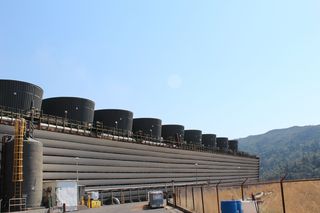
Today, we had the opportunity to take a tour of The Geysers geothermal dry steam field and one of its 16 electricity generation facilities, the McCabe 5 generation plant. The Geysers is the world’s largest energy production site fueled by geothermal.

Twelve miles up a country road from Sonoma County’s vineyards, the field was first discovered by western settlers when a hunter came across the steaming fumaroles and told his friends he had stumbled upon the gates to Hades. Soon thereafter, the site was developed as a resort, and from the 1850’s tourists would brave a treacherous stage ride to “take the waters” for health and recreation at the Geysers Resort Hotel.

The first geothermal well was tapped to generate electricity in the 1920’s, and today the plants in the field supply power to the coastal region of from San Francisco north to the Oregon border. Although output has

Continue Reading A Visit To The “Gates To Hades” – The Geysers Geothermal Field

For anyone who deals with state, municipal, and local government law, here’s a must-follow blog: The Municipal Minute, produced by our ABA State & Local Government Law Section colleague (and fellow U. Hawaii Law alum) Julie A. Tappendorf. Julie is a partner in the Chicago office Ancel Glink, and practices local government, land use, economic development, and zoning litigation, and is a frequent author and speaker.

Posts to date include “Hiring Experts in Land Use Cases,” “Tweeting into Trouble” (the upsides and downsides to social media use by local governments and officials), and “New Law Authorizes Zoning Hearing Procedural Rules.”

We’ve added it to our blogroll, and you should too. Continue Reading New Law Blog Worth Following: The Municipal Minute (Local Government Law)