The City of Hayward, California, was concerned that residential rentals within its borders were “decent, safe, and sanitary,” and by ordinance required the owners or tenants of such units to allow city officials to inspect them. If an owner or tenant refused, the “Enforcement Official” was authorized to procure an “inspection warrant” and levy a monetary fine on the property owner.

An association of rental owners sought a writ of mandate, challenging the ordinance because it violated the Fourth Amendment, among other reasons. The trial court granted the writ and held the ordinance facially invalid because it compels a property owner to provide access to a tenant’s residence without tenant consent, and violates the substantive due process rights of the property owners because it levies a monetary penalty on a property owner even when the tenant is the one refusing to allow inspection.The court enjoined enforcement of the ordinance.

The

Continue Reading Cal App: City May Enter Rental Property To Make Inspections
The Natural Resources Section of the Hawaii State Bar Association has kindly asked me to speak to its members at their monthly lunch meeting, next Tuesday, November 1, 2011, from noon to 1:00 p.m. at the HSBA conference room, located on the 10th floor of Alakea Corporate Tower, 1100 Alakea Street.

I’ll be discussing the case currently pending in the U.S. Supreme Court about the ability of property owners to challenge a jurisdictional determination by the U.S. Environmental Protection Agency, Sackett v. United States, No. 10-1062 (cert. granted June 28, 2011).

The issue now before the Court is whether the Ninth Circuit correctly concluded that property owners who contested the EPA’s Clean Water Act jurisdiction could do so only in the course of an EPA enforcement action, and could not seek immediate judicial review of whether their property was even subject to the EPA’s authority. Sackett v. EPA, 622

Continue Reading Upcoming Hawaii State Bar Association Presentation: Sackett v. EPA – Immediate Judicial Review Or Death By A Thousand Days?

Law professor Richard Epstein was a featured speaker (and past Brigham-Kanner prize winner) at the recent B-K Property Rights Conference in Beijing. He’s summarized his thoughts and insights in “Going Red on Property Rights,” posted at the Hoover Institute’s site. He writes:

Earlier this month, I attended a Chinese-American Conference in Beijing on property rights co-sponsored by the William and Mary Law School and the Tsinghua University Law School.  One purpose of the conference was to award in absentia the Brigham-Kanner Prize to retired Justice Sandra Day O’Connor for her contributions to understanding the law of property. The intensive two-day discussions on property rights were open, animated, and cordial. They also revealed deep ironies in both the Chinese and American approaches to property rights.

The entire piece is well worth reading. All of our posts on the B-K Conference are collected here. I’m writing my wrap-up of the Conference and will post it shortly.

In the meantime, I offer this little story.

A few of us are walking the 15 minutes from the hotel to the moot courtroom at the Tsinghua Law School, through the university campus. We cross the lightly traveled road, and most of us step up onto the opposite sidewalk. Professor Epstein, engrossed in conversation with another lawprof, doesn’t notice they are walking down the middle of the road, blocking traffic.

A few seconds later, a car comes up behind them.

In Beijing, pedestrians decidedly do not have the right of way.

“Get out of the road!” we call out.

Epstein slowly turns around, looks at the car, looks at us, and says with a smile, “sidewalks are for mere mortals.”

(But he does get out of the road.)
Continue Reading Brigham-Kanner Property Rights Conference – “Mere Mortal” Professor Richard Epstein on “Going Red on Property Rights”

Yosemite_conference Here are the links to the cases and other items discussed today at the session Regulatory Takings – Looking Back and Looking Forward at the Cal State Bar’s Environmental Law Section’s Environmental Law Conference at Yosemite.

These cases are also in your written materials.


Continue Reading Links From “Regulatory Takings: Looking Back And Looking Forward” (Cal. State Bar Yosemite Conference)

Here’s what we are reading this Thursday:

  • Appeals Court Declines Invitation To Destroy Land Use Law As We Know It – from the Massachusetts Land Use Monitor blog: “Now that the Appeals Court has reminded us of the permanence of permit conditions, anyone who receives a permit with a restrictive condition should think twice about whether that condition is a proper exercise of municipal authority, or whether an appeal should be taken in an effort to modify or strike a condition that will otherwise burden the land for time immemorial.”
  • The ‘Public Uses’ of Eminent Domain: History and Policy – (hat tip to PropertyProf blog for the heads-up) – “This paper examines the effects and implications of the ‘public use’ requirement for the exercise of eminent domain in the United States. It is part of an ongoing inquiry the consequences of eminent domain in the United States. The first part examines the history


Continue Reading Thursday Links: Public Use, Mass Court Saves Land Use, Judicial Takings

Save the date: on Thursday, December 1, 2011 (1:00pm-2:30pm EST, 10:00am-11:30am PST) we’ll be presenting the on-line seminar “Eminent Domain: Redevelopment Challenges for Local Governnment – Navigating Federal Funding Requirements, Challenges for Public Utilities in Right-of-Way Projects, and Objections to Taking for Public Use.

Joining me are colleagues Anthony Della Pelle (McKirdy & Riskin – New Jersey), J. Casey Pipes (Helmsing, Leach, Herlong, Newman & Rose – Alabama), Rick E. Rayl and Bradford Kuhn (Nossaman – California), and Mark M. Murakami (Damon Key Leong Kupchak Hastert – Hawaii).

Each member of the faculty should be well-known to our readers: Tony publishes the New Jersey Condemnation Law blog and is a frequent speaker at the annual ALI-ABA eminent domain program. Casey is with the Owners’ Counsel member firm from Alabama and Co-Chair of the ABA Litigation Section’s Condemnation, Land Use, and Zoning Law Committee. Rick and Brad produce

Continue Reading Upcoming National Webinar – Eminent Domain: Redevelopment Challenges for Local Government

Yosemite_conference One conference down, one to go.

We’re on the way back from the Brigham-Kanner Property Rights Conference in Beijing, and on our way to the California State Bar Environmental Law Section’s annual conference at Yosemite N.P., which begins later this week. More information about the conference here.

Along with U.C. Berkeley law professor Joseph Sax and Deputy California Attorney General Daniel L. Siegel, I will be speaking about “Regulatory Takings: Looking Back and Looking Forward.” E. Clement Shute will moderate the panel discussion.

We will be discussing the seminal regulatory takings cases from the past 20 years. “The panelists, who have been involved in several of the most significant takings cases since even before the founding of the annual Yosemite Environmental Law Conference twenty years ago, will highlight key decisions, offer their views on the evolution of takings law, and discuss cutting-edge issues raised by more recent

Continue Reading California Bar’s Yosemite Conference: “Regulatory Takings: Looking Back and Looking Forward”

Last week, after the welcome reception at the U.S. Embassy celebrating the Brigham-Kanner Conference’s visit to Beijing and the awarding of the B-K prize to Justice Sandra Day O’Connor, I had a chance to meet up with an old law school classmate and friend, Laurence Brahm.

Since our graduation nearly a quarter-century ago, Laurence has led a life that can best be described as “interesting” (as in “may you live in interesting times”), and he has not followed the usual lawyer career path. Lawyer, filmmaker, hotelier, economic advisor, philanthropist, author, futurist, and restaurateur, among many others. Over drinks and dinner at his retro-kitschy Red Capital restaurant (now that is the PRC I remember!), we caught up and Continue Reading Brigham-Kanner Conference: An Evening With An Old Friend

Here is the Petitioner’s Reply Brief in Colony Cove Properties, LLC v. City of Carson, No. 11-189 (cert. petition filed Aug. 11, 2011). We posted the cert petition and the amici and BIO here

The cert petition is asking the Supreme Court to revist and discard the ripeness rules of Williamson County Regional Planning Comm’n v. Hamilton Bank of Johnson City, 473 U.S. 172 (1985). It poses two Questions Presented:

1. Should Williamson County be overruled, to the extent that it arbitrarily denies a federal forum to regulatory takings claimants seeking just compensation for the violation of their rights under the Fifth Amendment, contrary to the intention of Congress in enacting Section 1983?

2. Should this Court recognize an exception to Williamson County’s “state procedures” requirement for takings claimants like Petitioner, whose Fifth Amendment claims will otherwise be relegated to a California state court system that

Continue Reading Final Cert Brief In Williamson County Challenge

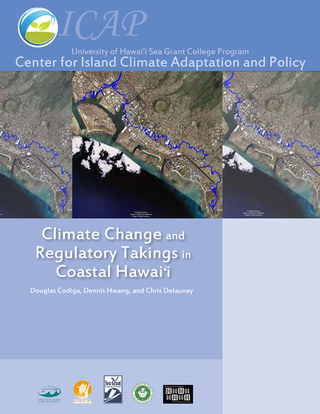
Climatechangemongraphpage

“There is strong consensus in the international scientific community that climate change is occurring and that greenhouse gas emissions from human activities contribute to climate change.”

So begins Climate Change and Regulatory Takings in Coastal Hawaii, a monograph by Douglas Codiga, Dennis Hwang, and Chris Delaunay, published by the University of Hawaii Sea Grant College Program’s Center for Island Climate Adaptation and Policy

We’re not entering into the debate about whether global warming/climate change is or isn’t happening. But the one certain thing is that every regulatory entity from the U.N. on down to your local neighborhood board believes it is real, and seems to want to do something about it. Thus, the question is how property owners may be affected by those actions, and what they can do in response. This report doesn’t really resolve anything, but it does establish the framework and makes some recommenations. From

Continue Reading Climate Change And Regulatory Takings In Coastal Hawaii