PXL_20230223_024826759

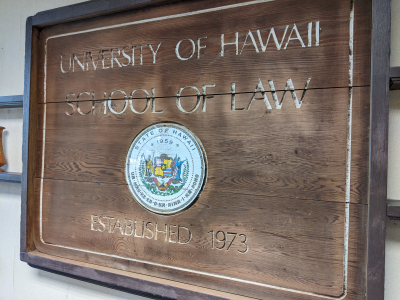
Starting in January, we’ll be helping our friend and former law partner Mark M. Murakami with the venerated and oh-so-important Land Use course (Law 580) at the University of Hawaii’s Law School.

We’re temporarily stepping into some mighty big slippers (this is Hawaii, so we don’t always wear shoes), as this is the course that our mentor Professor David Callies taught for decades. And is there a better venue in which to teach and study land use law and regulation, and its limits? After all, Hawaii may be the most heavily-regulated land on the planet, and is a focal point for every issue you can think of, from zoning to environmental restrictions to takings to public trust to subdivision to admin law to … well, you get the drift.

We’ll cover those topics, as well as the fundamentals. And we have a few surprises up our sleeves — some impressive

Continue Reading Hawaii Five-80: More Land Use (Law 580) At The University Of Hawaii
We’ve been eagerly waiting for the new season of the Institute for Justice’s podcast series, “Bound by Oath” to drop. Not only because it’s a great series – produced by John Ross, it is more like an audio documentary than a typical podcast – but also because John was kind enough to ask us to participate again (our last appearance was in Season 1, where we guested on the episode about the origins of the “incorporation” doctrine).

This season is all about property rights, and episode 2 is all about regulatory takings. Pennsylvania Coal Co. v. Mahon, and Penn Central Transp. Co. v. New York City, to be exact.

So just over a year ago, John and I headed up to anthracite coal country in Pennsylvania. We wanted to be on site on the exact 100th anniversary of the Supreme Court issuing the Mahon
Continue Reading “Groping in a Fog” – Bound by Oath Podcast, S3 E2: Regulatory Takings – Penn Coal And Penn Central … Unplugged!

You remember that longstanding trope: that matters of land use are “local” issues, and thus in civil rights claims involving a state or local government interfering with the right of property federal courts should avoid adjudication until the government has had every chance to do the right thing (even where it is patently obvious that it has no intention of doing so)? This trope most often shows up as a part of a ripeness dismissal, where the court says “too soon,” because, well, if given enough time and opportunity, the government might render adjudication unnecessary.

Well, in Ateres Bais Yaakov Academy of Rockland v. Town of Clarkstown, No. 22-1741 (Dec. 8, 2023), the U.S. Court of Appeals for the Second Circuit held a land use case ripe, and in the process blew up this overripe trope. Whoa!

But before you takings mavens get too excited, this is a RLUIPA

Continue Reading “Super-Zoning Board” No More – CA2 Busts The “Land Use Is Local” Trope: Town ZBA Doing Nothing On Variance Application Ripened Constitutional Claim

PXL_20231202_194330453.PORTRAIT

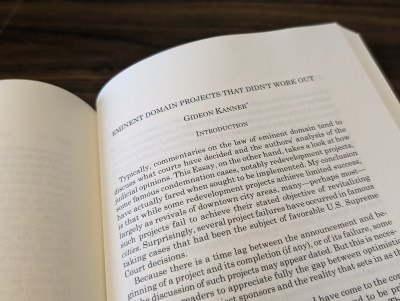
Here it is — Professor Gideon Kanner’s final law journal article, published shortly before his passing:

Gideon Kanner, Eminent Domain Projects That Didn’t Work Out, 12 Brigham-Kanner Prop. Rts. J. 171 (2023).

Appropriately, we think, published in William and Mary Law School’s Brigham-Kanner Property Rights Journal, named in part in Gideon’s honor.

This isn’t a typical law journal article, but an essay collecting Professor Kanner’s thoughts, comments, and (best of all) opinions on, well, eminent domain (and redevelopment) projects that didn’t work out.

In Gideon’s own words, from the Introduction:

But whether you favor widespread use of eminent domain or not, and whether the projects created by its use are sound or not, it is deplorable that the power of eminent domain has been often deployed to the detriment of racial and politically powerless minorities. Typically, redevelopment projects tend to displace middle class and poor people from

Continue Reading Professor Kanner’s Final Article: “Eminent Domain Projects That Didn’t Work Out,” 12 Brigham-Kanner Prop. Rts. J. 171 (2023)

Pace
22nd annual Alfred B. DelBello Land Use
and Sustainable Development Conference

Come, join us (and others) on Thursday-Friday, December 7-8, 2023, at Pace Law School in White Plains, New York for the Land Use and Sustainable Development Conference (this year’s conference theme is “Balancing Economic Realities with Environmental and Social Concerns”).

We’re speaking about the 100th anniversary of the modern regulatory takings doctrine, which got its start nearly 101 years ago with the Supreme Court’s opinion in Pennsylvania Coal Co. v. Mahon, where the Court held that property may be regulated, but if the regulation “goes too far,” it will be deemed a taking.

Here’s a description of the program:

The 100th Anniversary of Pennsylvania Coal vs. Mahon: How the Takings Clause Became the Primary Check on Government Power When SCOTUS Abandoned Review Under the Due Process and Contracts Clauses During the New Deal

The Takings Clause and 100

Continue Reading Join Us For 100 Years Of Pennsylvania Coal (Pace Land Use Conference, Dec. 8, 2023)

Euclid_front

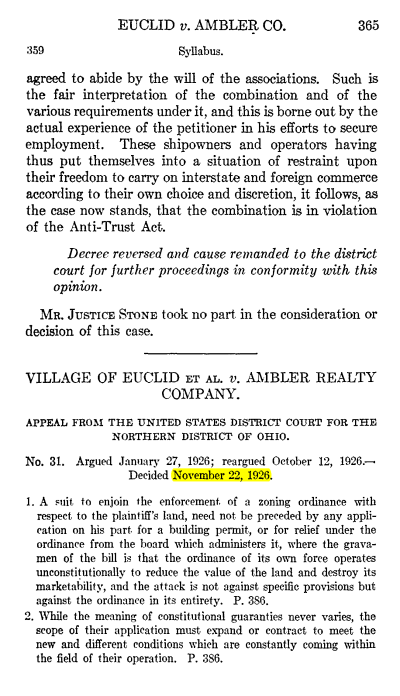
On this day in 1926, the United States Supreme Court issued its landmark opinion in Village of Euclid v. Ambler Realty Co., 272 U.S. 365 (Nov. 22, 1926).

You know this one (shame on you if you don’t!) – it is the case in which the Supreme Court first upheld — against a facial due process challenge — the validity of this thing we call “zoning.” While in the intervening century, zoning has become a catch-all term for regulatory restrictions on the uses of real property, land users know that “zoning” — ackshually — refers only to the regulation and separation of uses, and restrictions on density, and height regulation.

While “Euclid” and “Euclidean zoning” have become part of the land use lexicon and landscape, the decision might have been seen at the time as somewhat surprising. After all, the Supreme Court was in

Continue Reading (Un)Happy 97th Birthday, Euclid!

Check this out, our law firm colleague Joshua Thompson talks about regulatory takings, and his big Supreme Court victory in Cedar Point Nursery.

If you are reading this blog, you already know what that means. Regulatory takings. Bundle of sticks. Penn Central (bleh), and right to exclude. Here’s the description of the program:

In this thought-provoking episode, Bob Stetson and Joshua Thompson, Director of Equality and Opportunity Litigation at the Pacific Legal Foundation, discuss the landmark case of Cedar Point Nursery vs. Hassid and explore the intricate balance between private property rights and public interests. What constitutes a ‘taking’ and how far government regulations can go in the name of the public good?

Stream it above, or listen on Spotify here.

(Our own thoughts on the Cedar Point case here.)Continue Reading New Podcast: The Cedar Point Takings Case (From The Guy Who Argued Cedar Point)

Here’s the merits brief in a case we’ve been following (naturally, because it is one of ours). This is Sheetz v. El Dorado County, the case which asks whether a condition on development (aka an “exaction”) is exempt from the close nexus and rough proportionality standards of Nollan/Dolan/Koontz simply because the exaction is imposed on every owner who asks for permission to use its property, and not via an ad hoc administrative permit procedure.

Because this is one of ours, we’re not going to go into in further, but leave to you to read our brief:

In this Court’s key exactions precedents—Nollan, Dolan, and Koontz—it held that when government exacts money or real property as a condition on the right to use or develop land, it must establish that the exaction bears an “essential nexus” and “rough proportionality” to an adverse public impact caused by the owner’s proposed

Continue Reading Legislative Exactions Merits Brief (Ours): “the text and history of the Takings Clause admit no exception for legislative takings”

Another must-listen episode of Clint’s Eminent Domain Podcast. He’s joined by Pepperdine Law School Professor Shelley Ross Saxer:

Professor Shelley Ross Saxer joins the show to discuss the role that the damaging clauses found in more than half of state constitutions across the United States play in inverse condemnation claims related to natural disasters such as the recent Hawaii wildfires.

Definitely worth a listen (as always with EDP). Stream above, or download here. Continue Reading Inverse Condemnation And Hawaii’s Wildfires: Lawprof Shelley Saxer Joins Clint Schumacher’s Eminent Domain Podcast

ALI-CLE brochure cover page

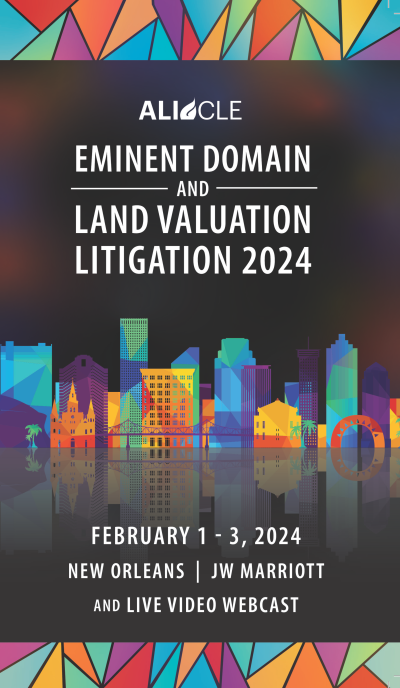
Here’s the brochure and the full agenda and registration information for the upcoming ALI-CLE Eminent Domain and Land Valuation Litigation Conference at the JW Marriott in New Orleans, February 1-3, 2024.

This is the long-running nationally-focused conference on all things eminent domain, takings, valuation, and related. We have three tracks, from which you can choose a la carte – Practice, Substantive, and Condemnation 101:

For over 40 years, we’ve been bringing eminent domain practitioners together to examine the latest issues, engage in healthy debate, and get the information they need to stay current in their practice. This year – our 41st – is THE perfect time to reunite with your eminent domain colleagues. There will be plentiful opportunities to meet and mingle with the faculty and other registrants – throughout the conference and at evening social events. Attendees come back year after year to make new friendships and renew

Continue Reading Here’s The Program For The 41st ALI-CLE Eminent Domain And Land Valuation Litigation Conference, Feb 1-3, 2024, New Orleans