Here’s a takings cert petition, filed yesterday.

Because this is one of ours, we’re not going to comment much beyond reposting the Question Presented, and to let you know this one is about how the “relatively modest” requirement that the government have taken some “definitive position” about what uses are allowed and what uses are not on a claimant’s property — as the Court noted in Pakdel, a “de facto” decision is enough. Yes, prudential ripeness.

Question Presented:

Matthew Haney sought to build a home on a small undeveloped island in Popponesset Bay, Massachusetts, zoned by the Town of Mashpee exclusively for single-family residential use. But building a home requires a variance from the Town’s setback and frontage requirements. Haney twice sought this variance, and twice the Town rejected his requests. The Town’s unqualified position that Haney could not obtain the necessary variance to build his home satisfies the
Continue Reading New Takings Ripeness Cert Petition (Ours): One Variance, Two Variance, Three Variance…More?

A quick one from the Alabama Supreme Court. In Dixon v. City of Auburn, No SC-2022-0741 (Oct. 27, 2023), the court rejected a property owner’s claim that the city outlawing short term rentals of residential properties — when the plaintiff had been renting his basement for a while — was not a violation of the Alabama Constitution.

The court rejected the argument that Dixon’s use was a nonconforming use or vested right, and concluded that his right to do so was not so because he had no legal right to rent out his property before the STR ordinance. The court rejected his claim that in the absence of regulations limiting that right, he could rent short term, because the zoning code prohibits any uses not expressly allowed. Slip op. at 10.

And here’s the interesting bit. Although Dixon styled one of his claims as “an ‘unlawful taking without just

Continue Reading Alabama: Banning Short-Term Rentals Is Constitutional (PS – “the Alabama Constitution does not recognize regulatory-takings claims”)

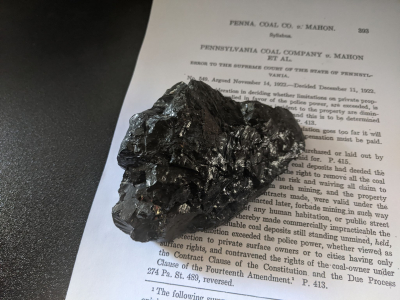
Penn Coal

Our thanks to Professor/Dean/Provost Patricia Salkin and Lawprof Simone Freeman for inviting me to drop in on their Touro Law School Land Use class last evening to talk about regulatory takings and some of the interesting details of the Pennsylvania Coal Co. v. Mahon case from 1922.

We discussed the case, using some photos we took during our site visit to the former Mahon property and environs last year on the 100th anniversary of the date the Court issued the landmark opinion. We also emphasized the importance in dirt law cases generally to get yourself on the ground and see the property in question. Even though we have an amazing set of technical tools by which we can remotely get a sense of the land (Google Maps, Street View, for example), there is no substitute for getting yourself to the site to feel the ground, touch the dirt, understand the

Continue Reading We Want A Lump Of Coal For Christmas (As Long As It Is Pennsylvania [Anthracite] Coal)

In Van Sant & Co. v. Town of Calhan, No. 22-1190 (Oct. 13, 2023), the U.S. Court of Appeals for the Tenth Circuit considered the claim of the operator of a mobile home park who asserted a due process property right to instead use its property as a RV park. Here’s why the court said no.

Van Sant was using its property as a mobile home park. It decided to use its land instead as a RV park. Turns out that the local municipality doesn’t much care for RV parks — or at least the way that Van Sant was going to use its property — so the Town shifted from a regime that didn’t regulate RV parks to a regime that prohibited or tightly controlled RV parks on certain lands (lands that looked an awful lot like Van Sant’s). And to cap it off, the Town’s new regulations

Continue Reading CA10: Absence Of Restrictions On Land Uses Isn’t A Due Process Property Right

Here’s what we’re reading about the Supreme Court’s property rights docket — some good, some disappointing — this day.

  • Niina Farah, “Supreme Court flooding case could ripple across the energy sector (E & E News / Energywire) – About the Devillier case (which we summarized here), in which we were quoted: “The Supreme Court decision to hear the Devillier case comes after a concerted effort in recent years to convince the court to address procedural maneuvers that have made it challenging for property owners to bring their claims to court, said Robert Thomas, director of property rights litigation at the Pacific Legal Foundation. The nonprofit is among the groups that has asked the court to address takings cases and has lent its support for the property owners in Devillier in a ‘friend of the court‘ brief. ‘There’s a lot of gamesmanship going on


Continue Reading Supreme Court Property Rights Round-Up

092923zr_q8l1_Page_1
I’ll take ‘Words I Like to See’ for $800, Alex.

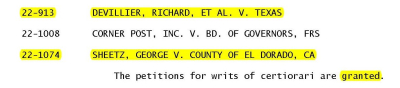
In this Order, the U.S. Supreme Court agreed to hear two important property rights cases (are there any other kind?). Both are cases we’ve been following — and indeed are now playing a part in.

The first is detailed in this post.

In the second, Sheetz v. El Dorado County, the Court is finally getting to the long-unresolved question of whether an exaction or permit condition is exempt from the usual requirements of “logical nexus” and “rough proportionality” simply because the condition is imposed uniformly by legislation, and not ad hoc via an administrative or other permit decision.

We commented on the Sheetz case in this post (“Whether $23K Traffic Fee Is Proportional To One Single-Family Home Is Beyond The Ken Of Judges“) and won’t repeat the facts or comments here.

But here’s

Continue Reading Cert Grant #2 – SCOTUS (Finally!) To Resolve Whether Legislative Exactions Are Subject To Nollan-Dolan-Koontz Nexus And Rough Proportionality

Before you get too excited by the U.S. Court of Appeals for the Sixth Circuit’s opinion in Catholic Healthcare Int’l, Inc. v. Genoa Twp., No. 22-2139 (Sep. 11, 2023), a spoiler up front: this may be a good ripeness decision, but this isn’t a takings case.

But you takings mavens may still want to take a quick look over the opinion for how the court deals with a ripeness argument in a case where the plaintiffs assert the Township violated their rights by denying (twice) its requests for a land use special permit.

The story is about a walking path created by Catholic Healthcare that contains fourteen “Stations of the Cross” “depicting the “story of Christ’s last day.” Slip op. at 1. The Township insisted that Catholic Healthcare obtain a special use permit, because the Township believed that the trail use is the equivalent of a church.

So

Continue Reading CA6: “The distric court’s ripeness determination, in turn, was plainly mistaken”

IRWA 6-2023 summary jpg

Thanks to our co-authors for the latest issue of this recurring update.

The International Right of Way Association’s Real Estate Law Committee produces twice-a-year reports “which contain summaries of eminent domain decisions and legislation within the United States.” (This is the “international” right of way association, so that last qualifier is important.)

And what is really nice is that they make the report available.

The laboring oars on this are really Brad Kuhn and Jullian Friess Leivas (both from the Nossaman firm), but they were kind enough to include us. Brad and Jillian wrote up more at the California Eminent Domain Report:

We recently had the pleasure of collaborating with Robert Thomas and Ajay Gajaria once again for the International Right of Way Association’s (IRWA) biannual report covering numerous eminent domain cases at local, state and federal levels from January through the end of June 2023. This


Continue Reading Just Published – IRWA’s “Summary of Major Eminent Domain Cases & Legislation: Jan 1, 2023 – June 30, 2023”

KS_aerial
According to the County, this is an “industrial” use,
incompatible with “agricultural” zoning

Note: sorry, this is one of those longer posts, but the topic is a serious one, so we felt it needed more than our usual cursory treatment.

How Can That Be?

We’ve been somewhat reluctant to post too much on the legal aspects of the Maui wildfires (other than to comment on the first lawsuit), just because it still seems “too soon.” The focus should be on aiding the victims and helping those who want to rebuild to do so, and not on premature blamestorming (see also this), legal theories, and  the “opportunities” this disaster presents (see also this, this.and this).

But we did want to clear one thing up. There are a lot of stories (see here, here, and here, for example), about the State of

Continue Reading Can One Government Official Really Hold Up Necessary Water Uses? The Hawaii Public Water Trust In Action