


Kuilima Resort Company has asked the Hawaii Supreme Court to reconsider or clarify its opinion in the Turtle Bay/Kuilima EIS case (Unite Here! Local 5 v. City and County of Honolulu, No. 28602 (Apr. 8, 2010)), in which the court held that a supplemental environmental impact statement is required when a project’s context changes, even if the project itself has not. The motion is available here.

Under Rule 40 of the Hawaii Rules of Appellate Procedure, no response can be filed unless the court asks for it, and the court has 10 days to act on the motion. If the court does not act within the 10 days, the motion is automatically rejected.Continue Reading Kuilima’s Motion For Reconsideration Of HAWSCT’s Supplemental EIS Opinion
A fascinating case is now pending in Hawaii’s Intermediate Court of Appeals involving the nature of “Torrens” title and, in a broader sense, the nature of property rights themselves. 

Hawaii has had a dual system of land registration. One is your run-of-the-mill system of registering deeds (what we creatively call “Regular System”). The other is “Land Court” registration, a statutory Torrens scheme of title registration where the State guarantees indefeasible title to the rights and interests reflected in the register. Land Court registration insures that interests which are not reflected on title do not exist. Indeed, persons who are wrongfully deprived of land or their interest through registration or the act or omission of the registrar are entitled to be paid by an indemnity fund, and the State’s guarantee operates against all claims, including claims by the State itself. 

As background (for those of you who, like me, weren’t paying

Continue Reading Land Court, Schmand Court: State Disregards Torrens Title, Claiming Unstated, Preexisting Rights

What we’re reading today:

  • Curbing abuse of eminent domain – A Denver Post editorial on a new Colorado statute designed to limit the power of the government to declare farmland “blighted” (“The new law says land that has been classified by the county assessor as agricultural land cannot be condemned for urban renewal. However, it makes an exception for agricultural land that is an enclave within cities and has had development around it for at least three years. We will have to see how the law shakes out in the coming years, but that seems to be an awfully big exception. That’s exactly the kind of land that usually needs the most protection from government.”).


Continue Reading Sunday Eminent Domain Round-Up

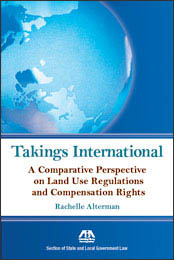
5330205_big I’ve finally had a chance to peruse the recently-published book Takings International: A Comparative Perspective on Land Use Regulations and Compensation Rights (ABA Section of State and Local Government Law 2010; $95 regular price; $75 for SLG members).

Takings International is about how 13 jurisdictions worldwide treat what we in the U.S. call “regulatory takings.” For those of us who have a keen interest in this area of law, this book is a goldmine of information about how the rest of the world deals with the issue. For those who may not be quite as interested, it is still a fascinating survey of how others treats the modern regulatory state’s impact on private property.

The book is headlined by Professor Rachelle Alterman (Technion-Israel Institute of Technology), and contains chapters authored by other experts on regulatory takings. It is divided up into several sections. In Part I, Professor Alterman provides an


Continue Reading Book Review: Takings International: A Comparative Perspective on Land Use Regulations and Compensation Rights

Don’t feel like reading all 74 pages of the majority and concurring opinions in the Turtle Bay/Kuilima EIS case (Unite Here! Local 5 v. City and County of Honolulu, No. 28602 (Apr. 8, 2010))? You’re in luck — here’s a summary.

[Disclosure: although I did not participate in this case, two of my Damon Key colleagues did. They represented a party in the circuit court and filed an amicus brief in the Supreme Court. Consequently, I will not be adding commentary, just summarizing.]

For a summary of the arguments of the parties, first check out our oral argument preview part I and part II, then check out our live blog of the oral arguments.

Here are the briefs of the parties and amici, both at the cert stage, and in the Intermediate Court of Appeals:


Continue Reading Summary Of HAWSCT Opinion In The Turtle Bay/Kuilima Supplemental EIS Case: A Change In “Context,” But Not The Project, Enough To Trigger Duty To Supplement

This just in: the Hawaii Supreme Court has issued an opinion in the Turtle Bay/Kuilima EIS case (Unite Here! Local 5 v. City and County of Honolulu). In short, the court held that a supplemental environmental impact statement is required when a project’s context changes, even if the project itself has not. The court’s opinion, authored by Chief Justice Moon, is here. We blogged about this case and the ICA’s decision here.

More, after a chance to read the 76 pages of the majority and concurring opinions.Continue Reading Turtle Bay/Kuilima Supplemental EIS Case: Is A Change In “Context,” But Not The Project, Enough To Trigger Supplemental EIS?

When one lawyer writes that another is “my friend and colleague,” watch out: what follows may not be exactly friendly or collegial. For legal academics, the rule is even more pronounced when the friend-and-colleague’s name shows up in the title of an article.

In that vein, we bring you the latest chapter in the ongoing debate about “background principles” in regulatory takings analysis. In Background Principles, Takings, and Libertarian Property: A Response to Professor Huffman (posted on SSRN here), lawprofs Michael C. Blumm and J.B. Ruhl respond to Professor James Huffman’s critique of their work.

A short refresher. The “background principles” issue was spawned by Lucas v. South Carolina Coastal Commission, 505 U.S. 1003 (1995), the case in which the Court held that a regulation takes property when it deprives a property owner of “economically beneficial or productive use of land,” even if the government’s reasons for enacting

Continue Reading Be Careful Of Lawprofs Bearing Praise: Another Chapter In The “Background Principles” Debate

The latest skirmish in California’s mobile home rent control wars, this time from the California Court of Appeal, Fourth District, in two cases out of San Diego county, MHC Financing Ltd. P’ship v. City of Santee, No. D053345 (Mar. 15, 2010).

The cases present a convoluted series of facts and procedural twists which we are not going to rehash, but recommend that you read yourself. It’s a long opinion (50 pages), but it’s worth delving into the details. The court held:

  • First, the property owner “sustained no legally remediable injury” from the retroactive application of a mobile home rent control ordinance which the city adopted to correct errors in an earlier-adopted mobile home rent control ordinance (the erroneous ordinance was based on the original version of a proposed initiative ordinance, and not the modified initiative ordinance which was certified by petition) (slip op. at 15-19).
  • Damages are not an


Continue Reading California Court Of Appeal: Takings Claims Brought Too Early, Too Late, And No Damages For Violations Of The Right To Petition (Inter Alia)

This just in: the U.S. Court of Appeals for the Ninth Circuit will be hearing Guggenheim v. City of Goleta, No. 06-56306 (Sep. 28, 2009) en banc.

The panel opinion in Guggenheim held that the city’s mobile home rent control ordinance was a regulatory taking, an issue the court had never considered before:

Daniel Guggenheim and others bring a facial challenge the the City of Goleta’s mobile home rent control ordinance. Guggenheim argues that the ordinance, which effects a transfer of nearly 90 percent of the property value from the mobile home park owners to mobile home tenants, constitutes a regulatory taking under Penn Central Transportation Co. v. New York City, 438 U.S. 104 (1978). We have fielded such challenges before, but have never reached the merits of the takings claim.

Slip op. at 13808-09. What review by the full Ninth Circuit probably portends is that whatever

Continue Reading Ninth Circuit To Hear Rent Control Takings Case En Banc