Why is it, you ask, that the ALI-CLE Eminent Domain & Land Valuation Litigation Conference (scheduled next February 1-3, 2024, in New Orleans) is an event that seems to be growing in popularity and attendance. In recent years, we have standing room only in the Conference halls, and have sold out the hotel block. After all, this is a pretty niche area of law. So what gives?

When we were in Austin earlier this year, we thought it might be nice to try and answer that question. We asked Conference participants why they come, year-after-year (and in Austin, despite massive travel disruptions). Yes, it is the various venues (Nashville, Austin, Scottsdale, Palm Springs, to name a few recent locations), and yes, it is the excellent and useful programming.

But as we suspected it is more than that. As the above video notes
Continue Reading ALI-CLE’s Eminent Domain & Land Valuation Litigation Conference (Feb 1-3, 2024, New Orleans): Why Attend? Here’s Why.

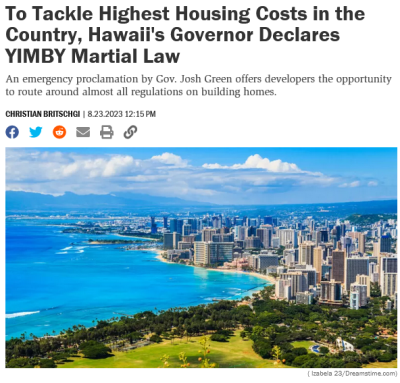
Screenshot 2023-08-23 at 16-13-54 To tackle highest housing costs in the country Hawaii's governor declares YIMBY martial law

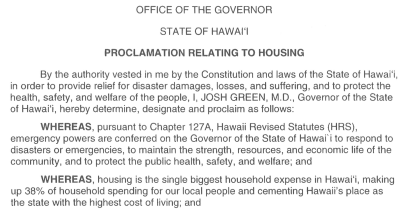
Here’s an excellent report on a situation we’ve been following, the Hawaii governor’s proclamation of a housing emergency. In “To Tackle Highest Housing Costs in the Country, Hawaii’s Governor Declares YIMBY Martial Law,” Christian Britschgi at Reason writes:

Developers with a [Beyond Barriers] working group [what we cheekily referred to as the “Privy Council”]–certified project wouldn’t have to comply with normal zoning restrictions. They wouldn’t have to go through Hawaii’s cumbersome environmental review process (which can add months or years to a project’s approval). They could avoid historic preservation regulations, and get relief from normal impact fees and taxes. They could also skip the need to get approval from the state’s Land Use Commission—a duplicative zoning body.

The story is an excellent summary of the substance of the emergency proclamation, the support and objections it has received, and some prognostication (including ours):

Thomas says that

Continue Reading “YIMBY Martial Law” – More On Hawaii Gov’s Gordian Knot Cutting

Here’s the latest in a case we’ve been following.

In this cert petition, the property owner is asking the U.S. Supreme Court to review an unpublished decision of the Ninth Circuit which rejected both Lucas and Penn Central takings claims.

Here are the Questions Presented:

1. Should this Court overrule in its entirety, or reconsider parts of, Penn Central Transportation Co. v. City of New York, 438 U.S. 104 (1978)?

2. Does the “economic impact” of a regulation on the subject property have to approach total loss of use and value to weigh in favor of a taking under Penn Central, as the District Court and Ninth Circuit held below?

3. Can a property owner ever have “distinct investment-backed expectations” for the beneficial use of property, for purposes of alleging a Penn Central taking, if restrictive downzoning is adopted before development of the property is undertaken?

Continue Reading New Cert Petition: Overrule Penn Central!

Screenshot Capture - 2023-08-18 - 08-32-14
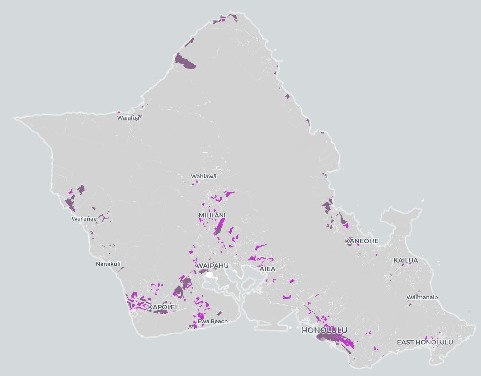
Where you can build 1-4 family residences by right

The Hawaii Zoning Atlas project has announced publication of the Hawaii Zoning Atlas, an “interactive map [that] explores how restrictive zoning laws can make it difficult to build diverse, affordable housing.”

The official announcement notes:

The map is based on an original dataset compiled by over 30 students [including some of our U.H. Law students!] and volunteers who combed nearly a thousand pages of regulations to extract key policy details, including whether housing units are legally allowed in an area and how many; restrictions on height, yards, and lot coverage; and parking requirements. All in all, more than 100 data points were collected for each zone in three counties–Honolulu, Maui, and Hawaiʻi. Kauaʻi will be available in a future release.

This is designed for people who are not land use insiders, to help understand how land use regulations restrict

Continue Reading “Zoning is the most important local law you’ve never heard of” – Hawaii Zoning Atlas Published

Untitled Extract Pages

Two years ago, Owners’ Counsel of America endowed a scholarship in the name of its founder, property rights advocate and trial lawyer Toby Prince Brigham (1934-2021). The scholarship is for a second- or third- year law student to attend the annual three-day ALI-CLE Eminent Domain and Land Valuation Litigation Conference (the upcoming Conference will be in New Orleans, Louisiana, February 1-3, 2024).

The Conference affords the Scholar an all-expenses-covered opportunity to meet and network with leading property rights and eminent domain lawyers from across the country, while also learning about property law and practice. 

Here’s the official description from OCA:  

In honor of Toby’s legacy of professionalism and achievement, in 2021 OCA established the Toby Prince Brigham OCA Scholarship to pay for all expenses of a second or third year law student to attend the ALI-CLE Eminent Domain conference and associated OCA events held annually in January. This unique

Continue Reading Owners’ Counsel Toby Prince Brigham Scholarship – Applications Being Accepted

We recently attended the American Bar Association’s Annual Meeting in Denver to speak at the Section of State and Local Government Law’s program, “The 100th Anniversary of Pennsylvania Coal v. Mahon: How the Takings Clause Became the Primary Check on Government Power When SCOTUS Abandoned Review Under the Due Process and Contracts Clauses During the New Deal.

But the real highlight of the Meeting was the Jefferson Fordham Awards which, as we noted earlier, were presented to property rights icon Michael Berger, who the Section recognized with the Daniel J. Curtin, Jr. Lifetime Achievement Award.

Also noteworthy: the presentation of the Anita P. Miller Advocacy Award to land use law giant, Professor John R. Nolon, and the Up and Comer Award to a former William and Mary student (and now colleague) of ours, Makenna X. Johnson. 

Professor Frank Schnidman introduced Michael Berger

Continue Reading Recognizing A Property Rights Icon: “Mentors, A Path to Fairness, and the Joy of Taking”

PXL_20230426_222217568
(Tip for applicants: understanding the symbology of the
Law School’s logo will show you know the score.)

Here’s your chance to teach Property and Land Use in what might be most interesting venue on Planet Earth for those subjects: the University of Hawaii School of Law has put out a call for applications for a tenured lawprof (along with six other openings in other subjects):

The University of Hawaiʻi at Mānoa, William S. Richardson School of Law seeks to fill up to seven tenured or tenure – track positions . For doctrinal faculty, we are seeking to fill positions in Constitutional Law (tenured or tenure – track) and Property /Land Use (tenured). We welcome candidates who, in addition to one of those two fields, have expertise in Administrative Law, Business and Commercial Law, Environmental Law, Family Law, Health Law, Intellectual Property, Labor and Employment Law, Native Hawaiian Law

Continue Reading Live The Dream! Teach Dirt Law In Hawaii: UH Law School Looking For Property & Land Use Lawprof

ExecOrder

The two-plus years under the declared Co-19 emergency surely have given Hawaii’s executive-branch officials a clear vision of how much easier they could get their agendas accomplished without all that pesky democracy.

Hawaii’s Sweeping Emergency Management Act: Governor is the “Sole Judge”

Hawaii’s Emergency Management Act gives state and county executives broad and nearly unreviewable authority to suspend a wide spectrum of the usual laws, regulations, and rules. As we wrote in Hoist The Yellow Flag and Spam® Up: The Separation of Powers Limitation on Hawaii’s Emergency Authority, 43 U. Hawaii L. Rev. 71 (2020), Hawaii’s Act confers among the nation’s most muscular and sweeping powers. For example, the governor is the “sole judge of the existence of the danger, threat, or circumstances giving rise to a declaration of a state of emergency.” The Act’s one limitation — the 60-day time limit on how long an

Continue Reading What If The Hawaii Governor’s Cutting Of The Gordian Land Use/Environmental Knot Actually Works?

The city told an owner whose three parcels were outside of the city’s jurisdiction that if it wanted the city’s permission to replat into 74 parcels, it would need city water and sewer service to each of the proposed lots.

So the owner asked to connect to the city’s water and sewer system (deliberately overbuilt to account for future users, apparently), and in response, the city told the developer that it would have to do two things. First, it would have to contribute to the cost of building the system by purchasing water/sewer chits (our term). When the system was built, the city anticipated future connections and created a chit system by which future connections would help pay for the cost of construction. Second, in order to purchase these chits, the buyer’s property must be included within the city’s jurisdiction. And that meant a voluntary annexation. Annexation does not come

Continue Reading Tex App: Nollan/Dolan Challenge To Annexation Fees Not Ripe: You Have To Apply For Annexation To Find Out What The Fee Will Be

PXL_20221211_185826126
The Mahon Property

Join us on Friday, August 4, 2023 (10:30-11:30am, MT) in Denver at the ABA Annual Meeting for our CLE session on “The 100th Anniversary of Pennsylvania Coal v. Mahon: How the Takings Clause Became the Primary Check on Government Power When SCOTUS Abandoned Review Under the Due Process and Contracts Clauses During the New Deal.”

The program description:

The Takings Clause and 100 years of the Pennsylvania Coal v. Mahon doctrine have become the primary check on governmental power that the Due Process and Contracts Clause used to serve, before the Supreme Court finally and formally abandoned judicial review under those doctrines during the New Deal. Mahon transcended its primary relevance as to compensation for the taking of private property to become the fundamental means by which the Rule of Law determines of the individual’s relation with the government.

This session will survey the evolution

Continue Reading Aug 4, 2023: “The 100th Anniversary of Pennsylvania Coal v. Mahon: How the Takings Clause Became the Primary Check on Government Power” (ABA Annual Meeting, Denver)