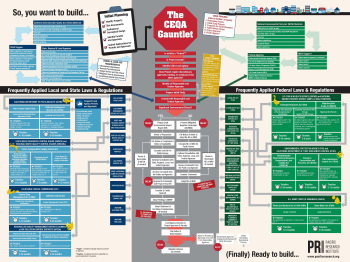
CEQAflowchartSee if you can navigate this maze.

Even if you are not in California, this thing called “CEQA” (the California Environmental Quality Act) is something you might have heard of. An environmental reporting statute on steroids, CEQA is, according to this new report from the Pacific Research Institute, the main reason why California is home to the unbeatable combination of sky-high home prices and nation-leading poverty rate, and has become as famous for its homeless problem as its beaches

In “The CEQA Gauntlet,” the authors report that the above problems are products of the fact that it is “very, very hard to build homes in California.” And the reason it is hard to build homes in California? That’s right, CEQA.

What started off as a data-gathering and informational requirement (so that the decision makers could incorporate environmental considerations) has become the tail that wags the dog

Continue Reading Death By A Thousand Days: Presenting “The CEQA Gauntlet” Report

Well, that was quick. Last month, as we reported here, the a Ninth Circuit panel held that the City of Oakland, California, could require property owners to pay thousands of dollars in what is branded “relocation fee” to their tenants as a precondition of the owner moving into their own property. This isn’t an “exaction” subject to the nexus and rough proportionality requirements applicable to such demands when they are in land use permits. This was merely a regulation of the landlord-tenant relationship.

Now, our colleagues Dave Breemer and Brian Hodges (the team responsible for Knick v. Township of Scott) have produced this cert petition.

As this is a case in which our firm has an active part, we won’t be doing much more here than posting the petition, and the Question Presented. You can read the petition yourself and get the idea of what the issues

Continue Reading New Cert Petition: Are Generally-Applicable Requirements Subject To Nollan-Dollan Analysis?

Lately, we’ve been zeroing in on one of the lesser known parts of the Supreme Court’s takings canon, Yee v. City of Escondido, 503 U.S. 519 (1992), where the Court concluded that a city ordinance that limited the amount a property owner could charge a tenant for rent was not a physical invasion taking.

In Yee, the Court held that the ordinance did not intrude on the owner’s right to exclude because the owners had invited their tenants to intrude on their property when they let them become tenants. Yeah, that invitation and resulting intrusion was conditioned on the tenant paying each month a specific amount of rent and the ordinance effectively rewrote that agreement, but the plaintiff raised only a facial categorical takings claim (and thus the question of whether the city-mandated lower rent prohibited a fair return to the owner was an issue that the owners could

Continue Reading Wash App: No Taking Of Right To Exclude Because Eviction Moratorium Merely Lets Tenants Remain

CedarpointPRELcoverpage

Thank you to the editors over at The Practical Real Estate Lawyer for publishing my missive on Cedar Point Nursery v. Hassid, the U.S. Supreme Court’s recent blockbuster regulatory takings decision (and for letting me post a copy of the article here so it is available even if you are not a PREL subscriber). And you know this, but I’m going to disclose it again: my law firm represented the property owner in that case, so yes, I do have a viewpoint; take that into account while reading. 

By the way, you might consider becoming a subscriber. The journal publishes just what the title suggests it does – practice-oriented articles about dirt lawyering. Good stuff.

Thomas, Common Sense and Common Law: Defining “Property” in Cedar Point v. Hassid, 38 Prac. Real Estate Law…

Continue Reading New Article: Common Sense and Common Law: Defining “Property” in Cedar Point v. Hassid

PXL_20220127_144224442

After a two-year absence in which we went remote, in the last week of last month (our usual spot on the calendar, between the playoffs and Super Bowl), we once again met in-person for the American Law Institute-CLE Eminent Domain and Land Valuation Litigation Conference.

Approximately 200 lawyers, judges, legal scholars, appraisers, law students, right-of-way agents, relocation experts, property owners, and other related professionals gathered in-person–yes, in-person–at the Scottsdale (Arizona) Resort at McCormick Ranch, to get reacquainted, learn stuff, and renew ties last made in-person in Nashville in 2020. In addition to the live attendance, we also welcomed about 50 remote colleagues, who joined the live webstream.

This was the 39th edition of the Conference, one of the most-established and successful conferences in the ALI-CLE stable of programs.

To those who joined us – thank you. This conference reminded us of why this program is so

Continue Reading 2022 ALI-CLE Eminent Domain And Land Valuation Litigation Conference, Scottsdale: You Should Have Been There!

Before we go further into the Ninth Circuit’s opinion in Ballinger v. City of Oakland, No. 19-16-550 (Feb. 2, 2022), this disclosure: this is a case in which our law firm represents the property owners. So take that into account as you read our take on the case.

The Ballingers own a home in Oakland, California, and were called away for a year while on active duty with the military. They rented their home with a one-year lease. Oakland makes property owners who want to move back into their own homes at the expiration of a lease to pay tenants a “relocation fee.” The Ballingers paid $6.5k to the tenant for the relocation fee, and sued the city for, inter alia, a physical taking of their money, and for an unconstitutional exaction of their home. The district court dismissed for failure to state a claim because the

Continue Reading CA9: We Reject Legislative/Administrative Distinction In Exactions, But City Requirement That Owners Pay Tenant To Move Back Into Their Home Isn’t A Taking

If you ever get the opportunity to teach in a law school — either as a full-time legal scholar, or part-time as an expert adjunct practitioner — take it if you can. You might think you know a lot about a particular subject, but there’s nothing like spending time at the lectern in a law classroom in front of sharp and eager lawyers-in-training to sharpen your thoughts, and get you to truly understand a subject.

And folks calling you “professor” can evoke a smile.

Sensei

But if there’s one downside to the law school experience from the teacher’s side of the lectern, it’s grading. Especially at a law school like William and Mary that has a pretty strict mandatory curve. In upper-division courses that we handle like Eminent Domain and Property Rights Law and Land Use — where we’re dealing with some very high-level stuff and the quality of the

Continue Reading The Circle Is Now Complete: A Sampling Of Final Paper Topics From William and Mary Law’s Eminent Domain & Property Rights, And Land Use Courses

In Rural Empowerment Ass’n for Community Help v. North Carolina, No. COA 21-175-1 (Dec. 21, 2021), the North Carolina Court of Appeals, the plaintiffs have a beef with hogs. Specifically, nearby hog farms that they allege are nuisances (see this story for a report on porky goings-on in NC). 

They want to sue, but they can’t. North Carolina likes the local pork industry. North Carolina has a Right to Farm Act that limits the ability to sue for a common law nuisance. See here for more on RTF Acts, generally.

The plaintiffs sued to invalidate the Act, claiming the statute violates their rights under the N.C. Constitution’s law of the land clause, and their “fundamental right to property.”

NC’s law of the land clause is the “equivalent of the Fourteenth Amendment’s Due Process Clause in the Constitution of the United States.” Slip op. at 11. An invalid exercise

Continue Reading NC Right To Farm Act Is Not A Taking Of Nuisance Claims

Here’s a must-read from the Texas Court of Appeals (Second District).

In City of Grapevine v. Muns, No. 02-19-00257 (Dec. 23, 2021), 

Before 2018, the city’s 1982 zoning ordinance authorized “single-family detached dwellings” and didn’t say anything about short-term renting (short-term being defined as less than 30 days). The ordinance didn’t expressly authorize it, but it didn’t prohibit it either. The ordinance was one of those that say anything not expressly authorized is prohibited. Bed and breakfast operations were recognized in a 2000 amendment, but these operations require, among other things, that the owner live on-site.

But after the introduction of platforms such as AirBnB and VRBO, the short-term market “exploded” and the usual complaints from neighborhood residents followed. Slip op. at 6 (“criminal mischief, domestic disputes, parking violations, alarm calls, and noise disturbances”). Next came studies, public hearings, and the city’s assertion that it didn’t really need to

Continue Reading Tex App: “Property” Includes Right To Rent It Out – City’s Short-Term Ban May Be A Taking

Check this out, the latest episode of Clint Schumacher’s Eminent Domain Podcast, where his guest is Judge Andrew Edison (who may be familiar to many of you for his ALI-CLE presentation a couple of years ago about the eminent domain angle in the JFK assassination film).

Today, the topic is Robert Moses, NYC taker and redeveloper extraordinaire. We’ve been waiting a long time for this episode, and you won’t be disappointed. 

Here are the liner notes:

U.S. Magistrate Judge Andrew Edison has devoted much time and research to the life and legacy of Robert Moses, a former Parks Commissioner who had a broad and deep impact on the development of New York City’s infrastructure over a period of 50 years. Moses’ career in many ways provides a study of the human cost of eminent domain for different socio-economic communities. Judge Edison’s insight into Moses’ legacy is relevant to

Continue Reading Latest Ep, Eminent Domain Podcast: The Legacy Of Robert Moses (Judge Andrew Edison)