Screenshot 2021-12-12 at 09-10-29 Event Registration

This Wednesday, December 15, 2021, at 1pm ET (10am PT) our PLF colleague Chris Kieser will be presenting an American Bar Association webinar, produced by the Real Property, Probate, and Trust Section, “Cedar Point Nursery v. Hassid: Supreme Court Weighs in on Definition of ‘Private Property’ and Implications for the Future.”

Register here. Here’s the details:

Chris Kieser, one of the attorneys representing Cedar Point Nursery in the recent Supreme Court case, will discuss the Court’s ruling as to what constitutes a physical taking of “Real Property” under the 5th Amendment and its potential applications in other contexts. He will be supported in the discussion by moderator, Nick Laurent, the chair of Land Use and Environmental Group – Condemnation Committee.

Chris is one of the lawyers representing the prevailing property owners in Cedar Point (our own look at the decision here), so he has a very
Continue Reading Wed, Dec. 15, 1pm ET: “Cedar Point Nursery v. Hassid: Supreme Court Weighs in on Definition of “Private Property” and Implications for the Future” ABA RPTE Webinar

PASH symposium

Back in February, we were honored to be part of the University of Hawaii Law Review’s symposium “25 Years of PASH,” a retrospective of one of the Hawaii Supreme Court’s most famous (or infamous) decisions, Pub. Access Shoreline Haw. v. Haw. Cnty. Plan. Comm’n, 79 Haw. 425, 903 P.2d 1246 (1993), cert. denied sub nom., Nansay Haw. v. Pub. Access Shoreline Haw., 517 U.S. 1163 (1996) (PASH).

At the conference, we spoke on the panel about “PASH and the Changing Coastal Environment” (see video here at the 2:02:25 mark if you want to watch our panel’s summations). The Law Review has now published the symposium, and here’s our contribution, Takings PASH and the Changing Coastal Environment, 43 U. Haw. L. Rev. 525 (2021).

For those of you not totally tuned in, in the PASH case the Hawaii Supreme Court

Continue Reading New Article: “Takings, PASH, and the Changing Coastal Environment,” 43 U. Haw. L. Rev. 525 (2021)

Check it out: the “Digging a Hole” Podcast includes in one of its recent episodes a discussion of SCOTUS’s latest takings case, Cedar Point Nursery v. Hassid.

Our final guest for Season 3 is Nikolas Bowie, assistant professor of law at Harvard Law School and board member of the ACLU of Massachusetts, Lawyers for Civil Rights, the People’s Parity Project, and MassVote. In this episode, we dive into two of his recent articles — “Antidemocracy” and “The Constitutional Right of Self-Government.” We begin by discussing the Court’s recent ruling in Cedar Point Nursery v. Hassid (2021) and how it ties to Heart of Atlanta Motel, Inc. v. United States (1964). As part of this conversation, we touch on the implications of Cedar Point moving forward, whether the Court is operating as a democratic institution, and how our institutions can move toward isocracy, a system of government where citizens have

Continue Reading Digging A Hole Podcast Takes On Cedar Point Nursery…And Isocracy

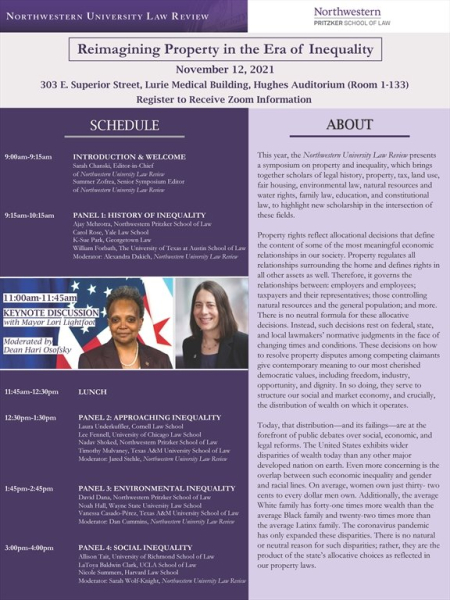
“This year, the Northwestern University Law Review presents a symposium on property and inequality, which brings together scholars of legal history, property, tax, land use, fair housing, environmental law, natural resources and water rights, family law, education, and constitutional law, to highlight new scholarship at the intersection of these fields.”

More information, as well as registration to attend remotely, here.

Nulr_symposium_posterContinue Reading Still Time To Sign Up For Northwestern L. Rev.’s Symposium: “Reimagining Property Rights in the Era of Inequality” (Friday, Nov. 12, 2021)

21a0226p-06

We thought we posted the U.S. Court of Appeals for the Sixth Circuit’s recent opinion in a takings case,  Golf Village North, LLC v. City of Powell, No. 20-4177 (Sep. 23, 2021), earlier, but a search of the blog reveals we did not, so here we go.

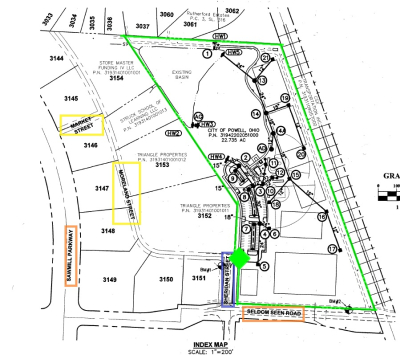
The City built a new 23-acre public park (highlighted in green on the map above), which had been dedicated by the developer, Golf Village North, as a condition of subdivision. A road that led to the one of the park entrances was to be made a public road (blue highlighted). The City’s plans noted that approval of the park construction and opening the blue road to the public were contingent on the City securing easements from Golf Village for public access to the private streets.

The city tried to obtain these easements but Golf Village declined. Notwithstanding the city’s plans required

Continue Reading CA6: City Park Causing Public To Use Private Roads Not A Taking Because Owner Can Erect Roadblock

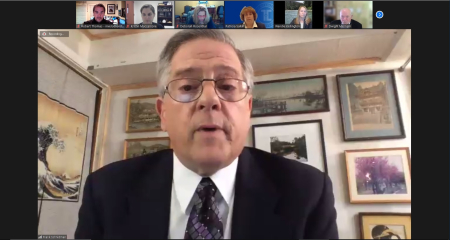
FrankLUI Co-Chair Prof. Frank Schnidman introducing the faculty
Here are the links to the cases and issues that we just finished speaking about at the 35th Annual Land Use Institute (more information on the LUI here). Today was day 1 of a multi-day remote program and the sessions are available ala carte, so there’s still time to join in and learn.

Supreme Court

  • Cedar Point Nursery: the Supreme Court affirms the “keep out” vibe in property law. Yes, there are three “exceptions” to the presumption that any physical intrusion into property is a taking (torts, entries allowed under “background principles,” and legal exactions), but overall a very strong affirmation of property rights.
  • Pakdel v. San Francisco: the “final decision” ripeness requirement in takings cases is “relatively modest” and turns on “de facto” readiness. Yes, it’s a technical requirement, but let’s not get too technical about it.
  • PennEast Pipeline


Continue Reading Links And Materials From Today’s Land Use Institute Takings/Eminent Domain Session

Here’s a new law journal article, just published, which we recommend everyone read.

Michael M. Berger, “Whither Regulatory Takings,” 51 Urban Lawyer 171 (2021). Available online here.

If you need encouragement to read it, here’s a sample:

The thrust of this article is severalfold. First, Holmes was right. His simple conclusion on behalf of eight Justices encapsulated the crux of modern government: while government needs to be able to regulate, zealous regulators can “go too far” and, when they do, regulation becomes a taking. The Constitution drew a line in the sand that may not be crossed without consequences. Second, a cautious Supreme Court thereafter left the Holmesian standard intact and nibbled around the edges, adding alternative descriptors that confused and confounded the situation. Third, the solution to the problem of how to define a regulatory taking lies in the simplicity of the common law. One of

Continue Reading New Article (Must-Read): Michael Berger, “Whither Regulatory Takings”

In case you missed it live, here’s the recording of the recent one-hour program on “The Future of Regulatory Takings at the Supreme Court,” featuring our colleagues Joshua Thompson (Pacific Legal Foundation) and Paul Utrecht (Utrecht & Lenvin, LLP), with Jim Burling (PLF) moderating.

The program discussed Cedar Point Nursery v. Hassid, Knick v. Township of Scott, and Pakdel v. City and County of San Francisco and what might be on the horizon.

If you are a takings nerd, a must-listen.Continue Reading Watch: “The Future of Regulatory Takings at the Supreme Court”

PXL_20210920_195630876

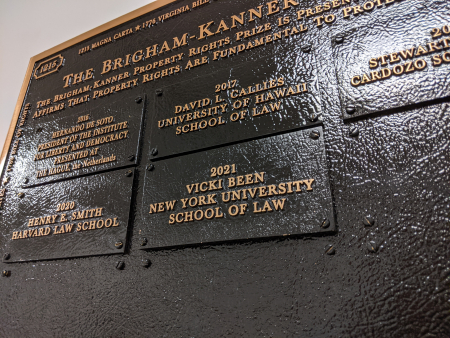
There’s still plenty of time to register and join us for the 18th Annual Brigham-Kanner Property Rights Conference at the William and Mary Law School, Thursday and Friday, September 30 and October 1, 2021.

Yes, you may attend in-person, or remotely. The registration fees are very reasonable, ranging from $0 (yes, free!) to $200 (go here, and click “Tickets” for the details).

This year’s Brigham-Kanner Property Rights Prize winner is Professor Vicki Been (NYU Law). The Conference includes presentations on:

  • Remembering Toby Brigham
  • The Role of Empirical Research in Defining the Scope of Constitutionally Protected Property Rights: A Tribute to Been
  • The Relationship between Eminent Domain and Social and Racial Injustice (this is the panel on which we’ll be presenting)
  • Just Compensation Issues, Changing Public Uses, and Other Recent Developments
  • The Interdependence of Property and First Amendment Rights
  • The Distributional Implications of Land Use Regulation

Details on

Continue Reading 2021 Brigham-Kanner Property Rights Conference (Sep. 30 – Oct. 1, 2021) – Still Time To Join Us

All the topics you want to know about, presented by top-notch faculty from across the nation. Sessions include:

  • Keynote: Do Animals Have Property Rights?
  • Did the Supreme Court Signal a New Direction in Property Rights in Cedar Point Nursery?
  • Maximizing Relocation Benefits: Understanding the Law and Regulations to Ensure Fairness
  • Challenging Public Use: Lessons From a 67-Day Trial
  • COVID Takings
  • Property Rights as Civil Rights
  • Eminent Domain National Update
  • Federal Court and the Daubert Challenge: How to Prepare
  • How to Position Your Client for the Fallout When Projects Don’t Get Built
  • Rural Broadband and the Emerging Constitutional Challenges
  • Are Precondemnation Entry Statutes Still Valid After Cedar Point Nursery?
  • How Condemnor and Property Owners’ Counsel Prepare the Battlefield
  • How Will the Trillion Dollar Infrastructure Bill Impact Your Practice?
  • Ethics
  • …and more, including a full slate of networking and social events!

We’ve sold out the last few years, so don’t Continue Reading Registration Open Now: ALI-CLE Eminent Domain & Land Valuation Litigation Conference, Jan 26-29, 2022, Scottsdale