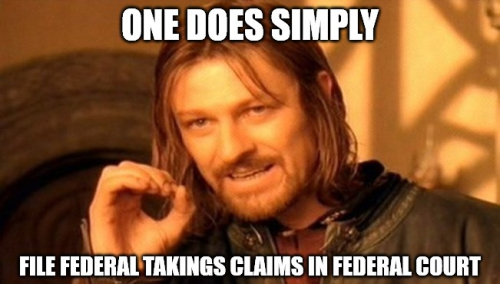
One does knick meme

Property lawyers, dust off your Federal Rules of Civil Procedure, and federal judges your long vacay from dealing with regulatory takings and inverse condemnation cases is over, because this just in: by a 5-4 margin (Chief Justice Roberts authored the majority opinion, with Justice Kagan writing the dissent), the U.S. Supreme Court today finally (finally!) overruled the state-litigation prong of the Williamson County ripeness doctrine. Knick v. Township of Scott, No. 17-647 (June 21, 2019).

Yes, overruled. Not trimmed around the edges. Overruled. 

Here’s what our quick skim turns up as a critical passage:

The Court in Williamson County relied on statements in our prior opinions that the Clause “does not provide or require that compensation shall be actually paid in advance of the occupancy of the land to be taken. But the owner is entitled to reasonable, certain and adequate provision for obtaining compensation” after a taking.

Continue Reading “The state-litigation requirement of Williamson County is overruled.”
A must-read for takings mavens. Property rights gurus Professor Gideon Kanner and Michael Berger have published a new article, The Nasty, Brutish, and Short Life of Agins v. Tiburon, 50 Urb. Lawyer 1 (2019). It’s the lead article in the latest volume of The Urban Lawyer, the law journal of our Section of the ABA, the Section of State and Local Government Law.

Barista’s note: since TUL ended its long-time editorial relationship with UMKC Law School last year, the journal has been published in-house, and we’ve taken on the role of Editor-in-Chief, in-between our lawyering and teaching day jobs. We recognize the efforts of our ABA editor, as well as our team of volunteer Associate Editors (our fellow lawyers who took on the responsibility of tech editing the pieces) in producing the journal. 

Kanner and Berger have written an informative (and entertaining) tour-de-force of modern regulatory takings law.

Continue Reading New Must-Read Article: Kanner & Berger, “The Nasty, Brutish, and Short Life of Agins v. City of Tiburon”

Chicago wants to know where the food trucks it licenses to operate on city streets are. So it conditions the approval of a license on the operator installing a GPS device on the vehicle. 

In LMP Services, Inc. v. City of Chicago, No. 123123 (May 23, 2019), a case decided by the Illinois Supreme Court, the “[p]laintiff contends that the requirement that it install a GPS unit in its food truck and transmit its location to a service provider constitutes a warrantless search in violation of the Illinois Constitution.” Slip op. at 11. 

The court disagreed: food trucks are a highly-regulated business, and the government has a “substantial interest” in the ability to know where they are. You have to know where they are in order to inspect them, just like “brick and mortar” restaurants.

What about that case in which the U.S. Supreme Court held it was a

Continue Reading It’s Not A Physical Intrusion On Property Rights To Condition Roach Coach License On GPS Installation

0412191003c_HDR

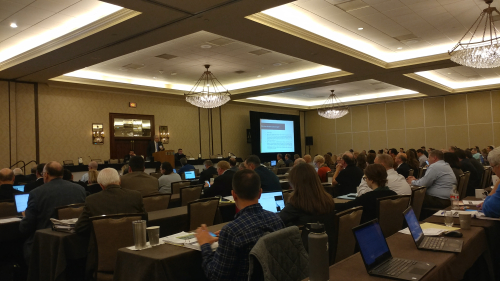
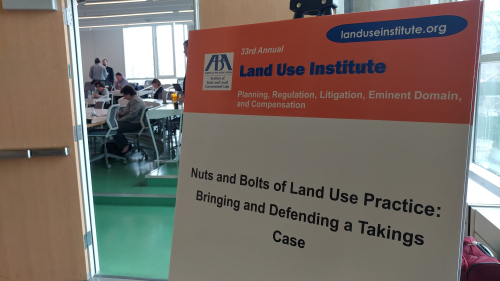
Here are the links from today’s two sessions (the first, federal water issues impacting local land use; the second, Bringing and Defending a Takings Case):

The morning started off with a talk by former Detroit Mayor (and Michigan Supreme Court justice) Dennis Archer, about Poletown, eminent domain, and economic

Continue Reading Links And Materials From Today’s Land Use Institute Sessions, Baltimore

Photoskidrow

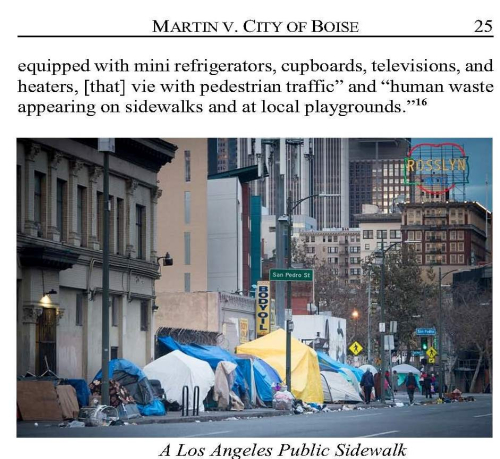
As we’ve noted before, the growing homeless and “urban camping” situation seems to be getting worse, and in our perception is reaching the point of being intractable. A trip down the sidewalk of any major city  — if you dare, particularly in the west — will confirm. And there are no easy answers, except maybe “get used to living with it.” Nor is there a consensus whether the law can do anything to remedy the problem.  

The Ninth Circuit’s latest foray into this area, this order denying rehearing and rehearing en banc of a panel opinion in a case out of Idaho, confirms. The case is a challenge to Boise’s ordinance under the Eighth Amendment’s prohibition on cruel and unusual punishments. The panel concluded that the city could not prosecute people for sleeping outside on public property because they have nowhere else to go. Until the

Continue Reading Ninth Circuit: Local Governments Cannot Enforce 24/7 Ban On Sleeping Or Camping On The Sidewalk If Nowhere Else To Go

Pretty simple facts in the North Dakota Supreme Court’s opinion in Lincoln Land Development, LLC v. City of Lincoln, No. 20180117 (Mar. 15, 2019): back in the day (the 1980’s) the City had a dirt road over private property, used to access its sewage treatment plant. Lincoln Land Development bought the property in 2005. Recently, the City graded and paved the road, raised the road bed, and added things like culverts.  

Inverse condemnation? 

The City denied liability, arguing that Lincoln Development didn’t have the right to exclude the City because the City owned an easement — either by express grant, or by implication or estoppel — and thus Lincoln Development didn’t possess property that the City had taken. 

The most interesting part of the North Dakota Supreme Court’s opinion, in our opinion, starts on page 5, where the court discusses the easement by prescription claim (after having agreed with

Continue Reading ND Supreme Court Rejects City’s Claim That “We Already Own The Property By Prescriptive Easement So Are Not Liable For A Taking”

0401191044b_HDR

Great crowd today in Austin for CLE International’s Eminent Domain seminar, co-chaired by our colleagues Chris Clough, Sejin Brooks, and Christopher Oddo. We spoke about “National Trends and Developing Issues in Eminent Domain.” 

Here are the cases I referred to which are not included in your written materials:


Continue Reading Materials And Links From Today’s Austin Eminent Domain CLE

We’ve been meaning to post the U.S. Court of Appeals for the Eleventh Circuit’s opinion in Hillcrest Property, LLP v. Pasco County, No. 16-14789 (Feb. 13, 2019), mostly because of the provocative way it starts off: 

The question before us is whether a litigant in this Circuit has a substantive-due-process claim under the Due Process Clause of the Fourteenth Amendment when the alleged conduct is the unlawful application of a land-use ordinance. The answer to that question is a resounding “no”—an answer that this Court delivered in McKinney v. Pate, 20 F.3d 1550 (11th Cir. 1994) (en banc), 24 years ago and has reaffirmed ever since. We held in McKinney that executive action never gives rise to a substantive-due-process claim unless it infringes on a fundamental right. A land-use decision is classic executive, rather than legislative, action—action that, at least here, does not implicate a fundamental right under

Continue Reading 11th Cir: The Use Of Land Isn’t A Fundamental Right, Even If “What happened to [the owner] here was pretty doggone s[tink]y.”

Header image LUI 2019

Come join us at the 33rd Annual Land Use Institute, in Baltimore, Maryland, April 11-12, 2019.

As the brochure notes:

This Annual Land Use Institute program is designed for attorneys, professional planners, and government officials involved in land use planning, zoning, permitting, property development, conservation and environmental protection, and related litigation. It not only addresses and analyzes the state-of-the-art efforts by government to manage land use and development, but also presents the key issues faced by property owners and developers in obtaining necessary governmental approvals. In addition, the entire approach of the program is to provide practice pointers that give immediate “take home value” by focusing on topics relevant to the average practice of the attendee.

The keynote will be delivered by Dennis Archer, former mayor of Detroit (and former Justice of the Michigan Supreme Court, and former President of the ABA), speaking about “Detroit’s New GM Plant from

Continue Reading 33rd Annual Land Use Institute: Baltimore April 11-12, 2019

It’s easy when legal cannabis or medical marijuana is involved to make a joke.

But (for now) we’ll resist that temptation and simply tell you about a webinar our colleagues at the American Planning Association are putting on about our favorite thing … Land use law. (What did you think we might say?)

Thursday, March 21, 2019 from 2:00 – 3:30pm, ET is where you want to be:

This webinar will explore how various land use and natural resource regulations shape the development of the legal cannabis industry. The scope of the conversation will range from regulatory options municipalities may consider as the legal cannabis industry develops to how individual businesses are fostered or stifled as a result of certain regulations. One goal of this webinar is to help practitioners identify key cannabis industry issues they should consider in working with either government officials or business owners.

More information including

Continue Reading Upcoming Webinar: How Land Use and Natural Resource Regulations are Shaping the Legal Cannabis Industry