Space is filling up, but there’s still time to join us later this month in Detroit for the 32nd Annual Land Use Institute (April-19-20). 

We’ll let program Planning Chair Frank Schnidman explain all the reasons why, and we’ll add only these points: (1) it’s a very good program that won’t take much of your time (fly in for the Thursday afternoon program, stay a night, fly home on Friday evening); (2) Detroit is the place to be these days; and (3) it’s one of the best deals in CLE credits, with tuition as low as $400.

2018 Land Use Institute Brochure Detroit 5 2018

Continue Reading There’s Still Time To Join Us In Detroit: 32d Annual Land Use Institute
We don’t usually post up trial court rulings, preferring to wait until the issue percolates up through the food chain. But this one is an exception, because, well, it’s darned interesting, and we wanted to get you all on board on the ground floor.

Here’s the trial court’s order granting the plaintiffs/property owners summary judgment in the case challenging the City of Seattle’s “first in time” ordinance, under which the city established the criteria for screening tenants, and required property owners to accept the first qualified applicant as a tenant.  The city acknowledged that the ordinance “affects a landlord’s ability to exercise discretion when deciding between potential tenants that may be based on factors unrelated to whether a potential tenant is a member of a protected class.” Slip op. at 2-3. The goal was to “eliminat[e] the role of implicit bias.”

In short, because a property owner might have an

Continue Reading Seattle’s “First in Time” Tenant Rule Is A Taking

Here’s what we’re reading this Thursday:

Cert(s) Denied

California Wildfires and Inverse Condemnation


Continue Reading Thursday Round Up: Cert(s) Denied, Cal Wildfires, City-to-City Takings, Other Stuff

Verdictform

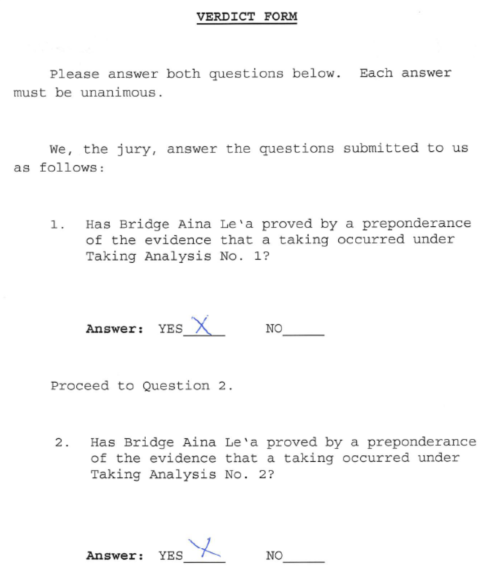
As we reported here, the U.S. District Court for the District of Hawaii just finished a jury trial in a regulatory takings case (removed by the defendant State of Hawaii from Hawaii courts) involving a stalled development on the Big Island.

The jury has returned a verdict after 8 days of trial, concluding the State is liable under both Lucas and Penn Central theories, after only 15 minutes of deliberation after their lunch break. 

But there’s more to this story, because here’s the buried lede. The court yesterday made this entry in the docket: 

EO: The court proposes to enter an order awarding nominal damages of $1 to the plaintiff and then to enter judgment in this case. This will start the running of the clock not only for appeal but also for requests for fees and costs under Local Rule 54.3. If the parties have concerns about this

Continue Reading Lunch And 15 Minutes: Federal Jury Finds State Land Use Commission Liable For Lucas And Penn Central Taking

IMG_3082

This fall, I’ll be teaching a new course at the William and Mary Law School in Williamsburg, Virginia.

Here’s the description of Property Rights: Law and Theory (Law 608) from the course catalog:

Property rights and property theory have been essential components of Anglo-American law for centuries, and the protection of the right of private property ownership is one of the foundations on which the U.S. Constitution, the Bill of Rights, and the post-Civil War Amendments are built. In more recent times, however, property law has taken on a new role, and has been viewed differently than in the past, especially in light of the development of environmental law and the evolving concept of public trust.

Property Rights Law and Theory will focus on the history, policy, and, to some extent, the politics of property law, property rights, and related legal topics. We will examine how the right of

Continue Reading The Paper Chase Is On!

Remember the Tom Cruise/Steven Spielberg flick Minority Report? That’s the one based on Philip K. Dick’s short story in which the police force’s PreCrime unit can presage that a citizen will violate the law in the future, so they arrest him now even though he has committed no crime. 

That’s the same vibe we get from the recent oral arguments in a case in which the Hawaii Supreme Court is being asked to resolve two fundamental questions in the latest case involving the Thirty Meter Telescope up on the top of the Big Island’s Mauna Kea.  

First, whether someone can possess a cultural property interest in publicly-owned land. Flores, a native Hawaiian, asserted he had such an interest in the land on which the telescope is planned. Second, if so, whether the State land agency’s consenting to the University of Hawaii’s sublease of that land to the TMT puts Flores’ interests

Continue Reading Department Of Precrime: HAWSCT Considers Cultural “Property” In Public Land

Emotionheader

Here’s the printable brochure with the details on the 32nd Annual Land Use Institute in Detroit, April 19-20, 2018. We’ve plugged the program before so we won’t do so again, except to say that you really should attend because (1) it’s a very good program that won’t take much of your time (fly in for the Thursday afternoon program, stay a night, fly home on Friday evening); (2) Detroit is the place to be these days; and (3) it’s one of the best deals in CLE credits, with tuition as low as $400.

2018 Land Use Institute Brochure Detroit 5 2018

Continue Reading April 19-20, 2018: Land Use Institute, Detroit (Printable Brochure)

For those of you who have not recently attended the ALI-CLE Eminent Domain and Land Valuation Litigation Conference (just wrapped in Charleston, planning Palm Springs 2019), here’s a small sampling of the kind of thing we do.

It’s U. Virginia lawprof Molly Brady talking about the U.S. Supreme Court’s regulatory takings decision in Murr v. Wisconsin, in the session she shared with John Groen (the Murrs’ Supreme Court counsel). A really informative session, and these clips only give a small taste. More here, from ALI-CLE, including links to the on-demand video sessions we recorded in Charleston.  

And it’s not too early to mark your calendars for Palm Springs, January 24-26, 2019. Stay tuned here for further details as they become available. 

Continue Reading Professor Molly Brady On Murr – Video Clips From The ALI-CLE Eminent Domain Conference

The last time the U.S. Supreme Court faced Williamson County in a merits case, the property owners made the mistake of not challenging that case’s “state procedures” requirement directly. An exchange with Justice O’Connor went like this; from the transcript:

Justice O’Connor: And you haven’t asked us to revisit that Williamson County case, have you?

Mr. Utrecht: We have not asked that this Court reconsider the decision in Williamson County.

Justice O’Connor: Maybe you should have.

Ouch.

But fool me once, shame on you; fool me twice…we won’t get fooled again!

This time, therefore, no mistake: the owners raised a challenge to Williamson County squarely, and as a result, there may now be a light at the end of the very bizarre ripeness tunnel that has mostly kept federal courts from reviewing claims that the U.S. Constitution has been violated.

This morning, the Court agreed to hear a case

Continue Reading New Cert Grant: Overrule Williamson County’s Exhaustion Of State Procedures Requirement?

ZPLR front page

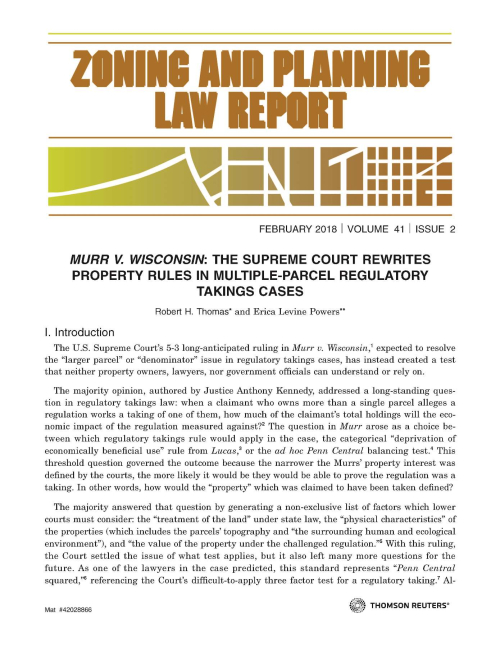
Here’s an article (“Murr v. Wisconsin: The Supreme Court Rewrites Property Rules in Multiple-Parcel Regulatory Takings Cases“), which we authored along with a colleague, published in February 2018’s Zoning and Planning Law Report, about the U.S. Supreme Court’s decision in Murr v. Wisconsin, the case about the “larger parcel” in regulatory takings.

As you might predict, we concluded that the Murr majority’s analysis was vague, unsatisfying, and generally not helpful. Strong letter to follow!

Here’s a passage from the Introduction:

The U.S. Supreme Court’s 5-3 long-anticipated ruling in Murr v. Wisconsin, expected to resolve the “larger parcel” or “denominator” issue in regulatory takings cases, has instead created a test that neither property owners, lawyers, nor government officials can understand or rely on.

The majority opinion, authored by Justice Anthony Kennedy, addressed a long-standing question in regulatory takings law: when a claimant who owns more

Continue Reading New Article: Murr And Other “Blurred Lines”