After the Supreme Court’s decision in Lingle v. Chevron U.S.A., Inc., 544 U.S. 528 (2005), whether a government action “substantially advances a legitimate state interest” — for a long time assumed to be a takings question under Agins — found a new home in the the Due Process Clause.  

Here’s the recently-filed cert petition, asking the Court to review a ruling by the Washington Court of Appeals

Questions Presented:

A Jefferson County, Washington, ordinance requires that all shoreline property owners dedicate, as a condition on any new development permit, a 150-foot conservation buffer purported to protect the marine environment from impacts like storm water runoff. The legislative record, however, contains findings that the government could not determine the need for, or the effectiveness of, a buffer without first considering site-specific factors and the specific development proposal.

The questions presented are:

1. Whether property rights are fundamental rights, such

Continue Reading “New” vs “Old” Property – New Cert Petition Asks, Is Right To Use Property “Fundamental?”

Little Pink House, the feature film about the Kelo v. City of New London case is in general release, and is now scheduled for a special screening in Honolulu in June.

Mark two dates on your calendar:

  • June 4, 2018: This is the deadline to buy your ticket. The way this works is that if a critical mass of tickets are presold, the screening is a go. If for some reason not enough tickets are sold by June 4, you get a refund. No lose. So buy your ticket here, right now.
  • June 11, 2018: The date of the screening. It will start at 6:30pm, at the Consolidated Theatres Kahala 8 (convenient, plus plenty of parking). Easy. 

We’ve seen the film (full review coming soon). It is a compelling piece, and very accurate to the real story (with a few concessions to the art form, of course).

If

Continue Reading Coming Attraction: Little Pink House (Honolulu, June 11, 2018, 6:30pm)

Here’s what we’re reading today:


Continue Reading Monday Readings: South Africa Takings, Redevelopment, Metes and Bounds, And More

18730910_303

Here’s the not unexpected decision from the U.S. Court of Appeals for the Ninth Circuit in a case we’ve been following (sort of). It should never have gotten this far, even as the “plaintiffs” raise the specter of a cert petition.

We say again: the federal courts seem to have time for this brand of nonsense, but when it comes to land use and takings cases, they won’t be “super zoning boards of appeals,” and almost always refuse to give them the time of day. At least PETA didn’t make a takings claim and further hose up the law. 

Once again, Dr. Zaius could not be reached for comment.

Rock on, Naruto.

Naruto v. Slater, No. 16-15469 (9th Cir. Apr. 23, 2018)

Continue Reading 9th Cir: “Ape Shall Not Sue Ape!” Court Has Time For Silly Monkey Selfie Case, But Not For Takings

IMG_2947
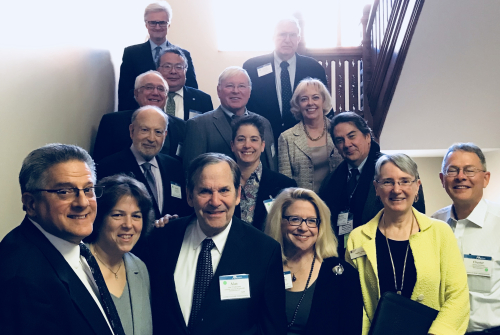
Some of the Land Use Institute faculty, including (front row left), Planning Chair Frank Schnidman and Planning Co-Chair Patty Salkin

Last Friday at the 32nd Annual Land Use Institute in Detroit, I was honored to moderate a freewheeling discussion by a panel of takings experts, Professor Steven Eagle, Minnesota lawyer Howard Roston, and Michigan’s own Alan Ackerman on “Takings, Eminent Domain, and Vested Rights.”

Here are the cases and other materials we discussed, as well as a few others which we did not have time to cover (but wish we could have):


Continue Reading Cases And Materials From The Takings And Eminent Domain Session At The Land Use Institute

Do we really need to tell you how a rent control regulatory takings claim fared in the Ninth Circuit? We didn’t think so.

In Colony Cove Properties, LLC v. City of Carson, No. 16-562655 (Apr. 23, 2018), a three-judge panel reversed a district court jury verdict which concluded that the City was liable for a Penn Central regulatory taking for the mobilehome Rent Board’s setting of a rent increase artificially low. The total award to the park owner, including damages for lost rental income, attorneys’ fees, and interest, was over $9 million. 

As we wrote in this post, the city and its amici predictably went ballistic and argued that the upholding the verdict threatened the very existence of mobilehome rent control. The court concluded that as a matter of law, the owner failed each of the three Penn Central factors.

First, the owner did not prove that the

Continue Reading 9th Cir: City Rent Board Determining Owner “Made Enough” Profit Isn’t A Penn Central Taking

20180419_150416_HDR

We’re in Detroit the rest of the week at the Mercy Law School for the venerable Land Use Institute, now in its 32nd iteration.

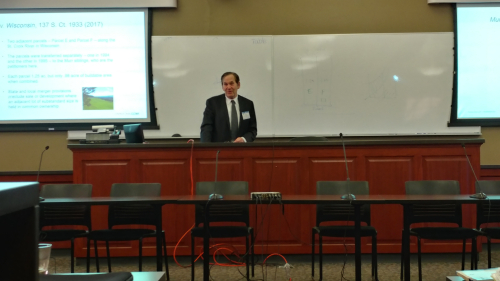
Planning Chair Frank Schnidman has assembled a great faculty including out Detroit colleague Alan Ackerman (above, talking about takings liability for flooding), and we’ll be spending the time talking inverse condemnation, public trust, planning law, homelessness, autonomous vehicles, affordable housing, RULIPA, and similar topics. We’ll be presenting on “Eminent Domain, Vested Rights, and Regulatory Takings,” “Client Representation: Developer, Government, and Citizens Groups,” and “Federal Laws Affecting Local Land Use Decision Making.” 

If you are here with us in Detroit, stop by and say hello. If you aren’t here, shame on you! This is one of the best and most affordable tuition deals in CLE.

But all kidding aside, if you are not in Detroit now, be sure to calendar these

Continue Reading Land Use Institute – Detroit

Today’s case is one of what we call “regionally classic” cases that we come across from time to time. You know, cases that just fit into all your preconceived notions about a place. Beach cases from Hawaii. Gator law opinions from Southern states. Vermont = snow law, California, land and wineries. Here’s another one of those from our Southern courts — Florida’s District Court of Appeals, to be precise — that we think fits the bill.

In Florida Fish and Wildlife Conservation Comm’n v. Daws, No. 1D16-4839 (Apr. 10, 2018), the First District Court of Appeals held that owners whose properties were physically invaded by “deer dog hunters and their dogs during the forty-four days of the year when deer dog hunting is authorized” by the Commission, have not suffered a taking because these invasions were only temporary, and “do not rise to the level of permanent

Continue Reading Fla App: That Takings Dawg* Don’t Hunt: Sporadic Trespass By Deer Dog Hunters (And Their Dogs) Isn’t A Permanent Physical Occupation

Sterk_475

The William and Mary Law School has announced the recipient of the 2018 Brigham-Kanner Property Rights Prize, Cardozo School of Law Professor Stewart E. Sterk.

He will receive the prize at the 15th Annual B-K Conference in Williamsburg, October 4-5, 2018

Sterk’s publications span a wide variety of areas, ranging from property and land use regulation to trusts and estates, copyright, and the conflict of laws. A member of the American Law Institute, he served as an advisor in the preparation of the Restatement (Third) of Property (Servitudes). He has co–authored casebooks on Trusts and Estates and on Land Use, and he also edits the New York Real Estate Law Reporter, a monthly newsletter published with the assistance of Cardozo students.

He joins an impressive list of legal scholars and practitioners as prizewinners, including Frank Michelman, Richard Epstein, James Ely, Carol Rose, Michael Berger, and David

Continue Reading 2018 Brigham-Kanner Prize Announced: Professor Stewart E. Sterk, Cardozo Law