


Here’s the second amicus curiae brief supporting the the cert petition in Arrigoni Ent., LLC v. Town of Durham, No. 15-631 (cert. petition filed Nov. 10, 2015). (Here’s the first.) 

This brief was filed by the Institute for Justice, and authored by Supreme Court takings maven Michael Berger:

1. It is time for the Court to reconsider Williamson County’s state court litigation prong, which requires state court confirmation that there is no state remedy for a governmental taking of property. Only then will a 5th Amendment claim be “ripe” for federal court litigation. The premise of that rule goes beyond the plain language and meaning of the 5th Amendment. A municipality’s taking of private property without just compensation is complete when property is taken and compensation is not paid by the government. It does not require a judicial determination to complete, or ripen, the taking.

Continue Reading Amicus Brief: You Guessed It – Reconsider Williamson County
Here’s the first in a series of amicus briefs we’re going to post which urge the Supreme Court to grant the cert petition in Arrigoni Ent., LLC v. Town of Durham, No. 15-631 (cert. petition filed Nov. 10, 2015). 

This amicus brief was filed by the Cato Institute, and like the petition, asks the Court to take the case in order to reconsider Williamson County‘s “state procedures” rule:

This case presents an opportunity for this Court to rectify a significant anomaly in its jurisprudence: the blanket exclusion from federal court of numerous constitutional rights cases arising under the Takings Clause of the Fifth Amendment. Under this Court’s decision in Williamson Cty. Reg’l Planning Comm’n v. Hamilton Bank of Johnson City, 473 U.S. 172 (1985), a property owner’s claim that a state government has taken his property without paying “just compensation,” as required by the Takings

Continue Reading Amicus Brief: Reconsider Williamson County’s “State Procedures” Requirement

Here’s the first in a series of posts we’re going to put up, with the cert petition and the supporting amici briefs (ours included) in Arrigoni, Ent., LLC v. Town of Durham, No. 150631 (petition filed Nov. 10, 2015).

In that case, the Second Circuit in a two-sentence ruling, summarily affirmed the District Court’s dismissal of Arrigoni’s regulatory takings claim under the “state procedures” prong of Williamson County, because the property owner “failed to ‘seek compensation through the procedures the State has provided for doing so.'” Slip op. at 2.

The petition poses these Questions Presented:

1. Whether the Court should reconsider, and then overrule or modify, the portion of Williamson County Regional Planning Commission v. Hamilton Bank of Johnson City, 473 U.S. 172, 194 (1985), barring property owners from filing a federal takings claim in federal court until they exhaust state court remedies, when this rule results

Continue Reading Cert Petition: Overrule Williamson County!

Here’s a case we’ve been following for quite a while, waiting for the opinion to drop.

And now it has. In State v. Palama, No. CAAP-12-0000434 (Dec. 11, 2015), the Hawaii Intermediate Court of Appeals, in an unpublished memorandum opinion, upheld the trial court’s dismissal of criminal trespass charges against a fellow who asserted that his unpermitted entry on private property was privileged because he was exercising his traditional and customary native Hawaiian right to hunt feral pigs.

Pig hunting in this case involved dogs and a knife, not guns. For more on this practice, see this 2013 New York Times story (“Hunting Pesky Pigs in Paradise“). For more on the background of the case and the arguments, see the opinion, this post from the KauaiEclectic blog, or the briefs of the parties and amici filed in the ICA:


Continue Reading Strategic Nonpublication By The Court Of Appeals: Pig Hunting Is A Traditional And Customary Hawaiian Practice (In This Case)

Space. The final frontier. These are the voyages of the telescope Thirty Meter. Its five year continuing mission: to explore strange new worlds. To seek out a Conservation District Use Permit from the Board of Land and Natural Resources, and navigate the treacherous waters of Hawaii administrative law. To boldly go where twelve other telescopes have gone before

The “the cart before the horse,” is what the majority opinion authored by Chief Justice Recktenwald which invalidated the CDUP held the BLNR did when it “issued the permit before the contested case hearing was resolved and the hearing was held.” But the same might be said about the court’s procedural due process reasoning, because it could have reached the same result by employing a much narrower — and in our view, a much less opaque — statute-based rationale.

Dead Man Walking

Ironically — given the huge public interest in the

Continue Reading Carts Before Horses, And Pearls Before Swine: The Hawaii Supreme Court’s Fractured Rationale For Invalidating The TMT Permit

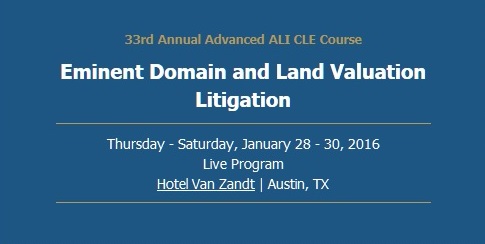
Here’s the recently-published brochure with more details about the ALI-CLE Eminent Domain and Land Valuation LItigation conference, set for Austin in January 2016. 

In the coming days and weeks, we’ll be posting more details about the conference. Our co-planning chairs Joe Waldo, Jack Sperber, and Andrew Brigham have assembled a great agenda, taught by the usual stellar faculty. If eminent domain, appraisal, or land use is your thing, you really should attend. 

33d Annual ALI-CLE Eminent Domain and Land Valuation Litigation Conference, Jan. 28-30, 2016, Austin, TX

Continue Reading ALI-CLE Eminent Domain And Land Valuation Conference: Full Brochure

“Waikiki” means a lot of things to a lot of people. With its wall-to-wall high rises, it could be Las Vegas-by-the-Sea. Or the site of the most famous beach in Hawaii, if not the world. A place where impossibly tony shops and kitsch exist side-by-side. Where the “Hawaiian” bric-a-brac is imported from the Phillipines and China, and the beach sand is reputed to be Australian. A place to go, and a place to escape from

But whatever Waikiki might be, one thing is certain: it no longer has just two hotels as it once did, nor is it a sleepy agricultural backwater. It is the economic engine that drives Hawaii’s tourist economy, and the visitor destination, where one-third of our tourists end up. Even with these contradictions — or perhaps because of them — the ordinance which controls development within the Waikiki Special District requires consideration

Continue Reading What Does “Waikiki” Mean? – Variances, Safety Valves, And A “Hawaiian Sense Of Place”

Here’s the amici brief we filed today in California Building Industry Ass’n v. City of San Jose, No. 15-330 (Oct. 16, 2015).

That’s the case in which the California Supreme Court upheld the city’s “affordable housing” requirement against a challenge which asserted that it was an exaction and thus should have been subject to the heightened scrutiny of the unconstitutional conditions doctrine of Nollan, Dolan, and Koontz. The California court disagreed, holding that because the ordinance did not require a developer to give up land, or money in lieu of land, it was a mere zoning restriction and subject to the “rational basis” test. 

CBIA filed a cert petition, and our brief (filed on behalf of the National Federation of Independent Business Small Business Legal Center and the Owners’ Counsel of America) agrees that the Court should review this case. We argue that even though

Continue Reading Amici Brief In SCOTUS Affordable Housing Case: Prohibiting Homebuilders From Selling At Fair Market Value For 55 Years Is A Taking

Here are some upcoming events in which you may be interested, in chronological order:


Continue Reading Upcoming Events And CLE’s – Appellate, RLUIPA, Sharing Economy, And More

ALI-CLE-2016-masthead

Here’s the full agenda for the 2016 Eminent Domain and Land Valuation Litigation / Condemnation 101 Conference, January 28-30, 2016, in Austin, Texas. 

Together with our friend and colleague Joe Waldo, we think we’re put together a pretty good program that covers a lot of ground. This is the first time the conference has been to Austin, and we’re starting off with a talk by Austin Mayor Steve Adler, who in his former life was an eminent domain lawyer. Other highlights:

  • Professor Ilya Somin will speak about his recently-published book in a segment entitled “The Impact of Kelo and the Limits of Eminent Domain.”
  • Pipelines and Energy Corridors: Valuation Perspectives of Condemnors and Condemnees” with the lawyers on the front lines of one of the hottest topics in eminent domain law nationwide.
  • Retired Minnesota Supreme Court Justice Paul H. Anderson will give us his tips


Continue Reading It’s Here – 2016 ALI-CLE Eminent Domain Conference: Complete Agenda, Faculty, Registration Information