Check out City of Kemah v. Crow, No. 01-23-00417-CV (July 25, 2024), from the Texas Court of Appeal (First District).

This is yet another takings ripeness case — here, the so-called “final decision” requirement — the second recent opinion on this issue from the Texas court. SeeFinal Decision Takings Ripeness Is Based On All Circumstances, Not Hard-And-Fast Requirements (Read That Again: A Factual Question)” for our write-up of the other case.

In this one, the owner asserted that the city issued her a building permit for her “barndominium” and and two other structures to be used as short-term rentals, but later issued a stop work order. This resulted in a Penn Central taking, she asserted.   

The city sought ripeness dismissal, asserting the owner didn’t actually have a permit issued by the city council as its ordinances require. The owner didn’t have the actual

Continue Reading Relying On Complaint’s Allegation That City Issued A Permit As Confirmed By Chief Building Officer Email, Texas App Holds Takings Claim Ripe Even Though City Said Council Must Issue Permits

Check out this decision, entered by a Rhode Island Superior Court (a general jurisdiction trial court) denying the State’s motion for summary judgment. The court concluded that a recently-adopted statute shifting the boundary between public and private property on RI’s beaches is a taking.

We won’t be commenting in too much detail because this is one of ours (PLF colleague Dave Breemer represents the plaintiffs). But here’s what you need to know:

  • Until recently, RI law used the high water mark (mean high-tide line) as the boundary between the public beach and private property.
  • In 2023, the RI Assembly adopted a statute that redefined that boundary, and moved it shorewards to where “the land held in trust by the state for the enjoyment of all of its people ends and private property belonging to littoral owners begins.”
  • As a consequence, the public may enter and use “where


Continue Reading Statute Allowing Public To Access Formerly Private Portions Of Rhode Island Beaches Is A Taking

Screenshot 2024-07-14 at 09-00-18 Sheetz v. County of El Dorado Legislatures Must Comply with the Takings Clause by Brian T. Hodges Deborah La Fetra SSRN

Check this out: our Pacific Legal Foundation colleagues (Brian Hodges and Deborah La Fetra we on our Sheetz SCOTUS team), have posted a new scholarly piece on SSRN, “Sheetz v. County of El Dorado: Legislatures Must Comply with the Takings Clause.”

Here’s the Abstract:

For more than 30 years, the Supreme Court has recognized that building permit conditions requiring a dedication of property to the public implicate the Fifth Amendment’s Takings Clause and are therefore subject to the unconstitutional conditions doctrine as set out by Nollan v. California Coastal Commission, 483 U.S. 825 (1987), and Dolan v. City of Tigard, 512 U.S. 374 (1994). But for nearly as long as the Nollan/Dolan doctrine has been in place, state and lower federal courts have divided on the foundational question of whether the doctrine applies equally to all branches of government, or if it applies only to administrative

Continue Reading New Article – “Sheetz v. County of El Dorado: Legislatures Must Comply with the Takings Clause” (Brian Hodges & Deb La Fetra)

Check out this decision, entered by a Rhode Island Superior Court (a general jurisdiction trial court) denying the State’s motion for summary judgment. The court concluded that a recently-adopted statute shifting the boundary between public and private property on RI’s beaches is a taking.

We won’t be commenting in too much detail because this is one of ours (PLF colleague Dave Breemer represents the plaintiffs). But here’s what you need to know:

  • Until recently, RI law used the high water mark (mean high-tide line) as the boundary between the public beach and private property.
  • In 2023, the RI Assembly adopted a statute that redefined that boundary, and moved it shorewards to where “the land held in trust by the state for the enjoyment of all of its people ends and private property belonging to littoral owners begins.”
  • As a consequence, the public may enter and use “where


Continue Reading Statute Moving The Public/Private Beach Boundary Shoreward Is A Taking

Today at 10am Hawaii Time (1pm PT/4pm ET), the Hawaii Supreme Court will hear oral arguments in a case asking whether a 1922 deed restriction imposed by the Territory of Hawaii on a land patent conveying fee simple title to a private owner, subject to the land always being used for “church purposes” (i.e., a fee simple determinable) void under either the Hawaii Constitution’s Establishment Clause, the U.S. Constitution’s Establishment Clause, or a Hawaii statute declaring that “[e]very provision in … a written instrument relating to real property that purports to forbid or restrict the conveyance … to individuals because of .. religion” is void? 

Here’s how the Judiciary’s web site describes the case:

In 1922, the Territory of Hawai‘i sold property to Heber J. Grant, trustee for the Church of Jesus Christ of Latter-Day Saints, pursuant to a Land Patent.  The Land Patent contained a restriction requiring

Continue Reading Argument Preview: Is Gov’t Imposed “Church Purposes” Deed Restriction Void?

DJK was adding a bedroom to an existing residence and needed a wastewater permit from Vermont’s environmental agency. The agency has a “presumptive isolation zone” around potable water supplies and septic systems in which a property owner is presumed to be barred from doing anything sewage related. In this case, the isolation zone for DJK’s property crossed over onto the property of their neighbors, the Crowleys.

The agency granted DJK the permit, which contained a provision that not only no sewage-related construction could take place in the isolation zone, but that “[n]o buildings” could be construction which “might interfere with the operation of a wastewater system or potable water supply[.]” Remember, the isolation zone was located partially on the Crowley property.

The Crowleys were not very appreciative, so appealed (to a Vermont trial court sitting as the Environmental court). They argued that the permit was invalid because it worked a

Continue Reading Vermont: Environmental Court Doesn’t Have Jurisdiction To Determine Property Rights, But We’re Going To Find No Cedar Point Taking Anyway

Screenshot 2024-06-12 at 16-43-41 California Courts - Appellate Court Case Information Screenshot 2024-06-12 at 16-43-31 California Courts - Appellate Court Case Information

Disclosure: this one is one of ours, so we’re not going to do a deep dive or do much commentary (must resist!).

Yesterday, the California Supreme Court granted a Los Osos property owner’s petition, and agreed to review an (unpublished) Court of Appeal opinion which held that the California Coastal Commission has the authority to appeal (to itself!) the County of San Luis Obispo’s decision to grant Shear a Coastal Development Permit to build a handful of homes in the coastal zone.

The County has adopted a Local Coastal Program ordinance regulating development in the coastal zone in the County. Under the California Coastal Act, a municipal government adopting a LCP delegates to the municipality to authority to make these type of land-use permitting decisions, with a very limited window for the Commission to inject itself. The point of the Coastal Act is to maintain

Continue Reading California SCT To Review Major Challenge To Coastal Commission’s Claimed Power To Overrule Local Govt’s Housing Approvals

Here are three federal circuit opinions, all unpublished. None of them worthy of a stand-alone post, but also not to be overlooked entirely.

  • GHP Management Corp. v. City of Los Angeles, No. 23-55013 (9th Cir. May 31, 2024): Lessors “failed to state a claim for a Fifth Amendment per se physical taking[,]” in their challenge to LA’s eviction moratorium. You know why: you waived your right to exclude by renting your properties, so the government prohibiting you from getting breaching tenants out is merely a regulation of the landlord/tenant relationship. Yee.
  • Innova Investment Group, LLC v. Village of Key Biscayne, No. 21-11877 (11th Cir. May 29, 2024): After the Village tagged Innova with a NOV and $4k fine for not obtaining an interior demolition permit and Innova failed to correct the violations within the 60-day deadline, the Village imposed $4k per day fines and “aggregate penalties of


Continue Reading Unpublished Wednesday: Eviction Moratorium Taking, Excessive Fines Taking, And 1983 Zoning Statutes Of Limitations

IMG_20170323_143119 (Medium)

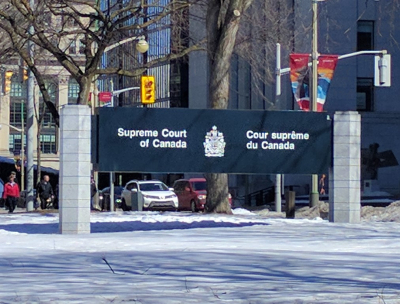
Readers know that from time-to-time, we like to cover the going’s on in the courts of our neighbors to the north. See here and here, for example. Although property rights are not a constitutional principle in Canada (the people did not include property as a fundamental constitutional right when the Constitution was amended last), there’s a lot for U.S. lawyers to learn from the way Canada law treats those from whom the government must expropriate property (either directly, or in what they call “de facto” or constructive takings (i.e., regulatory takings and inverse condemnation). In some ways, their system treats property owners slightly better than our constitutional system.

Well, here’s the latest in a case we’ve been following.

In St. John’s (City) v. Lynch, 2024 SCC 17 (May 10, 2024), the Supreme Court held that compensation in a de facto taking is calculated by excluding

Continue Reading La Cour suprême du Canada: In Constructive Takings, Compensation Calculated Without Reference To “The Scheme”

1000002646

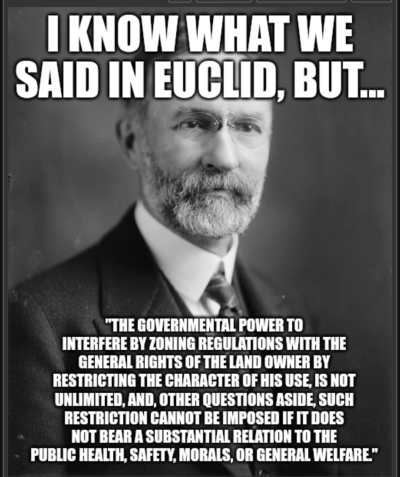
It was on this day in 1928 when the U.S. Supreme Court issued its second most famous decision about zoning, Nectow v. City of Cambridge., 277 U.S. 183 (1928). 

We say “second” because everyone knows that the first is the Court’s decision issued just two years earlier which generally upheld comprehensive use, height, and density regulations as a valid exercise of the government’s police power to regulate property uses to further the public health, safety, welfare, or morals. See Village of Euclid v. Ambler Realty Co., 272 U S. 365 (1926). 

Partly because of the hype surrounding Euclid and the broad governmental embrace of exclusionary land use policies that Euclid unleashed, we think that Nectow has not received the attention it is due. After all, it should be seen as the companion case to Euclid: it was authored by same Justice who wrote Euclid (Justice Sutherland)

Continue Reading Happy Birthday, Nectow v. City of Cambridge!