This one isn’t so much a property or property rights opinion, but more “property adjacent” as they say.

Even so, we’re not going to comment much about the Massachusetts Appellate Court’s opinion in Lyman v. Lanser, No. 23-P-73 (Mar. 7, 2024), and not just because it seems faintly ridiculous.

The entire court vacated a single justice’s order vacating a preliminary injunction entered by the trial court which ordered the parties who were apparently locked in deadly combat about a jointly-owned dog named “Teddy Bear Lanser-Lyman.” The trial judge had ordered the parties to share custody of Teddy Bear, as if it were a child or something. Well, you clowns named the dog like a child and probably treat it like a child, so why not fight over it as if it were a child? “Pet parenting” gone too far. 

Read the darn thing. Maybe you will laugh, maybe you

Continue Reading Mass App: You Can Share Custody Of A Dog (Named Teddy Bear)

This is one we’ve been meaning to post for a while, but something else always seemed to intervene.

In BMG Monroe I, LLC v. Village of Monroe, No. 22-1047 (Feb. 16, 2024), the U.S. Court of Appeals for the Second Circuit affirmed the dismissal of a statutory and constitutional challenge to the Village’s .

The court did so on the basis of the surviving part of the Williamson County ripeness requirement, that the government has taken a definitive position on whether it will allow some development of the plaintiff’s land under the challenged regulations.

BMG wanted to build 181 homes, so it developed plans for a mix of uses across several parcels, and development of related infrastructure like roads and a community center. This “did not conform to the zoning codes of the Village and Town.” Slip op. at 4. The Village and Town were ok with the proposal

Continue Reading CA2: If You Want To Be A Land Use Player, You Gotta Play (And That Means Keep On Trying – Without Hitching Rides)!

PXL_20240422_045016733.MP
There are some rewards for working late in the 808

Yesterday was the last day of instruction for the Spring 2024 semester at the University of Hawaii Law School. Did these last few months ever go by fast. 

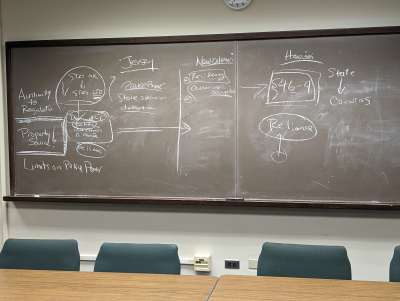
A big thank you to Professor Mark M. Murakami, with whom I guest-lectured at the Old School (both of us earned our JD’s at the Law School) over the semester, on such topics as Euclid, vested rights and development agreements, and of course limitations on the police power such as takings.

Although our students have another couple of weeks to finish up with their final papers, we can say with certainty that the future of Hawaii land use law is in good hands. We had some very intriguing and educational discussions over the past few months. 

PXL_20230426_222214630

Law of the Splintered Paddle

PXL_20240423_050055849.MP       
Old School chalkboards remain in some of the classrooms.

Continue Reading Aloha To Another Semester Of U. Hawaii Land Use

Screenshot 2024-04-24 at 10-12-17 VICTORY Breaking Down the Supreme Court Ruling on Permit Fees

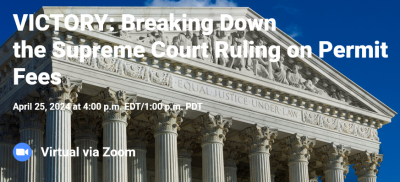
Be sure to join our Pacific Legal Foundation colleagues Brian Hodges and Larry Salzman, and Paul Beard (arguing counsel) and Chance Weldon (Texas Public Policy Foundation) tomorrow, Thursday, April 25, 2024, at 4pm ET for a free webinar on Sheetz v. El Dorado County, the Supreme Court’s recent decision holding that all permit conditions are subject to the nexus and proportionality tests of Nollan and Dolan.

Here’s the description:

Pacific Legal Foundation just won its 18th Supreme Court victory! Join us for a virtual discussion to learn more about the case, Sheetz v. County of El Dorado, and how it helps secure property rights (and lower housing costs) for everyone. 

When George Sheetz wanted to build a modest manufactured home on the property he bought in El Dorado Country, California, the government told him he was going to have to pay a “traffic impact fee” of more than


Continue Reading “Breaking Down the Supreme Court Ruling on Permit Fees” (Thursday, Apr. 25, 2024, 4pm ET/1pm PT)

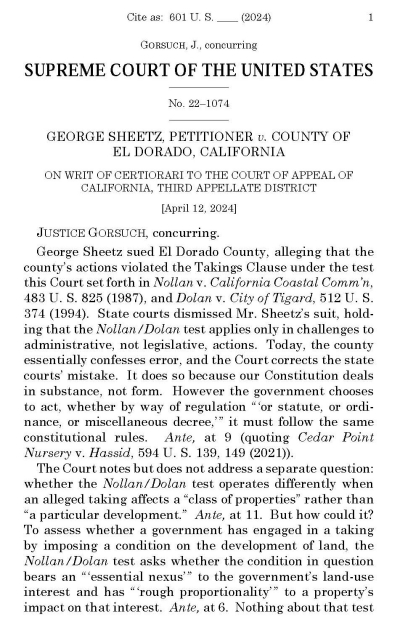
Gorsuch concurring

Note: this is the second of our posts on the recent Supreme Court opinions in Sheetz v. County of El Dorado, the case in which the unanimous Court held that exactions imposed by legislation are not exempt from the essential nexus (Nollan) and rough proportionality (Dolan) standards. Here’s our first post, which covers the case and the main opinion (“Sheetz pt. I – ‘Radical Agreement’ At SCOTUS: ‘Your Money Or Your Rights’ Isn’t OK Just Because A Legislature Does It“).

[Disclosure: this case is one of ours.]

In this post, we cover the three very short concurring opinions.

* * * *

The Court took no position on whether the County’s traffic impact fee has an essential nexus to the Sheetz development, or whether $23 grand is roughly proportional to any traffic his proposal might be responsible for. For this and more

Continue Reading Sheetz pt. II: The Concurrences – Does Nollan/Dolan Operate Differently When Exaction Affects A Class?

If there’s a money quote in yesterday’s opinion by the Supreme Court of Nevada which “wholly affirm[ed] a trial court judgment awarding $48 million in just compensation for Las Vegas’s regulatory taking in City of Las Vegas v. 180 Land Co., LLC, No. 24-13605 (Apr. 18, 2024), it might just be this sentence:

Although the City rejected 180 Land’s development proposals, its representatives had previously recognized the site’s ability to be developed residentially.

Slip op. at 8.

That alone should tell you where this one is ultimately headed. But let’s break it down and see how this got there.

Residential PUD Zoning

It started off well for the property owner, who owned land it wanted to use as a golf course, part of a (much) larger 2,200 acre ranch. The city preliminarily approved a request to zone the proposed golf course for residential PUD (planned unit development – which

Continue Reading $48 Million The Hard Zoning Way: Thanks To NIMBYs And NIMTOOs, Las Vegas Must Pony Up A Lucas Takings Judgment

PXL_20231101_125417762.PORTRAIT (Small)
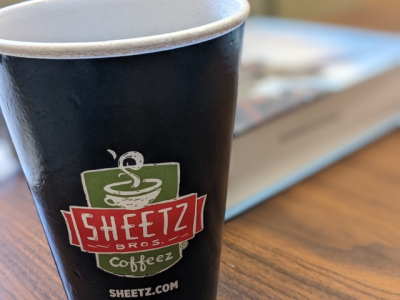
Guess where we stopped for coffee this morning?
(A reminder: this case has nothing to do
with the convenience store.)

Note: this is the first of two posts on the recent Supreme Court opinions in Sheetz v. County of El Dorado, the case in which the unanimous Court held that exactions imposed by legislation are not exempt from the essential nexus (Nollan) and rough proportionality (Dolan) standards. Here’s the second post, which covers the concurring opinions.

[Disclosure: this case is one of ours.]

In this post, we cover the background, and the Court’s unanimous opinion.

* * * *

Does the government have the unfettered ability to demand “the goodies” (as one municipality’s chief land use planner famously called them in the 1980s), simply because a property owner needs the government’s approval to make use if his or her land?

That’s the

Continue Reading Sheetz pt. I – “Radical Agreement” At SCOTUS: “Your Money Or Your Rights” Isn’t OK Just Because A Legislature Does It

Here’s what folks are saying about yesterday’s unanimous U.S. Supreme Court decision in Sheetz v. County of El Dorado, where the Court held that impact fees and exactions imposed by legislative action are not categorically immune from the close nexus and rough proportionality requirements already applicable to ad hoc/administratively-imposed exactions under Nollan, Dolan, and Koontz.


Continue Reading Sheetz Round-Up

Sheetz

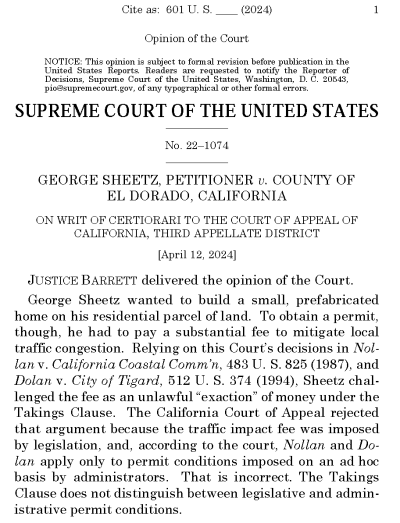
This just in: the U.S. Supreme Court has issued a unanimous opinion in Sheetz v. County of El Dorado, a case we’ve been following (not only because it is one of ours).

The Court, as predicted, held that an exaction (in this case a traffic impact fee) isn’t immune from the Nollan/Dolan nexus and rough proportionality requirements merely because the exaction is imposed by legislation.

At heart, this is a very pro-YIMBY decision because it gives property owners and housing builders a path to object to barriers to creating housing and the government’s use of the land use approval process as a way of exacting “goodies” that increase housing costs.

While we digest the opinion and the multiple concurring opinions — we shall post more once we do so — you can either read the opinions themselves, or see what we thought after the oral arguments. Or

Continue Reading Unanimous SCOTUS Delivers A YIMBY Blow: “The Takings Clause does not distinguish between legislative and administrative permit conditions.”

Here’s what we’re reading today:


Continue Reading Thursday Round Up: Pretextual Takings, Squatting, Unconstitutional Conditions