The Hawaii Supreme Court has been on a roll lately, giving us a series of decisions clarifying appellate procedure. So in the past couple of months, we’ve got cases about appealability, dismissing appeals for a brief not conforming to the rules, and what is a final appealable order. Good stuff for those of us who practice a lot in the appellate courts. 

Here’s the latest (and bonus for us, it’s a land use case). It addresses what remedy should be applied by a court of appeals when a case becomes moot while on appeal, and what a court should do with the appealed-from judgment: leave it in place even though it has been rendered academic, or vacate it and wipe it off the books as if it never existed at all? 

The court framed the issue and its conclusion in Goo v. Arakawa, No. SCWC-30142 (Feb.

Continue Reading How Do You Solve A Problem Like … Appellate Mootness? More Process!
Ninth_circuit

Update 2/19/14: the Honolulu Star-Advertiser has this report (“The appellate court decision was an ‘overwhelming victory for the city from an ideologically diverse panel, said Robert Thomas, a Hono­lulu-and San Francisco-based attorney who attended the hearing in August. The panel comprised Judges Stephen Rein­hardt, Mary Schroe­der and Andrew Hur­witz. ‘All three of them agreed. They made pretty short work of the challengers’ arguments on the merits’ while spending much of the decision on the panel’s jurisdiction concerns, Thomas said.”). The Star-Advertiser also reported that the one issue remaining before the District Court was also (coincidentially) resolved yesterday against the challengers. Here is the court’s order (we will have a report on that issue shortly). 

++++++++++++++++++++++++++++

Okay, we’ve got the obligatory “rail” pun out of the way with the title. On to the opinion, which we posted earlier today, which we’ve now had a chance to review it in more

Continue Reading 9th Cir: Honolulu Rail Project On Track

Update: a deeper review of the opinion here.

The Ninth Circuit has affirmed the District Court’s decision upholding for the most part the environmental review of the Honolulu rail project. Here’s the summary from the court: 

The panel affirmed the district court’s dismissal of plaintiffs’ claims under the National Environmental Policy Act and Section 4(f) of the Department of Transportation Act arising from litigation challenging the construction of a highspeed rail project in Honolulu, Hawaii.

The panel held that it had appellate jurisdiction under either 28 U.S.C. § 1292(a)(1), as an appeal from the grant or refusal of injunctive relief, or 28 U.S.C. § 1291, as an appeal of a final judgment. The panel also held that the Environmental Impact Statement’s identification of the project objectives, and analysis of alternatives, satisfied the National Environmental Policy Act’s requirements. The panel further held the defendants did not violate Section 4(f) of the Department of Transportation Act where the defendants did not adopt a Managed

Continue Reading 9th Cir OK’s Environmental Review Of Honolulu Rail Project

fracknow

Here’s the Verified Petition and Complaint, filed last week, in which a coalition of New York landowners sued the governor, claiming that the state is dragging its heels in its environmental review of fracking. We’re interested because a bad on fracking may lead to takings problems, although this lawsuit does not raise such issues, but seeks an order forcing the state to stop delaying and allow drilling to go forward. Here’s the Memorandum of Law supporting the petition, which details the legal basis for the claims.

According to the plaintiffs’ press release, the lawsuit seeks the following:

  • An order compelling the New York state Department of Environmental Conservation to finalize the “Supplemental Generic Environmental Impact Statement.” 
  • A determination that the DEC referral of the SGEIS to the Department of Health was arbitrary and capricious, an abuse of discretion and an improper delegation of the DEC’s Lead Agency


Continue Reading Frack Now: NY Property Owners Sue To Halt Delays

Property

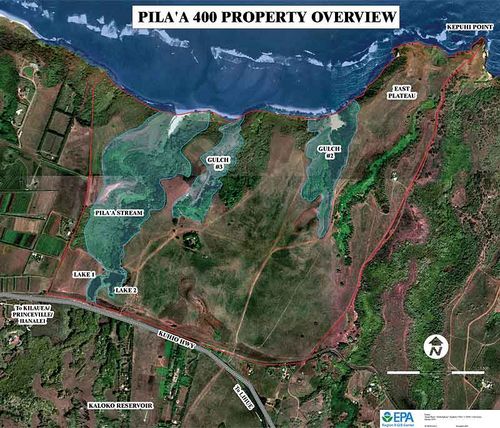
There’s not much doubt that the now-notorious large-scale unpermitted upland grading and grubbing by a Kauai property owner on its private land caused the runoff that catastrophically damaged the adjacent beach and the reef offshore. The damage was pretty bad, and resulted in the “largest storm water settlement [with the federal EPA] in the United States for violations at a single site by a single landowner.” See also the photo above (much larger version here).

The state also pursued the owner, and after a contested case, the Board of Land and Natural Resources assessed approximately $4 million in damages, and $70k for administrative costs. To reach this assessment, It did not apply a preexisting damage formula, but used a method it crafted for the case:

The value of Pilaa beach, bay and reef includes use value, option value, commodity value, existence value, bequest value, cultural values, including

Continue Reading HAWSCT: Damage To Unique Property Subject To Unique Rules

Looks like eminent domain and Hawaii are in the news today. Here’s what we’re reading:

Continue Reading Tuesday Round-Up: Hawaii In The Eminent Domain Spotlight

BadspockReading the Alabama Supreme Court’s decision in City of Alabaster v. Shelby Land Partners, LLC, No.1120677 (Jan. 24, 2014), we are reminded of that episode of Star Trek where the gang accidentally ends up in a parallel universe, where things are all backwards. That’s the episode that probably started the meme that in order to portray someone as “evil,” just give ’em a Van Dyke, like mirror Mr. Spock. Well, to an outside observer like us, nearly every party in the City of Alabaster case may need a beard, because the situation, with the exception of the final result, seemed so backwards from the situation that we’re used to in zoning cases.

Here, the developer wanted to make less intensive use of its property — it asked for a downzoning to allow a senior residence in a commercial district — and asked the City for a change in designation

Continue Reading The “Alternate Universe” Of Alabama Land Use

Mich Ave 2-6-2014

We’re at the ABA Midyear meeting in sunny Chicago, so we have our to-read links posted today instead of a new case digest. Our fingers are too frozen to post anything more:

  • No well. No way (from The Garden Island, Kauai’s daily newspaper, a story that just sums up how some decisions get made in one little corner of paradise).


Continue Reading Things To Read In Chicago When You’re Freezing

Blog-Logo

One of the perks of attending the annual ALI-CLE Eminent Domain and Land Valuation conference (this year in New Orleans) is that in addition to 2 1/2 days of high-level CLE programming involving our favorite topic, you get to meet colleagues from across the nation (and internationally – expropriation lawyers from Canada were also with us, and gave us an update on the Antrim Truck decision). 

You also find out things that, despite the seemingly infinite resource that is the internet, you didn’t know before. And that’s how we came to find out about a new law blog, covering Wisconsin issues in eminent domain and related topics, “The Preeminent Domain” (http://thepreeminentdomain.com/). As an aside, we love that URL. 

Steve Streck, a partner at Axley Brynelson leads the blogging team, and thus far, their posts look pretty interesting (underwater mortgages, rails-to-trails, and, of course, Wisconsin-centric eminent domain

Continue Reading New Eminent Domain (And Related) Law Blog

Coy Koontz, Jr., the prevailing property owner in Koontz v. St. Johns Water Management District, No. 11-1147 (June 25, 2013) joined our Pacific Legal Foundation colleague Jim Burling for an interview on Fox and Friends.

Kudos to Jim and Mr. Koontz for getting down to the studio in the wee hours of the morning — we shared dinner last night (Mr. Koontz has joined us to accept the 2014 Crystal Eagle award from Owners’ Counsel of America on Saturday), and even after all that a New Orleans meal involves, they were able to drag themselves to the studio and look remarkably fresh. Good work, guys.Continue Reading Coy Koontz, Prevailing Property Owner In SCOTUS Victory, Interviewed