


Here are the cert briefs in Kellberg v. Yuen, No. SCWC-12-0000266 (Haw. Jan. 22, 2014), the case in which the Hawaii Supreme Court held that there is only one “final decision” that a challenger must administratively appeal when objecting, and that due process requires the agency to give a challenger notice of the administrative process. 

We represent the prevailing Petitioner in the case, and promised to post the cert briefs, which, along with the briefs filed in the Intermediate Court of Appeals, are all of the appellate briefs filed in the case (the court did not request additional briefing after accepting cert). So here they are:

We’re still at the ALI-CLE Eminent Domain conference, so have not had a chance to write up our thoughts on the opinion, so until we do, here’s

Continue Reading Cert Briefs In Admin Due Process Case

The Hawaii Supreme Court has issued an opinion that is very good for property owners and anyone who must use the administrative appeals process. [Disclosure: we represent the prevailing Petitioner in this case.]

In Kellberg v. Yuen, No. SCWC-12-0000266 (Jan. 22, 2014), the unanimous court, in a detailed opinion by Justice Pollack, held that a person who challenged the County of Hawaii’s admittedly illegal subdivision of a neighboring parcel need only appeal to the Board of Appeals from the “final” subdivision approval, and not a decision made months later. The court also held that if an agency believes that its decision must be appealed via its administrative process, it has an obligation to say so in a clear way:

If the goal of the exhaustion doctrine is to redirect grievances to their proper forum, then such a goal is not served by fostering uncertainty over the Director’s decisions and

Continue Reading HAWSCT: Triggers To Administrative Appeals Must Be Clear And Noticed

Next week, we’ll be in New Orleans for the 2014 edition of the ALI-CLE Eminent Domain program, now in its 31st year. 

As usual, my Owners’ Counsel colleagues Leslie Fields and Joe Waldo (the programming co-chairs) have put together a fantastic 2.5 day of programming, taught by expert faculty.  At 11:00 a.m. on the first day of the program, I will be joining Professor James Ely to speak about “The Full and Perfect Equivalent for Just Compensation: The Historical Context and Practice.” 

Should be fun. If you are not joining us in-person, ALI-CLE is producing it as a live webcast, and will make the coursebook and video and audio available for later listening or viewing. 

More details here, or download the brochure here, or below. 

31st Annual Eminent Domain and Land Valuation Litigation, ALI-CLE Program (CV023) (Jan. 23-25, 2014) New Or…

Continue Reading 31st Annual ALI-CLE Eminent Domain And Land Valuation Litigation (New Orleans)

In Powell v. County of Humboldt, No. A137238 (Jan. 16, 2014), the California Court of Appeal held the County’s demand that landowners who sought an after-the-fact building permit for a carport and porch for their mobile home dedicate an overflight easement for the nearby Eureka airport did not run afoul of NollanDolanKoontz

The court concluded that the overflight easement did not consitute a per se physical taking of the Powell’s property, and thus they did not meet that part of the NDK standard which prohibits the conditioning of a permit on the surrender of the right to compensation for a taking. Here, the court held, the Powells did not show that the easement was a taking. See slip op. at 15. Although property owners generally have airspace rights, there is no right to exclude aircraft from the “navigable airspace above their property in accordance

Continue Reading Cal App: County Can Condition Building Permit On Landowner Allowing Aircraft Overflight Easement

Here are the written materials from today’s HSBA Appellate Section presentation on administrative law and appeals in Hawaii courts. 

A video of the presentation is posted above — it may be a bit dark, but no matter: all you really need is the sound, anyway. Listen to the audio-only session here:

GWK-RHT-HSBA-appellate-admin-appeals-1-13-2014

Administrative Appeals in Hawaii Courts: How Do You Get There, and How Do You Get Out? (Hawaii State Bar As…

Continue Reading Materials From State Bar Association Appellate Section Presentation: Admin Law Appeals

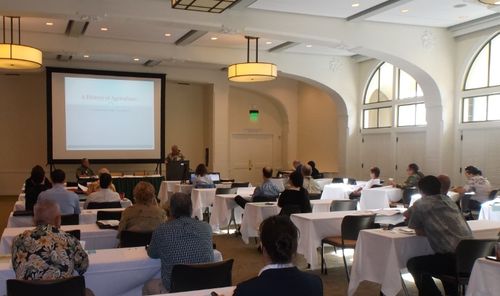
At the Hawaii Agriculture Law Conference which we just wrapped last week, perhaps the hottest topic on the agenda was the anti-GMO ordinances recently adopted by the Counties of Hawaii (Big Island) and Kauai.

Barista’s note: One advantage of having POTUS in town for a couple of weeks was that it resulted in a cohort of national reporters sitting around with nothing to write about, no doubt being pestered by their editors suffering back in the polar vortex to get off the beach and actually file a story or two. Thus, we saw a series of big league newspapers filing stories about Hawaii, including this marqee piece in the New York Times about the anti-GMO measures, “A Lonely Quest for Facts on Genetically Modified Crops.”

At the Ag Conference, we discussed the possibility of a lawsuit being filed against Kauai, since it seems to be the locus

Continue Reading The Other Shoe Drops: Kauai Anti-GMO Ordinance Challenged In Federal Court

Last month, we posted a decision about nonconforming uses, White v. City of Elk River, No. A12-0681 (Minn. Dec. 4, 2013), and want to follow up by posting a good summary of the issues, as well as the amicus brief that was filed in the case in support of the property owner.

Start here (“Can Government Revoke Your Right to Continue an Existing Business?“) by Luke Wake (also one of the counsel who filed this amici curiae brief). Luke’s piece discusses the Minnesota Supreme Court’s holding that the city could not revoke a campground’s nonconforming use as penalty for alleged violations of the conditions of the conditional use permit. The court also held that a nonconforming use is an independent property right, not a mere privilege as a product of a CUP ordinance. Luke writes:

The case raised a question of fundamental importance in Minnesota—one that might

Continue Reading Do You Have A Right To Continue A Business?

Next Monday, January 13, 2014, from noon to 1:00 p.m., I’ll be speaking — along with my Damon Key partner Greg Kugle — to the Hawaii State Bar’s Appellate Law Section about administrative appeals, in a session entitled “Administrative Appeals: How Do You Get There And How Do You Get Out Of There?” 

Because of the areas in which we practice, we’re going to be focusing on the issues in the context of land use cases, but the principles are generally applicable to any matter in which there is the possibility of agency appeal or contested case, followed by judicial review under the Administrative Procedures Act. Because most of the recent interesting decisions have come out of the Hawaii Supreme Court, we’ll be limiting our presentations to state law. 

Details: 

Date: Monday, January 13, 2014

Time: noon – 1:00 p.m.

Location: Damon Key offices, 1003 Bishop Street

Continue Reading Upcoming HSBA Program: Administrative Appeals – How Do You Get There And How Do You Get Out Of There?

14.AGRHI

Here are links to some of the materials mentioned at our session today on the GMO issue at the Hawaii Agriculture Law Conference:

DSCF1529
My co-planning Chair, Dave Bateman (a lawyer and a coffee farmer), Continue Reading Links From Today’s Session On GMO Issues

If you were to try to predict the result in an appeal before the Ninth Circuit where the lead plaintiff is the “Alliance for Property Rights and Fiscal Responsibility,” the defendant is a municipality, and knowing nothing else, you’d probably have guessed wrong in this case.

In Alliance for Property Rights and Fiscal Responsibility v. City of Idaho Falls, No. 12-35800 (Dec. 31, 2013), the three-judge panel ruled unanimously in favor of the Alliance, holding that the city did not have the power to take property outside of its territory for the purpose of constructing electric transmission lines.

The panel (N.R. Smith, Schroeder, Thomas), held that the city lacked the power to take easements for power lines when state law did not delegate it the authority to act extraterritorially. The court started with the black-letter rule that munciipalities are creatures of state law, and cannot exercise powers not delegated

Continue Reading 9th Cir: City Cannot Take Property Outside City Limits