


Here’s the inevitable reaction to U. Hawaii law Professor David Callies’ recently-published law review article (and follow-up interview) about the stunning success rates certain parties enjoy in the Hawaii Supreme Court. In that article, the good professor labeled the record of the 1993-2010 Hawaii Supreme Court on property issues “appalling,” so it should come as no surprise that two of the beneficiaries of those rulings have now rallied to that court’s defense.

In “Hawaii Court Upholds Public Responsibility In Environmental Cases,” an opinion piece in Honolulu Civil Beat, an Earthjustice lawyer and the Director of the Hawaii Sierra Club jointly write:

Callies complains that the Supreme Court “created out of whole cloth” the requirement that the Turtle Bay Resort supplement its 25-year old Environmental Impact Statement. He was on the losing end of that argument before the Court, and he’s still wrong now. Supplemental EISs are
Continue Reading The Empire Strikes Back: Reaction To UH Lawprof’s Study Of Success Rates In Hawaii Supreme Court Cases

The Hawaii Intermediate Court of Appeals, in a unanimous panel opinion authored by Judge Foley, held that a “zoning verification” by the Director of the City and County’s Department of Planning and Permitting is not a “decision of the Director” which a property owner must administratively appeal to the Honolulu Zoning Board of Appeals. Hoku Lele, LLC v. City and County of Honolulu, No. CAAP-11-0001064 (Jan. 25, 2013). The circuit court had dismissed the complaint for lack of jurisdiction because the property owner did not seek administrative review.

We represent the property owner/plaintiff/appellant in the case, so we’re not going to analyze the issue in detail, and leave it up to you to read the opinion. Needless to say, we think it is a correct and well-reasoned decision.

Hoku Lele, LLC v. City and County of Honolulu, No. CAAP-11-0001064 (Jan. 25, 2013)


Continue Reading HAWICA Clarifies What Actions By Planning Dept Trigger Administrative Zoning Appeals

Does the editorial board of the New York Times really have the stones to start off its latest editorial about the Takings Clause, “Where Is the Taking?“, with this:

When a city condemns private property to make way for a public highway, that is a classic “taking” for which government must provide “just compensation” under the Constitution’s Fifth Amendment.

Seriously, Times? How about when it’s not a “classic” taking, and the city condemns an entire block of urban private property to make way for the 52-story office headquarters of a large corporation … say, for example, a newspaper with the initials “NYT?” Would it be a “classic” exercise of power to use emient domain to take property so that:

A high rise office tower would be built at Site 8 South providing the Times with a new headquarters, as well as providing 700,000 square feet of space

Continue Reading We Can Try To Understand The New York Times’ Effect On Man (When It Opines On Eminent Domain Law)

Mark your calendars for next Friday, January 25, 2013 from noon to 1:00 p.m. Pacific for “Arkansas Game & Fish Commission v. United States: Practical Implications Of The Supreme Court’s Decision,” presented by Law Seminars International.

It’s a discussion of Arkansas Game, the decision in which the Supreme Court held that the federal government was not immune from liability for a taking when it was responsible for flooding, even if the flooding is temporary. They’ve assembled a great faculty, which includes arguing counsel for the prevailing petitioner James Goodhart. Also speaking will be takings litigator Nancie Marzulla and Washington Legal Foundation Chief Counsel Richard Samp. Here’s a description of the one-hour program:

On December 4, 2012, the U.S. Supreme Court issued a unanimous opinion in Arkansas Game & Fish Commission v. United States, holding that when the federal government floods property, even temporarily, the Fifth

Continue Reading Upcoming TeleBriefing On Takings Issues After Arkansas Game & Fish

The Hawaii Supreme Court has accepted certiorari and agreed to review the Intermediate Court of Appeals’ unpublished memorandum opinion in Diamond v. Dobbin, No. 30572 (Aug. 31, 2012). The Supreme Court’s order is here.

It’s another beach case, this time involving a shoreline certification. Shoreline certifications approved by the State Department of Land and Natural Resources are used as the baseline from which to measure building setbacks on littoral parcels, and do not involve the boundary between public and private property on beaches. The DLNR certified the shoreline on a Kauai parcel, and two nearby residents who claimed the shoreline was further mauka (landward) administratively appealed to the Board of Land and Natural Resources. The Board rejected the appeal and approved the certification, and the two neighbors appealed to the circuit court under the Hawaii Administrative Procedures Act.

The circuit court concluded the BLNR’s findings of fact were

Continue Reading Another HAWSCT Shoreline Cert Grant

In addition to our summary of and reaction to yesterday’s oral arguments in Koontz v. St Johns River Water Mgmt Dist., No. 11-1447 (cert. granted Oct. 5, 2012), here is the leading commentary from other sources:

  • Lyle Denniston at SCOTUSblog: “The very idea that an unconstitutional “taking” had occurred to an owner of a small plot of ground in Florida seemed near to vanishing, propelled toward oblivion by a spreading fear on the bench that maybe the entire regulatory apparatus of government might be at risk. Credit lawyers for a state agency and the federal government for deepening this anxiety.”
  • Greenwire‘s Lawrence Hurley: Supreme court: Justices weigh Fla. property rights dispute: “Rather than focus on the two Supreme Court precedents on permitting conditions, some justices seemed to agree with the Obama administration that, if Koontz did have a claim, it would be in the form of


Continue Reading The Good, The Bad, And The Scalia: Koontz Oral Argument Round-Up

pbeard

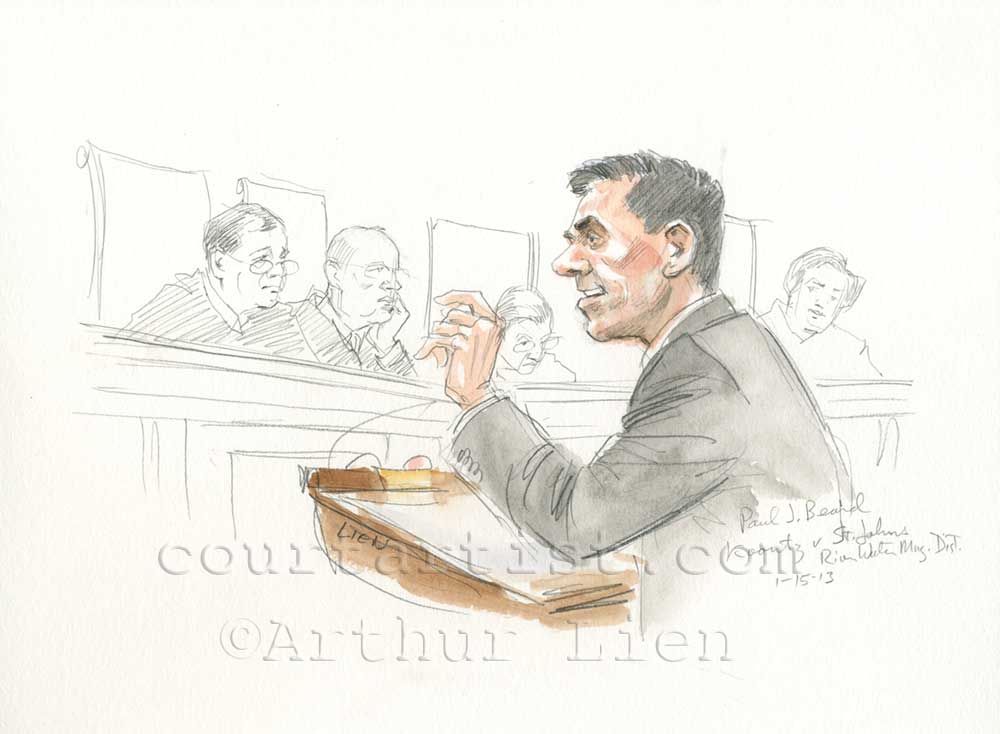
When you are a property owner making a takings argument and Justice Scalia gives you a hard time at oral argument, you would be safe in thinking that you’ve got an uphill battle.

That was the situation today during the oral argument (transcript here) in Koontz v. St Johns River Water Mgmt Dist., No. 11-1447 (cert. granted Oct. 5, 2012), the case in which the Court is considering whether the “essential nexus” and “rough proportionality” standards of Nollan and Dolan are applicable only to exactions for land, or whether they are generally-applicable tests for all exactions.

Justice Scalia, author of the Nollan opinion, did not seem all that concerned with the second Question Presented (whether only exactions of real property are subject to Nollan/Dolan), but more on whether a takings claim can be based on an excessive exaction attached to a permit when the property

Continue Reading SCOTUS Arguments In Monetary Exactions Case: (Sliced) Bread And Circuses

For those of us who were far, far away, and thus not able to be in D.C. for today’s oral arguments in person, here is the transcript in Koontz v. St Johns River Water Mgmt Dist., No. 11-1447 (cert. granted Oct. 5, 2012).

Here’s the first recap of the arguments, from Greenwire‘s Lawrence Hurley, “Supreme court: Justices weigh Fla. property rights dispute.”

More, after a chance to digest the transcript.

Transcript of oral arguments, Koontz v. St John’s River Water Mgmt Dist., No. 11-1447 (Jan. 15, 2013) 


Continue Reading SCOTUS Transcript In Koontz

PICT0408

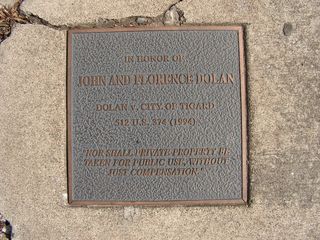
With the oral arguments in Koontz v. St Johns River Water Mgmt Dist., No. 11-1447 (cert. granted Oct. 5, 2012) at last here, we thought we’d go back and revisit our write-up of our visit to the Dolan site, complete with photos: Regulatory Takings Pilgrimage Part II.

Koontz, as you know, is about whether the Nollan nexus test, and Dolan‘s requirement of “rough proportionality” apply only to land exactions, or is a generally-applicable test for all exactions.

Continue Reading Exactions Flashback – Our Visit To The Dolan Site

Here‘s the Legal Information Institute’s preview of tomorrow’s U.S. Supreme Court arguments in Koontz v. St Johns River Water Mgmt Dist., No. 11-1447 (cert. granted Oct. 5, 2012). That’s the case in which the Court will be addressing whether the “essential nexus” and “rough proportionality” standards of Nollan and Dolan are applicable only to exactions for land, or whether they are generally-applicable tests for all exactions.

Disclosure: we filed an amicus brief in the case in support of the property owner/petitioner. The property owner’s brief on the merits is available here. The other amicus briefs supporting the property owner are available here, here, and here. The Water Management District’s merits brief is posted here. The amicus briefs suporting the Water District are posted here. The property owner’s reply brief is here.

The LII’s preview has a good “he said she said”

Continue Reading LII Preview: Koontz “has the potential to drastically modify takings jurisprudence with regard to exactions”