


A key win for property rights today in the Minnesota Supreme Court’s decision in White v. City of Elk River, No. A12-0681 (Dec. 4, 2013). In that case, the court concluded that a municipality could not revoke a campground’s nonconforming use as penalty for alleged violations of the conditions of the conditional use permit. The court also held that a nonconforming use is an independent property right, not a mere privilege as a product of a CUP ordinance. 

The campground had been operating since 1973, well before the city adopted zoning. Seven years later, the city adopted an ordinance which banned campgrounds. Three years later, the city amended the ordinance to allow campgrounds as a conditional use (which required a CUP). But later, the city amended the ordinance yet again, to bar campgrounds entirely. During the time that a CUP was required, the campground got one from the city

Continue Reading Minn S Ct: Zoning Requirement To Obtain CUP Does Not Affect Nonconforming Use Owner’s Property Rights

We’re offline today because we’re arguing a case in the Hawaii Supreme Court about automatic approval statutes and zoning law. Here’s the summary of the issues, via the Judiciary web site:

This appeal arises out of a decision by the Respondent Planning Commission of the County of Kaua`i (Planning Commission) to deny the Petitioner Kauai Springs, Inc.’s (Kauai Springs) application for three permits related to the continued operation of Kauai Springs’ water bottling facility. The Circuit Court of the Fifth Circuit (circuit court) reversed in part and vacated in part the Planning Commission’s decision and ordered that all three permits be issued to Kauai Springs. The Intermediate Court of Appeals (ICA) subsequently vacated the circuit court’s judgment and remanded the case to the Planning Commission for consideration of whether Kauai Springs could satisfy the relevant permit requirements.

In its application, Kauai Springs argues that the ICA gravely erred by: 1)

Continue Reading HAWSCT Oral Arguments: Inferring Assent To Extend Auto-approval Deadlines

A must read from our colleague Professor Steven Eagle (author of the Regulatory Takings treatise) about the Koontz case, Koontz in the Mansion and the Gatehouse, forthcoming in the Urban Lawyer.

Here’s the abstract:

This Article focuses on problems in implementing the U.S. Supreme Court’s expansion of its doctrine of unconstitutional conditions pertaining to land development approvals in Koontz v. St. Johns River Water Management District. As earlier developed in Nollan v. California Coastal Commission and Dolan v. City of Tigard, the doctrine applied only to unrelated or disproportional exactions of interests in real property. The doctrine was expanded in Koontz to include denials of development approval after landowner refusal to accede to unreasonable exaction demands, and also to exactions of money as well as real property interests.

Drawing an analogy to Yale Kamisar’s disparate treatment of criminal defendants in the “mansion” of the judicial system and the “gatehouse”

Continue Reading New Article: “Koontz in the Mansion and the Gatehouse” (Professor Steven Eagle)

Worth reading: a new working paper on exactions and Koontz by a Pacific Legal Foundtion Fellow (PLF represented the prevailing property owner in Koontz).

The article, “Nollan and Dolan and Koontz – Oh My! The Exactions Trilogy Requires Developers to Cover the Full Social Costs of Their Projects, But No More,” by Christina Martin,

argues that, contrary to appalled assertions of some observers, the U.S. Supreme Court’s decision in Koontz v. St. Johns River Water Management District is a straightforward application of Nollan v. California Coastal Commission and Dolan v. City of Tigard. Nollan and Dolan established that when government requires a permit applicant to give up property in exchange for a permit, the demand must be closely related and roughly proportional to the development’s social cost. Anything that exceeds those bounds violates the unconstitutional conditions doctrine by burdening the right to just compensation for a taking. Koontz

Continue Reading New Article On Nollan-Dolan-Koontz

Cornell lawprof Robert Hockett, the guy who by all accounts thought up of the idea of using eminent domain to take “blighted” (underwater, but mostly performing) mortgages, was interviewed on “Air Occupy” about the scheme yesterday. Here’s the podcast (we originally embedded the podcast below, but the darn thing was set to play automatically and it was just supremely irritating, so we deleted it and provided the link instead).

He goes into his thoughts on the motive of the opponents, among other things.

One thing we can’t figure: how an organization (although perhaps “decentralized, hacktivist collective” would be more acceptable to the group), can get within five feet of supporting a plan that was proposed, funded, and pushed by a bunch of the same “Wall Street” types who supposedly caused the problem. Anarchy breeds strange bedfellows?Continue Reading Cornell Lawprof Talks About His Plan To Take Underwater Mortgages

The Honolulu City Council has proposed a charter amendment that asks the voters to approve eliminating the Mayor’s current veto power over the Council’s eminent domain resolutions.

The Resolution doesn’t directly say that, of course, but what it does command is that after the Council adopts a resolution to take property, the city administration must within 90 days start the condemnation action. In other words, no mayoral veto. Currently under the Charter, the Mayor may veto resolutions of taking:

Resolutions authorizing proceedings in eminent domain shall not be acted upon on the date of introduction, but shall be laid over for at least one week before adoption. Such resolutions shall be advertised once in a daily newspaper of general circulation and may be advertised, as deemed helpful, in other newspapers at least three days before adoption by the council. Not less than three copies of such resolutions shall be filed

Continue Reading Should The Honolulu Charter Eliminate The Already Minimal Check Of A Mayoral Veto On Eminent Domain Resolutions?

Before we get to the California Supreme Court’s opinion in Sterling Park, L.P. v. City of Palo Alto, No. 204771 (Oct, 17, 2013), here’s what we think is the money quote:

For these reasons, we believe Fogarty and Williams correctly interpreted [Cal. Cov’t Code] section 66020. The statute governs conditions on development a local agency imposes that divest the developer of money or a possessory interest in property, but not restrictions on the manner in which a developer may use its property. [Cal. Gov. Code] Section 66499.37 governs the latter restrictions.

Slip op. at 17.

The court backed into defining “exaction,” since the case involved the choice of which statute of limitations applied to the plaintiff’s challenge to the city’s requirement that developers who want to build (in this case, a 96 unit condominium project) must either set aside a certain percentage of units for sale

Continue Reading Cal Supremes: “Exaction” Includes Demand For Land Or Money

DHM_IMLA

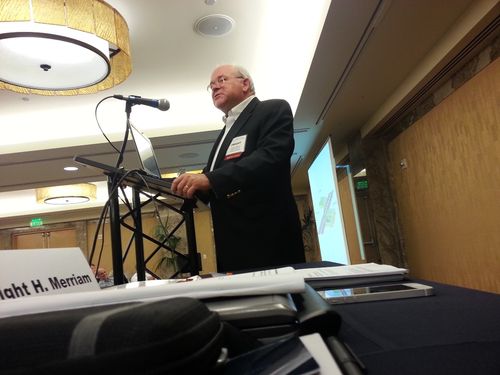
A big thanks to my Owners Counsel of America and ABA State and Local Government Law Section colleague Dwight Merriam for emceeing today’s well-attended double session on land use and takings law at the International Municipal Lawyers Association’s 2013 annual meeting in San Francisco. Dwight and I were joined by land use expert Cecily Barclay, who presented sessions on Harvey Cedars, while I covered Koontz and Dwight did the relevant parcel/Lost Tree sessions. Continue Reading IMLA Conference Session On Koontz, Harvey Cedars, Relevant Parcel