


Check this out: the lawprof who thought up the underwater mortgage taking plan, Cornell’s Robert Hockett, along with his co-author, the “Founder and Chief Strategy Officer” of Mortgage Resolution Partners (the venture capitalists who are funding the scheme and who stand to benefit from it), have posted a new article in the Harvard Law & Policy Review, “A Federalist Blessing in Disguise: From National Inaction to Local Action on Underwater Mortgages.”

One guess what the article concludes.

In case you have not been paying attention, here’s the abstract:

While it is widely recognized that the mortgage debt overhang left by the housing price bubble and bust continues to operate as the principal drag upon U.S. macroeconomic recovery, few seem to appreciate just how locally concentrated the problem is. This paper takes the measure of the national mortgage debt overhang problem as a cluster of local problems
Continue Reading Surprise – New Article In Mortgage Resolution Partners Law Review: Use Of Eminent Domain To Take Mortgages OK!

A link to a story worth reading about the U.S. Supreme Court’s decision in Koontz v. St. Johns River Water Management District, No. 11-1147 (June 25, 2013).

In Developing Story at Florida Trend (“The Magazine of Florida Business”), our Owners’ Counsel of America colleague Amy Brigham Boulris is quoted along with the property owner/petitioner Coy Koontz, and two lawprofs who don’t care for the decision.

Check it out, it’s a quick read. Continue Reading Worth Reading On Koontz: “A 20-year legal battle over a water management district’s condition for development is over – sort of.”

It’s Monday and we’ve got a petition due Tuesday, so we’re not going to spend too much time on posting today. But we did want to update you on the latest on the mortgage front.

  • A San Francisco federal judge concluded that it was too early to bring the lawsuits challenging the takings. This means that the case is just not quite ripe (although it looks like it is ripening fast), not, as some media outlets have been reporting, that the judge approved of the MRP/Richmond eminent domain scheme. 
  • Our Florida colleague Carlos Kelly sends this report from the “Legal Scoop on Southwest Florida Real Estate,” a publication of his firm. Read his Update: Condemnation of Underwater Mortgages here. Many good links to other stories and reports.
  • An Arizona reader sends this item, “Using


Continue Reading The Latest On The Mortgage Takings Issue

As we noted here, where we posted the petition for review, what might be the first major appellate decision following the U.S. Supreme Court’s decision in Koontz may be on the way.

Today, the California Supreme Court agreed to review (order here) the Court of Appeal’s decision in California Building Industry Ass’n v. City of San Jose (6th District June 6, 2013), which held that under rational basis review (and not heightend scrutiny) the city of San Jose’s affordable housing exaction might survive because it was designed to promote the development of affordable housing, and not to mitigate the impacts of market priced housing.

This is not only a chance for the Cal Supreme Court to resolve the lower appellate court split on the issue, but whether, as the Petition‘s Question Presented argued, Koontz “governs the judicial review of in-lieu development fees in California. Koontz clarifies

Continue Reading Cal S Ct To Review “Inclusionary Housing” Money Exaction – First Major Post-Koontz Decision On The Way?

 Norfolk

Earlier today, the Virginia Supreme Court, in PKO Ventures, LLC v. Norfolk Redevelopment and Housing Authority, No. 121534 (Sep. 12, 2013), invalidated takings of non-blighted properties which were part of a larger area designated as blighted.

In 2007, Virginia adopted a statute requiring that if property is taken to eliminate blight, the property itself must be blighted. That might seem like an obvious proposition, but as readers certainly know, since the U.S. Supreme Court’s decision in Berman, it has been ok to take the baby with the bathwater under the Fifth Amendment, and as long as a legislator rationally could have believed that taking a perfectly fine property would somehow help alleviate other blight, then the courts would not stand in the way.

The Virginia statute defines “blighted property” as one that is in bad shape “at the time of the filing of the petition for condemnation,”

Continue Reading Virginia S Ct: No Taking Of Non-Blighted Property That Happens To Be In An Area Designated “Blighted”

Dwight Merriam, familiar to our readers for the items of interest he frequently forwards, as a co-author of a recent brief in the New York rent control case, chapter author in the seminal eminent domain treatise Nichols on Eminent Domain, for being the editor of the ABA’s annual “Cutting Edge” land use books, the author of “The Complete Guide to Zoning” (which could be our favorite book on the subject), and the moderator of perhaps the most well-attended legal teleconferences on the planet (we understand this recent example had over 800 participants), has authored “Eminent Domain for Underwater Mortgages: A Cure Worse Than the Disease?,” a piece for The Abstract, the magazine of the American College of Mortgage Attorneys. 

It’s a good quick summary of the facts in the case of the plan for the city of Richmond, California to

Continue Reading Merriam On Taking Underwater Mortgages: “Lindsay Lohan has a greater chance of staying out of trouble than the city of Richmond”

Here’s the cert petition filed earlier this week, asking the Supreme Court to review the Ninth Circuit’s decision in MHC Financing Ltd. P’ship v. City of San Rafael,714 P.3d 1118 (9th Cir. 2013).

That’s the case in which the Ninth Circuit overturned the District Court’s ruling (after two trials) that MHC had proven a Penn Central taking and was entitled to just compensation for the City’s mobilehome rent control ordinance. The panel’s rationale was that MHC purchased the mobilehome park with the oppressive regulations already in place, so it had no “investment backed expectations” of operating free of the regulations.

We posted our thoughts on the Ninth Circuit’s ruling here, so we won’t go into the details of the cert petition, except to note two things:

  • We didn’t get how the Ninth Circuit just ignored Palazzolo. We still don’t.
  • The second Question Presented (below) is particularly fasinating.


Continue Reading New Regulatory Takings Cert Petition: 9th Circuit Made Hash Of Penn Central

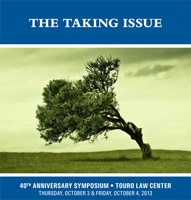
Taking_coverimage_webIf you are anywhere within striking distance of Touro Law School (Central Islip, Long Island), you should make plans to attend a conference that promises two days of fantastic programming on October 3 and 4, 2013.

The Taking Issue – 40th Anniversary Symposium” is dedicated to the memory of the legendary Professor Fred Bosselman, and lead author of The Taking Issue, a 1973 report to the President’s Council on Environmental Quality. While the themes in the book have been overtaken by the Supreme Court’s takings cases, it remains a touchstone work for anyone interested in the subject.

Conference co-Chairs Dean Patricia Salkin and Professor David Callies (a co-author of The Taking Issue) have assembled an excellent faculty and agenda. There will be panels on partial takings, the Nollan/Dolan/Koontz issue, the relevant parcel question, and one on ripeness which we’ll be moderating

Continue Reading Conference Announcement: The Taking Issue – 40th Anniversary Symposium

The U.S. Court of Appeals for the Eleventh Circuit, in Temple B’Nai Zion, Inc v. City of Sunny Isles, No. 12-12094 (Aug. 29, 2013), held that the Williamson County ripeness doctrine did not prevent the Temple from bringing its RLUIPA (and related) claims in federal court. 

The right result for sure. But wait, you say, isn’t Williamson County a ripeness rule for takings claims? After all, it supposedly is based in the language of the Fifth Amendment (the taking isn’t unconstitutional until just compensation has not been paid, and there’s been no “taking” until the government has made a final decision)? No matter, several courts have extended the Williamson County doctrine beyond takings claims, requiring plaintiffs in free speech, due process, and religious land use cases to exhaust administrative remedies before they come to federal court.

The Eleventh Circuit rejected the defense, but not because Williamson County simply doesn’t

Continue Reading 11th Cir: RLUIPA Case Not Unripe Under Williamson County

According to this story in the San Francisco Chronicle, “Eminent domain plan may have spooked investors,” Richmond, California’s plan to take underwater mortgages by eminent domain “Wall Street spurned its efforts to refinance its highly rated municipal bonds [A-minus rating], an unusual snub that cost the city nearly $4 million in lost savings.”

“Paying Paul and robbing no one”, indeed. Continue Reading Well, Who Didn’t See This Coming?