PXL_20231202_194330453.PORTRAIT

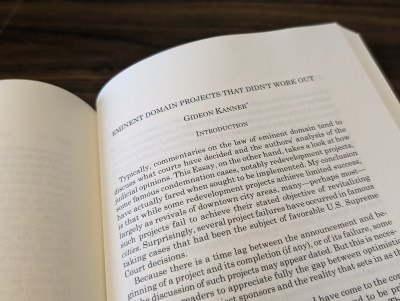
Here it is — Professor Gideon Kanner’s final law journal article, published shortly before his passing:

Gideon Kanner, Eminent Domain Projects That Didn’t Work Out, 12 Brigham-Kanner Prop. Rts. J. 171 (2023).

Appropriately, we think, published in William and Mary Law School’s Brigham-Kanner Property Rights Journal, named in part in Gideon’s honor.

This isn’t a typical law journal article, but an essay collecting Professor Kanner’s thoughts, comments, and (best of all) opinions on, well, eminent domain (and redevelopment) projects that didn’t work out.

In Gideon’s own words, from the Introduction:

But whether you favor widespread use of eminent domain or not, and whether the projects created by its use are sound or not, it is deplorable that the power of eminent domain has been often deployed to the detriment of racial and politically powerless minorities. Typically, redevelopment projects tend to displace middle class and poor people from
Continue Reading Professor Kanner’s Final Article: “Eminent Domain Projects That Didn’t Work Out,” 12 Brigham-Kanner Prop. Rts. J. 171 (2023)

Pace
22nd annual Alfred B. DelBello Land Use
and Sustainable Development Conference

Come, join us (and others) on Thursday-Friday, December 7-8, 2023, at Pace Law School in White Plains, New York for the Land Use and Sustainable Development Conference (this year’s conference theme is “Balancing Economic Realities with Environmental and Social Concerns”).

We’re speaking about the 100th anniversary of the modern regulatory takings doctrine, which got its start nearly 101 years ago with the Supreme Court’s opinion in Pennsylvania Coal Co. v. Mahon, where the Court held that property may be regulated, but if the regulation “goes too far,” it will be deemed a taking.

Here’s a description of the program:

The 100th Anniversary of Pennsylvania Coal vs. Mahon: How the Takings Clause Became the Primary Check on Government Power When SCOTUS Abandoned Review Under the Due Process and Contracts Clauses During the New Deal

The Takings Clause and 100

Continue Reading Join Us For 100 Years Of Pennsylvania Coal (Pace Land Use Conference, Dec. 8, 2023)

Screenshot 2023-11-24 at 11-46-32 Tyler v. Hennepin County - Harvard Law Review

Check this one out, the Harvard Law Review‘s summary of Tyler v. Hennepin County, the “home equity theft” takings case decided unanimously by the Supreme Court.

Some highlights:

Beginning with traditional principles, Chief Justice Roberts suggested that a property interest in surplus equity had English origins — King John proclaimed in the Magna Carta that when collecting debts owed to him by a deceased person, any surplus “shall be left to the executors.” Parliament endorsed this principle, giving the Crown the power to seize and sell a taxpayer’s property to satisfy a tax debt but requiring the surplus to be returned to the original owner.And according to Blackstone, the English common law required the same.

So too did historic and contemporary American laws.

While the Tyler Court continued the trend of a robust Takings Clause, it introduced novel evidence of a taking: a lack of internal consistency

Continue Reading Harvard Law Review On Tyler v. Hennepin County: Reflecting The “Diminishing” Role Of State Property Law In Takings

Euclid_front

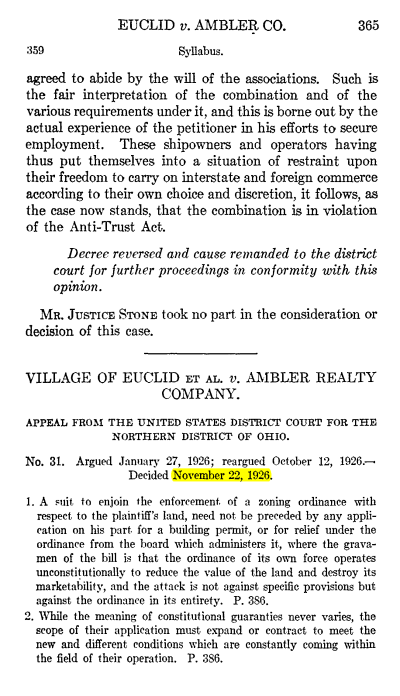
On this day in 1926, the United States Supreme Court issued its landmark opinion in Village of Euclid v. Ambler Realty Co., 272 U.S. 365 (Nov. 22, 1926).

You know this one (shame on you if you don’t!) – it is the case in which the Supreme Court first upheld — against a facial due process challenge — the validity of this thing we call “zoning.” While in the intervening century, zoning has become a catch-all term for regulatory restrictions on the uses of real property, land users know that “zoning” — ackshually — refers only to the regulation and separation of uses, and restrictions on density, and height regulation.

While “Euclid” and “Euclidean zoning” have become part of the land use lexicon and landscape, the decision might have been seen at the time as somewhat surprising. After all, the Supreme Court was in

Continue Reading (Un)Happy 97th Birthday, Euclid!

“No need to ask, he’s a smooth operator…”

Here’s the amicus brief we just filed in a case we’ve (obviously) been paying close attention to.

This is Devillier v. Texas, the case in which the Supreme Court is considering what does the it mean when it describes the Just Compensation Clause as “self-executing?” Do you need statutory authorization in order to bring a takings or just compensation claim, or can you sue directly under the Constitution? Does it matter that Congress has adopted a statute which authorizes damages suits against local governments (“persons”), but has not expressly done so against states qua states?

We say no and our brief explains why.

Note that there’s no Eleventh Amendment issue here, because Devillier filed his federal claims in a Texas court, and it was the State of Texas that removed it to federal court (thus forfeiting any 11A claim, because

Continue Reading “The courts don’t need Congress’s permission to enforce the self-executing constitutional right to just compensation.”

Check this out, our law firm colleague Joshua Thompson talks about regulatory takings, and his big Supreme Court victory in Cedar Point Nursery.

If you are reading this blog, you already know what that means. Regulatory takings. Bundle of sticks. Penn Central (bleh), and right to exclude. Here’s the description of the program:

In this thought-provoking episode, Bob Stetson and Joshua Thompson, Director of Equality and Opportunity Litigation at the Pacific Legal Foundation, discuss the landmark case of Cedar Point Nursery vs. Hassid and explore the intricate balance between private property rights and public interests. What constitutes a ‘taking’ and how far government regulations can go in the name of the public good?

Stream it above, or listen on Spotify here.

(Our own thoughts on the Cedar Point case here.)Continue Reading New Podcast: The Cedar Point Takings Case (From The Guy Who Argued Cedar Point)

Here’s the merits brief in a case we’ve been following (naturally, because it is one of ours). This is Sheetz v. El Dorado County, the case which asks whether a condition on development (aka an “exaction”) is exempt from the close nexus and rough proportionality standards of Nollan/Dolan/Koontz simply because the exaction is imposed on every owner who asks for permission to use its property, and not via an ad hoc administrative permit procedure.

Because this is one of ours, we’re not going to go into in further, but leave to you to read our brief:

In this Court’s key exactions precedents—Nollan, Dolan, and Koontz—it held that when government exacts money or real property as a condition on the right to use or develop land, it must establish that the exaction bears an “essential nexus” and “rough proportionality” to an adverse public impact caused by the owner’s proposed

Continue Reading Legislative Exactions Merits Brief (Ours): “the text and history of the Takings Clause admit no exception for legislative takings”

ALI-CLE brochure cover page

Here’s the brochure and the full agenda and registration information for the upcoming ALI-CLE Eminent Domain and Land Valuation Litigation Conference at the JW Marriott in New Orleans, February 1-3, 2024.

This is the long-running nationally-focused conference on all things eminent domain, takings, valuation, and related. We have three tracks, from which you can choose a la carte – Practice, Substantive, and Condemnation 101:

For over 40 years, we’ve been bringing eminent domain practitioners together to examine the latest issues, engage in healthy debate, and get the information they need to stay current in their practice. This year – our 41st – is THE perfect time to reunite with your eminent domain colleagues. There will be plentiful opportunities to meet and mingle with the faculty and other registrants – throughout the conference and at evening social events. Attendees come back year after year to make new friendships and renew

Continue Reading Here’s The Program For The 41st ALI-CLE Eminent Domain And Land Valuation Litigation Conference, Feb 1-3, 2024, New Orleans

Here’s a takings cert petition, filed yesterday.

Because this is one of ours, we’re not going to comment much beyond reposting the Question Presented, and to let you know this one is about how the “relatively modest” requirement that the government have taken some “definitive position” about what uses are allowed and what uses are not on a claimant’s property — as the Court noted in Pakdel, a “de facto” decision is enough. Yes, prudential ripeness.

Question Presented:

Matthew Haney sought to build a home on a small undeveloped island in Popponesset Bay, Massachusetts, zoned by the Town of Mashpee exclusively for single-family residential use. But building a home requires a variance from the Town’s setback and frontage requirements. Haney twice sought this variance, and twice the Town rejected his requests. The Town’s unqualified position that Haney could not obtain the necessary variance to build his home satisfies the

Continue Reading New Takings Ripeness Cert Petition (Ours): One Variance, Two Variance, Three Variance…More?

A quick one from the Alabama Supreme Court. In Dixon v. City of Auburn, No SC-2022-0741 (Oct. 27, 2023), the court rejected a property owner’s claim that the city outlawing short term rentals of residential properties — when the plaintiff had been renting his basement for a while — was not a violation of the Alabama Constitution.

The court rejected the argument that Dixon’s use was a nonconforming use or vested right, and concluded that his right to do so was not so because he had no legal right to rent out his property before the STR ordinance. The court rejected his claim that in the absence of regulations limiting that right, he could rent short term, because the zoning code prohibits any uses not expressly allowed. Slip op. at 10.

And here’s the interesting bit. Although Dixon styled one of his claims as “an ‘unlawful taking without just

Continue Reading Alabama: Banning Short-Term Rentals Is Constitutional (PS – “the Alabama Constitution does not recognize regulatory-takings claims”)