ExecOrder

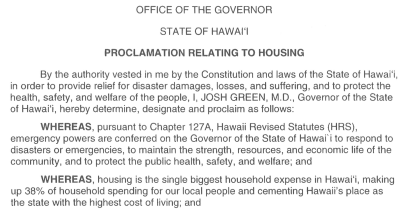
The two-plus years under the declared Co-19 emergency surely have given Hawaii’s executive-branch officials a clear vision of how much easier they could get their agendas accomplished without all that pesky democracy.

Hawaii’s Sweeping Emergency Management Act: Governor is the “Sole Judge”

Hawaii’s Emergency Management Act gives state and county executives broad and nearly unreviewable authority to suspend a wide spectrum of the usual laws, regulations, and rules. As we wrote in Hoist The Yellow Flag and Spam® Up: The Separation of Powers Limitation on Hawaii’s Emergency Authority, 43 U. Hawaii L. Rev. 71 (2020), Hawaii’s Act confers among the nation’s most muscular and sweeping powers. For example, the governor is the “sole judge of the existence of the danger, threat, or circumstances giving rise to a declaration of a state of emergency.” The Act’s one limitation — the 60-day time limit on how long an
Continue Reading What If The Hawaii Governor’s Cutting Of The Gordian Land Use/Environmental Knot Actually Works?

Screenshot 2023-07-31 at 08-01-31 Necessity Exceptions to Takings

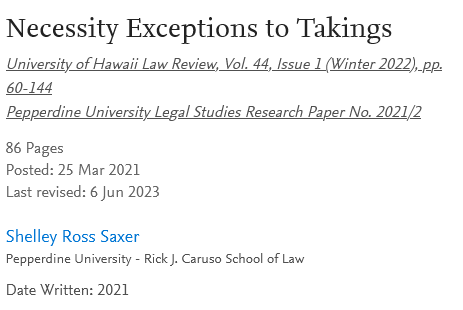
Worth checking out: a new article from Pepperdine Law School’s Shelley Ross Saxer, published in the University of Hawaii Law Review, “Necessity Exceptions to Takings,” 44 U. Haw. L. Rev. 60 (2022). [Disclosure: as noted in the author’s note, we reviewed an earlier draft of the piece and provided some thoughts.]

Here’s the Abstract:

The doctrine of necessity has strong roots in the common law of tort and property going back hundreds of years. In the United States the doctrine has been applied in various situations to negate judicial review of constitutional challenges to government action, most recently in some of the wildfire and flood claims resulting from disasters. But now, the states’ responses to the COVID-19 pandemic have brought one of these necessity doctrines—the public health necessity relying on Jacobson v. Massachusetts—to the forefront as courts across the country review constitutional challenges to state public

Continue Reading New Article – “Necessity Exceptions to Takings” (Shelley Ross Saxer)

The city told an owner whose three parcels were outside of the city’s jurisdiction that if it wanted the city’s permission to replat into 74 parcels, it would need city water and sewer service to each of the proposed lots.

So the owner asked to connect to the city’s water and sewer system (deliberately overbuilt to account for future users, apparently), and in response, the city told the developer that it would have to do two things. First, it would have to contribute to the cost of building the system by purchasing water/sewer chits (our term). When the system was built, the city anticipated future connections and created a chit system by which future connections would help pay for the cost of construction. Second, in order to purchase these chits, the buyer’s property must be included within the city’s jurisdiction. And that meant a voluntary annexation. Annexation does not come

Continue Reading Tex App: Nollan/Dolan Challenge To Annexation Fees Not Ripe: You Have To Apply For Annexation To Find Out What The Fee Will Be

PC PREL

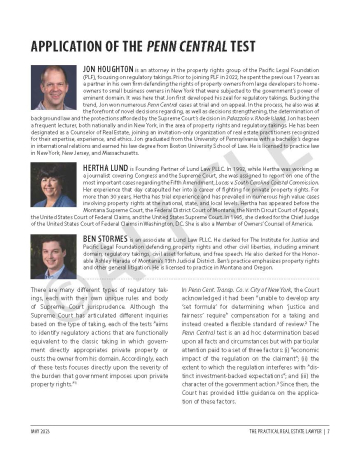
Here’s a recently-published article (ALI-CLE’s The Practical Real Estate Lawyer) on a subject that we know you will want to read about: Jon Houghton, Hertha Lund, and Ben Stormes, Application of the Penn Central Test, 7 Prac. Real Estate Lawyer 7 (May 2023).

Check it out. It’s short, practical (naturally), and worth your time.

Jon Houghton, Hertha Lund, and Ben Stormes, Application of the Penn Central Test, Prac. Real Estate Lawyer…

Continue Reading New Article: Application of the Penn Central Test

PXL_20221211_185826126
The Mahon Property

Join us on Friday, August 4, 2023 (10:30-11:30am, MT) in Denver at the ABA Annual Meeting for our CLE session on “The 100th Anniversary of Pennsylvania Coal v. Mahon: How the Takings Clause Became the Primary Check on Government Power When SCOTUS Abandoned Review Under the Due Process and Contracts Clauses During the New Deal.”

The program description:

The Takings Clause and 100 years of the Pennsylvania Coal v. Mahon doctrine have become the primary check on governmental power that the Due Process and Contracts Clause used to serve, before the Supreme Court finally and formally abandoned judicial review under those doctrines during the New Deal. Mahon transcended its primary relevance as to compensation for the taking of private property to become the fundamental means by which the Rule of Law determines of the individual’s relation with the government.

This session will survey the evolution

Continue Reading Aug 4, 2023: “The 100th Anniversary of Pennsylvania Coal v. Mahon: How the Takings Clause Became the Primary Check on Government Power” (ABA Annual Meeting, Denver)

The voters of South Lake Tahoe, California, adopted an ordinance that forbade the city from issuing short-term rental permits for properties in residential zones unless the owner was a permanent resident of the city, and declared that all short-term rental permits would expire three years later. The trial court granted the city summary judgment on all claims raised by an association of property owners who rented short-term. 

In South Lake Tahoe Property Owners Group v. City of South Lake Tahoe, No. C093603 (June 20, 2023), the California Court of Appeal mostly agreed, holding that the owners’ vested rights and state law preemption claims did not survive. But the court disagreed with the trial court’s dismissal of a (dormant) Commerce Clause challenge to the residency component. As noted in this recent Fifth Circuit decision, local ordinances that discriminate between residents and non-residents are (or at least could be) too

Continue Reading Cal Ct App: Prohibition On Short-Term Rentals Might Have A Commerce Clause Problem

We’re not going to dwell all that much on the California Court of Appeal’s recent opinion in Discovery Builders, Inc. v. City of Oakland, No. A164315 (June 22, 2023), mostly because it seems entirely predictable.

The developer thought it had an agreement with the city to pay certain fees (dare we say “exactions”) the city required in order to approve and provide what the court calls “project oversight.” The contract “provided that the fees set forth in the agreement satisfied ‘all of the Developer’s obligations for fees due to the City for the Project.'” Slip op. at 1. You know where this is headed, don’t you?

That’s right, eleven years later while the project was still underway, the city adopted new ordinances imposing new impact fees. When the developer sought additional building permits … no permit without paying the additional exactions. The trial court thought the contract took care

Continue Reading Chump Alert! Developer’s Claim That City Can Be Held To Its Contract Limiting Exactions Goes About As Well As You’d Expect

One from the Louisiana Court of Appeal, 3000-3022 St. Claude Avenue, LLC v. City of New Orleans, No. 2022-CA-0813 (June 22, 2023) demonstrating that the standard of judicial review for zoning matters (rational basis) is pretty powerful.

The owner wanted to develop its New Orleans property, but first needed a zoning amendment from residential to commercial, followed by a conditional use permit for its proposed use. The city denied the request. After much procedural back-and-forth, including a trip to the court of appeal to resolve, the case was sent back to the city council to state the basis for the denial. The council held a public meeting at which it denied the rezoning, and declined to state more, including the reasons why.

So back to court the owner went. The trial court thought it had been clear enough: you were supposed to say why you denied the rezoning. Hearing

Continue Reading Nectow Is Meaningless Because It “relies on pre-Lochner administrative review jurisprudence”

In this very short (but apparently published) opinion, the U.S. Court of Appeals held that it was not right to dismiss a claim on the pleadings and that factual development is warranted, even where the complaint alleges that a municipal land use ordinance is arbitrary and capricious, and the city claims it has a rational basis for the ordinance.

And when we say “short,” we mean it. Here’s the entirety of the opinion:

Plaintiffs here appeal the Rule 12(b)(6) dismissal of their complaint alleging that the City of New Braunfels’s zoning regulation banning short-term rentals of residential properties in certain areas of the city is unconstitutional. The district court ordered dismissal by approving a few conclusory paragraphs in the magistrate judge’s recommendation. This court’s relevant case law, however, indicates that some factual development may often occur in these cases, and that summary judgment may often follow. See, e.g

Continue Reading CA5 Makes Short Work Argument That Asserting A Rational Basis For A Short-Term Rental Ban Is Enough To Secure Pleadings Dismissal Of Arbitrary And Capricious Challenge

Screenshot 2023-06-16 at 17-28-39 TJB SC Orders & Opinions 2023 June June 16 2023

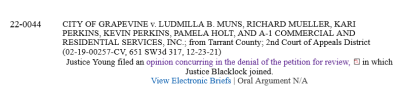
In this order, the Texas Supreme Court declined to review a case we’ve been following, in which the court of appeals held that Grapevine’s total ban on short-term renting of property — banning even owners who had been doing so for a while — might be a taking. The court held that even though the owners did not possess a classic vested right to continue using their properties to rent on a short-term basis, they owned their properties and that was enough. Property ownership comes with the “fundamental” right to rent it out and there’s no need to show more, such as a vested right under state law. More details on the city’s ban and the court’s reasoning here.

The city sought discretionary review and somewhat unusually, the property owners agreed that this is an important issue worthy of the Supreme Court’s review.

But even with everyone

Continue Reading Texas Supreme Court: We Want To Resolve Whether Short-Term Renting Property A Natural Right, Just Not In This Case