Here’s the latest in a case we’ve been following.

In this cert petition, business owners on the losing end of a Co-19 shutdown order assert that the Sixth Circuit got it wrong when it concluded that the “overriding public purpose” of the shutdown orders should be given what amounts to dispositive weight under the “character of the government action” Penn Central factor.

The Sixth Circuit correctly (in our view) rejected the district court’s rationale that the takings claim could be rejected simply because “the state acts pursuant to its police powers to protect public health.” Slip op. at 15. But the Sixth Circuit didn’t stop there, and affirmed the dismissal because the “character” of responding to the Co-19 emergency was so overwhelming that it outweighed the other two factors (which the court had already concluded “weigh in favor of the Plaintiffs”).

As we explained in an article on

Continue Reading New Cert Petition: There Must Be A Real Emergency Before Commandeerings Are Exempt From Compensation

Here it is, the official agenda and program for the 40th ALI-CLE Eminent Domain & Land Valuation Litigation Conference, February 2-4, 2023 (with a special event the evening of Wednesday, February 1, 2023 to entice you to arrive early).

Screenshot 2022-11-18 at 13-35-13 ALI CLE PA NY VA TX FL Continuing Legal Education

Here’s the brochure with the complete agenda, schedule, and faculty listing. But to tempt you, here are some of the highlights of the program:

  • Everything Old is New Again: Why Today’s Practitioners Need to Understand the Original Meaning of the Takings and Just Compensation Clauses
  • Private Utility Takeovers – Lessons From a 67 Day Trial

  • Valuation Issues When Billboards and Signs are Condemned

  • Setting Client Expectations and Identifying Red Flags

  • Developing Property Right Issues in Texas – Questions and Answers from the Bench: A View From the Bench (with Texas Supreme Court Justice Jimmy Blacklock)

  • Eminent Domain and Regulatory Takings Updates: Important Decisions You Need to Know

  • Ethics:


Continue Reading Here’s The Program For The 40th ALI-CLE Eminent Domain & Land Valuation Litigation Conference, Feb 1-4, 2023, Austin

Well, that was quick. As we noted here, we recently argued a case in the Ninth Circuit (October 20, 2022) about whether a regulatory takings claim is ripe

Not long after we posted the argument recording, the Ninth Circuit panel issued a short memorandum opinion rejecting our arguments wholesale (November 1, 2022).

So earlier this week, we asked the entire Ninth Circuit to take a look. Here’s our en banc petition.

We’ll leave it to you to read it and see why we think this one is ripe.

Appellants’ Petition for Rehearing En Banc, Ralston v. San Mateo Cnty., No 21-16489 (9th Cir. Nov. 15, 2022…

Continue Reading Let’s Take A Deeper Look At Takings Ripeness, Ninth Circuit

Just missed

Yes, the granddaddy of all SCOTUS regulatory takings cases, from which we got such phrases as these was argued 100 years ago this day.

  • The general rule, at least, is that, while property may be regulated to a certain extent, if regulation goes too far, it will be recognized as a taking.”
  • Government hardly could go on if, to some extent, values incident to property could not be diminished without paying for every such change in the general law.
  • “We are in danger of forgetting that a strong public desire to improve the public condition is not enough to warrant achieving the desire by a shorter cut than the constitutional way of paying for the change.”
  • “As long recognized, some values are enjoyed under an implied limitation, and must yield to the police power. But obviously the implied limitation must have its limits, or the contract and


Continue Reading It Was A Hundred Years Ago Today … Happy Argument Birthday, Pennsylvania Coal v. Mahon

To “slow the spread” in the early days of the Co-19 thing, the City ordered businesses to shut down. But not Wal-Mart, liquor stores, or churches. Golden Glow, a tanning salon objected, and told anyone who would listen that it could operate without person-to-person contact. Sorry, no exceptions.

Federal lawsuit followed, alleging the claims you might expect: equal protection and takings claims. Predictably, the district court granted summary judgment to the City.

And just as predictably, in Golden Glow Tanning Salon, Inc. v. City of Columbus, No. 21-60898 (Nov. 8, 2022), the U.S. Court of Appeals for the Fifth Circuit affirmed. The opinion, as you might expect is short.

Was Golden Glow treated differently from other businesses similarly situated without a rational reason? No. First, Golden Glow is similar to other shut down businesses: “[e]ach class of shut-down business provides recreational, social, or, as some would say, ‘nonessential’ services

Continue Reading Tanning Beds v. Liquor Stores – No Equal Protection, No Physical Take, No Lucas Take For Co-19 Biz Shutdown Order

Florida law makes it really difficult for municipalities to adopt rent controls. State statutes and the Florida Constitution erect all sorts of substantive and procedural hurdles that must be crossed. For example, a statute requires findings that any such measures are responding to an emergency, a “grave … menace to the general public,” and places the burden on the municipality to not just make findings, but back up those findings with facts, and show that rent control will actually “eliminate” the emergency. Single-family properties cannot be rent controlled. And any ordinance adopted by a municipality must be approved by the voters.

Facing what it concluded was a problem — a shortage of 26,500 housing units and a population increase of 25% in the last decade – Orange County’s County Commission voted, 3-2, to control rents. The measure limited the frequency and amount of rent increases.

After the measure was placed

Continue Reading County: We’re Short Of Housing, So Let’s Do Rent Control! Court: Not So Fast.

The County of El Dorado requires everyone seeking a building permit for new development to pay a fee to mitigate the additional traffic that the proposed development is predicted to cause. But the County doesn’t calculate the fee by actually looking at a proposed development and predicting what traffic impacts in may be responsible for. Rather, it has a generic fee schedule that applies to all proposed developments broken down by location and type (residential, commercial, etc.). We don’t care whether your development actually causes more traffic (or if it does, the extent of the increase), we’re hitting you all up.

Or as the California Court of Appeal put it in Sheetz v. County of El Dorado, No. C093682 (Oct. 19, 2022), “[i]n assessing the fee, the County does not make any ‘individualized determinations’ as to the nature and extent of the traffic impacts caused by a particular project

Continue Reading Whether $23K Traffic Fee Is Proportional To One Single-Family Home Is Beyond The Ken Of Judges

Earlier this month, the U.S. District Court invalidated Honolulu’s stretching of the minimum term for a residential rental from 30 days to three months, concluding that the ordinance likely violates the state Zoning Enabling Act, and also would be a taking if implemented. The court issued a preliminary injunction.

The lawyers repping the plaintiffs in that case — our former law partner Greg Kugle — appeared on Kelii Akina’s Hawaii Together (Think Tech) program to talk about it more. Check it out.Continue Reading More On Federal Court Invalidating Honolulu’s 3-Month Minimum Rental Term

October 20, 2022 was what one advocate noted was “land use day at the Ninth Circuit,” because three out of the four cases being argued in Courtroom 3 of the San Francisco courthouse were indeed land use — or perhaps more accurately, regulatory takings — cases.

Ours was one of those cases, Ralston v. San Mateo County.

Without going into too much detail, this is an appeal from the district court’s 12(b)(6) dismissal of our regulatory takings complaint. The crux of the claim is that Ralston’s R-1 zoned property is subject to an “overlay” district called the Montecito Riparian Corridor, a highly-restricted zone that allows only 5 environmental uses of land within the zone (none of which are consistent with the R-1 zoning). (Ralston’s property is labeled “076-19” on the County’s MRC map.)

Montecito Riparian Corridor

Absent some kind of special dispensation — what the County calls an “override” —

Continue Reading CA9 Takings Ripeness Oral Arguments: Must Property Owners Secure Govt’s Agreement That Property Is Subject To Challenged Regulations Before A Court Can Review?

IMG_20170323_142842

Here’s one we’ve been waiting to drop, in a case we’ve been following.

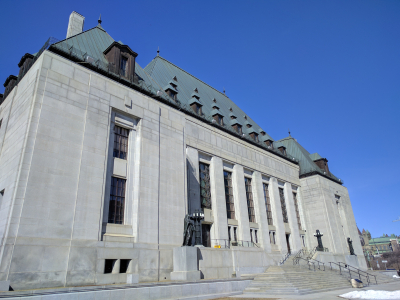
Today, in Annapolis Group Inc. v. Halifax Regional Municipality, No. 39594 (Oct. 21, 2022), the Supreme Court of Canada held (and we’re translating into United States here), that to state a claim for a regulatory taking based on the government’s refusal to approve a development application consistent with the residential zoning, requires only that the plaintiff allege a taking of a beneficial interest, and does not require that the government have seized land.

Our northern friends do not label this claim a “taking” or “regulatory taking,” but use different terms: de facto expropriation or constructive appropriation, or constructive taking, or even “disguised expropriation.” You get the drift. (For the record, we really like “disguised expropriation.”)

One major difference between Canadian takings law and the U.S. approach is that Canada does not consider property rights to

Continue Reading Oh, Canada! SCOCAN: Constructive Appropriation (Regulatory Takings) Claim Need Not Be Based On Land Acquisition; Taking Of Beneficial Interest Suffices