We won’t be providing our detailed thoughts on last week’s U.S. Court of Appeals for the Sixth Circuit’s opinion in Hall v. Meisner, No. 21-1700 (Oct. 13, 2022), because we’re obviously biased: our law firm colleagues Christina Martin and Kady Valois represent the prevailing property owners, so we naturally agree with the court. Thus, you should really read the opinion in its entirety yourself. But we shall offer some commentary:

  • This is another one of those “home equity theft” cases where, after foreclosing property in order to satisfy a tax or other debt, the government doesn’t remit the excess equity to the property owner, but keeps it or allows a private third-party to do so.
  • This case is a takings challenge to a Michigan county doing just that under the authority of state law. Hall owed a tax debt of $22k, and her home was worth close to $300k.
Continue Reading CA6: Home Equity Is Property Even If State Law Says Otherwise: Govt Can’t Foreclose To Satisfy A Tax Debt, Then Keep The Change

Many Honolulu residents don’t like short-term (less than 30 day) rentals. Whether fueled by NIMBY-ism, a genuine belief that tourists should stay out of residents’ neighborhoods and be limited to accommodations built for transients, or the belief that long-term rentals to locals somehow promote more affordable housing, the anti-transient renter vibe is most definitely there.

The no-less-than-thirty-days restriction wasn’t enough, however, and recently the City and County of Honolulu made it illegal to rent for less than three months (90 days). The ordinance stated the reasons:

Short-term rentals are disruptive to the character and fabric of our residential neighborhoods; they are inconsistent with the land uses that are intended for our residential zoned areas and increase the price of housing for O‘ahu’s resident population by removing housing stock from the for-sale and long-term rental markets. The City Council finds that any economic benefits of opening up our residential areas

Continue Reading Federal Court: Honolulu’s 3-Month Minimum Rental Term Preempted By State Law (And Would Be A Taking Of Vested Rights)

We already know that in Rafaeli, LLC v. Oakland County, 952 N.W.2d 434 (2020), the Michigan Supreme Court held that a homeowner has a property interest in the equity in her home, and that if she fails to pay the full amount of her property taxes and the government forecloses, the government can’t keep the proceeds in excess of the amount of the tax delinquency.

But did this ruling apply retroactively to cases where the foreclosure and sale (and the government keeping the change) occurred before the Rafaeli opinion was issued? That was the issue the Michigan Court of Appeals considered in Schafer v. Kent County, No. 356908 (Sep. 22, 2022).

Long story short: yes, the Rafaeli ruling is one upholding the Michigan Constitution, and did not so much establish a new principle of law as “returned the law to that which was recognized at common law and

Continue Reading Mich App: Supreme Court’s Takings Ruling Is Retroactive Because It Is Not A New Rule, But Returned To Common Law

PXL_20220927_164202969

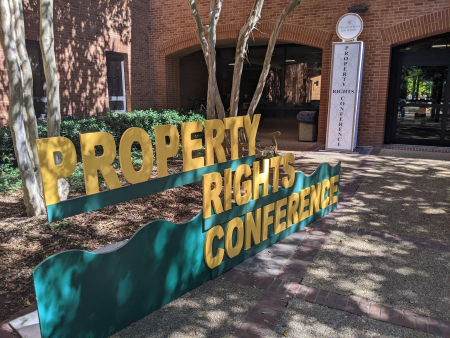
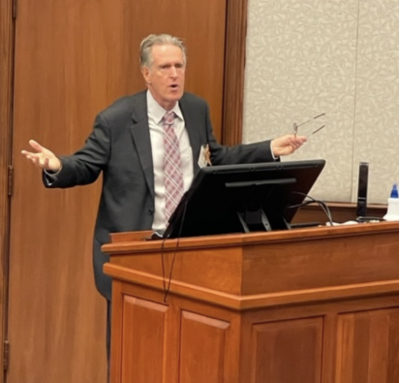
We spoke on the second panel of the day at the 2022 Brigham-Kanner Property Rights Conference at the William and Mary Law School. The subject of our panel — which included Professors David Callies, Tim Mulvaney, and Dave Owen — was “Reshaping the Framework Protecting Property Under the Roberts Court.

Here’s a rough transcript of my remarks.

————————————–

President Reveley, Professor Butler, distinguished Brigham-Kanner Prizewinners (present and future), mentors, colleagues, family and friends: thank you for the opportunity to speak today.

The story goes that when asked what it was like to be a part of the “Rat Pack,*” that Dean Martin responded “It’s Frank’s world, we just live in it.”

Fd5_62PUoAEo-y8

When I first heard the title of this portion of the program and the discussion of how and if the Roberts Court is reshaping property, my first reaction was a paraphrase of Dean

Continue Reading Brigham-Kanner Property Rights Conference 2022 Report: It’s Chief Justice Roberts’ Property World, We Just Live In It

We were all set to write a deep and insightful takings analysis of the U.S. Court of Appeals’ recent opinion in Net Choice, LLC v. Paxton, No. 21-51178 (Sep. 16, 2022), a challenge by the major social media platforms to a Texas statute that limits the platforms’ ability to censor speech or “de-platform” (kick out) speakers they don’t like.

In NetChoice, the Fifth Circuit sustained the statute against a Free Speech challenge. There’s been a lot of commentary on the court’s reasoning, as well as the conflicting result reached by the Eleventh Circuit in a similar case. See here and here, for example.

But the arguments in both of those cases focused on the First Amendment speech issues. Naturally, we don’t limit our view of the issues, and see lurking property rights questions. But in the Fifth Circuit case, the plaintiffs purposely avoided raising takings claims:

Continue Reading Viewing Social Media Content Censorship Through The Takings Lens

Screenshot 2022-09-13 at 14-12-11 Feed LinkedIn

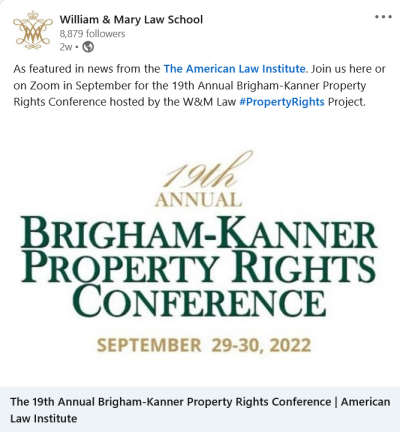
One last reminder that there’ still time to register for the upcoming Brigham-Kanner Property Rights Conference at the William and Mary Law School in Williamsburg, Virginia, September 29-30, 2022. If you can’t make it to the historic campus, there’s an option to attend remotely.

In our opinion, the Conference is the best of its kind because it brings together legal scholars and the practicing bar to talk dirt law theory and practice. We also a have a full supplemental program for law students, that covers property law and careers in eminent domain law, a recruiting session, a program on international property rights, and a program on land use law.

Registration for the Conference is ongoing, and you can sign up here.

Here is the full agenda. (We’ll be speaking on Panel #2, “Reshaping the Framework Protecting Property Under the Roberts Court.”)

Come on, join us!

Continue Reading Still Time To Join Us (In-Person Or Remote) For The 19th Annual Brigham-Kanner Property Rights Conference

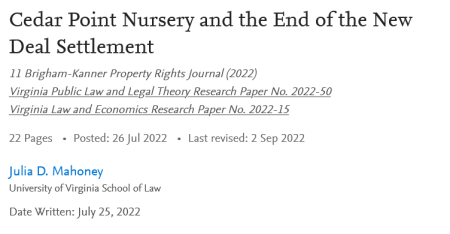
Screenshot 2022-09-08 at 11-03-58 Cedar Point Nursery and the End of the New Deal Settlement

Here’s your must-read for today, a new article from U. Va. lawprof Julia D. Mahoney, “Cedar Point Nursery and the End of the New Deal Settlement.”

Disclosure: we show up in footnote * along with others for offering “comments and conversations” about the piece. 

Here’s the Abstract:

In Cedar Point Nursery v. Hassid, the United States Supreme Court ruled that a California state regulation granting labor organizations a limited “right to take access” to agricultural employers’ property constitutes a per se physical taking. Cedar Point has sparked intense criticism, with critics arguing that the decision threatens to transform the law of property rights so as to “hobble” government land use regulation and even undermine democracy. This Article explains why the objections of Cedar Point’s detractors are misplaced. Far from disabling government regulation or fomenting stasis by favoring the “already haves,” Cedar Point is best understood as another

Continue Reading New Must-Read Article: “Cedar Point Nursery and the End of the New Deal Settlement” – Property Rights Are Civil And Human Rights

You remember that case we posted recently, from the U.S. District Court for the Eastern District of Texas in which the court granted summary judgment to a property owner after the city police damaged her home in the course of the police’s apprehension of a suspect. The court rejected the Tenth Circuit’s rationale in a similar case (which concluded that these are “police power” actions, and thus never a taking).

After that ruling, the remaining issues (was the city liable under section 1983, and if so what is the just compensation owed) were tried by a jury.

On June 20, 2022, this case went to trial. Two days later, the jury returned its verdict (Dkt. #74). The jury found the City was liable under § 1983 because it acted under color of state law when it violated Baker’s constitutional rights under the Fifth Amendment of the United States Constitution by

Continue Reading District Court Declines To Back Off Its “SWAT Takings” Verdict

In Hignell-Stark v. City of New Orleans, No. 21-30643 (Aug. 22, 2022), the U.S. Court of Appeals for the Fifth Circuit, like a lot of other courts, reached an unsurprising conclusion: New Orleans’ restrictions on short-term rental of residential properties isn’t a taking. But there are parts of the opinion that are definitely worth your time to check out. Read on.

The city had gone back-and-forth on whether renting for less than thirty days was a good thing. Originally barring STRs, then in 2016 offering city licenses, and then when the inevitable flood of STRs resulted, retrenching and substantially revising the licensing program:

One year into the initial regime, the City commissioned a study from its Planning Commission to reevaluate the STR policies. The study found that the rapid proliferation of STRs had brought nuisances to the City. Specifically, it discovered that STRs in residential neighborhoods had lowered

Continue Reading CA5: “But there’s a big difference between saying that something is property for purposes of procedural due process and saying that it is property for purposes of the Takings Clause”

We recommend you review the North Carolina Supreme Court’s opinion in Anderson Creek Partners, L.P. v. County of Harnett, No. 63PA21-1 (Aug. 19, 2022). It’s long (70 page majority, plus 19 pages of concurring and dissenting opinions), but worth your time because the majority concludes that legislatively-imposed fees, applicable to all, are “exactions” that are subject to the nexus/rough proportionality requirements of Nollan/Dolan/Koontz.

The county adopted a requirement that residential property developers pay a per-lot, one-time water and sewer capacity use fee as a condition of the county accepting applications for a water or sewer permit. The details:

Section 28(h) of the ordinance provides for the collection of “capacity use” fees for the purpose of “partially recover[ing] directly from new customers the costs of capacity of the utility system to serve them.” More specifically, the ordinance provides that, for each new residential connection to

Continue Reading NC: Generally-Applicable Impact Fee Is Subject To Nollan/Dolan/Koontz