If you ever get the opportunity to teach in a law school — either as a full-time legal scholar, or part-time as an expert adjunct practitioner — take it if you can. You might think you know a lot about a particular subject, but there’s nothing like spending time at the lectern in a law classroom in front of sharp and eager lawyers-in-training to sharpen your thoughts, and get you to truly understand a subject.

And folks calling you “professor” can evoke a smile.

Sensei

But if there’s one downside to the law school experience from the teacher’s side of the lectern, it’s grading. Especially at a law school like William and Mary that has a pretty strict mandatory curve. In upper-division courses that we handle like Eminent Domain and Property Rights Law and Land Use — where we’re dealing with some very high-level stuff and the quality of the

Continue Reading The Circle Is Now Complete: A Sampling Of Final Paper Topics From William and Mary Law’s Eminent Domain & Property Rights, And Land Use Courses

A short trial court decision. But because it deals with an interesting question, we’re posting it.

Check it out: in this order, the U.S. District Court for the District of Minnesota denied the city’s motion to dismiss in a case alleging, inter alia, a Fifth Amendment taking.

The property owners’ complaint alleged that their property, located in Tonka Bay, Minnesota, was taken by the neighboring city of Shorewood. The back of the property, you see buts up against the Shorewood border, and the owners have an unpaved driveway to access Timber Lane. The owners have used the driveway for a dozen years. 

But Shorewood neighbors “took issue with the [plaintiffs’] use of the unpaved driveway.” Slip op. at 3. (Thank goodness for neighbors, what would we do without them?). They asked Shorewood to install a barrier along the city boundary to prevent drivers from using Timber

Continue Reading A Tale Of Two Cities: A City’s Road Barriers Might Be A Taking, Even Though The Property Taken Is In A Neighboring City

Here’s a must-read from the Texas Court of Appeals (Second District).

In City of Grapevine v. Muns, No. 02-19-00257 (Dec. 23, 2021), 

Before 2018, the city’s 1982 zoning ordinance authorized “single-family detached dwellings” and didn’t say anything about short-term renting (short-term being defined as less than 30 days). The ordinance didn’t expressly authorize it, but it didn’t prohibit it either. The ordinance was one of those that say anything not expressly authorized is prohibited. Bed and breakfast operations were recognized in a 2000 amendment, but these operations require, among other things, that the owner live on-site.

But after the introduction of platforms such as AirBnB and VRBO, the short-term market “exploded” and the usual complaints from neighborhood residents followed. Slip op. at 6 (“criminal mischief, domestic disputes, parking violations, alarm calls, and noise disturbances”). Next came studies, public hearings, and the city’s assertion that it didn’t really need to

Continue Reading Tex App: “Property” Includes Right To Rent It Out – City’s Short-Term Ban May Be A Taking

Check this out, the latest episode of Clint Schumacher’s Eminent Domain Podcast, where his guest is Judge Andrew Edison (who may be familiar to many of you for his ALI-CLE presentation a couple of years ago about the eminent domain angle in the JFK assassination film).

Today, the topic is Robert Moses, NYC taker and redeveloper extraordinaire. We’ve been waiting a long time for this episode, and you won’t be disappointed. 

Here are the liner notes:

U.S. Magistrate Judge Andrew Edison has devoted much time and research to the life and legacy of Robert Moses, a former Parks Commissioner who had a broad and deep impact on the development of New York City’s infrastructure over a period of 50 years. Moses’ career in many ways provides a study of the human cost of eminent domain for different socio-economic communities. Judge Edison’s insight into Moses’ legacy is relevant to

Continue Reading Latest Ep, Eminent Domain Podcast: The Legacy Of Robert Moses (Judge Andrew Edison)

PASH symposium

Back in February, we were honored to be part of the University of Hawaii Law Review’s symposium “25 Years of PASH,” a retrospective of one of the Hawaii Supreme Court’s most famous (or infamous) decisions, Pub. Access Shoreline Haw. v. Haw. Cnty. Plan. Comm’n, 79 Haw. 425, 903 P.2d 1246 (1993), cert. denied sub nom., Nansay Haw. v. Pub. Access Shoreline Haw., 517 U.S. 1163 (1996) (PASH).

At the conference, we spoke on the panel about “PASH and the Changing Coastal Environment” (see video here at the 2:02:25 mark if you want to watch our panel’s summations). The Law Review has now published the symposium, and here’s our contribution, Takings PASH and the Changing Coastal Environment, 43 U. Haw. L. Rev. 525 (2021).

For those of you not totally tuned in, in the PASH case the Hawaii Supreme Court

Continue Reading New Article: “Takings, PASH, and the Changing Coastal Environment,” 43 U. Haw. L. Rev. 525 (2021)

Like a lot of things in Gary, Indiana, the Housing Authority was “troubled.” So troubled, the feds took it over. The Housing Authority received big money from the feds, and was required to agree to an annual contribution agreement, by which the Authority ok’d a HUD takeover in the even of the Authority’s substantial default.

Next up, default. The city dissolved the Housing Authority’s Board of Commissioners, and HUD appointed one of its employees to be the administrator of the Authority and to serve as the Board of Commissioners. Back in business.

Part of the administrator’s … ahem … “Authority’s” business was redevelopment. The Authority decided to take 624 Broadway’s property (which, not surprisingly, included 624 Broadway) to do some mixed-use and affordable housing. The taking was undertaken under Indiana’s eminent domain procedures. Attempts to purchase the property were not successful, so the Authority instituted an administrative taking.

Continue Reading Indiana App: Even When Federal Agency Steps Into The Shoes Of A Local Redevelopment Agency, It Has To Follow Local Rules

Screenshot 2021-11-15 at 11-33-55 Takings Localism

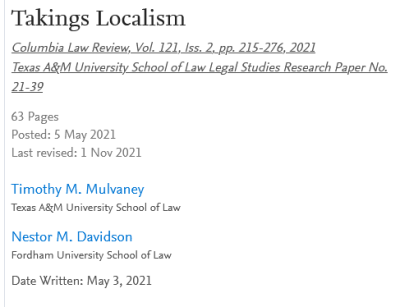
Be sure to check out the latest article from takings scholars and Nestor Davidson and Tim Mulvaney, “Takings Localism,” 121 Colum. L. Rev. 215 (2021) (pdf here).

Here’s the abstract:

Conflicts over “sanctuary” cities, minimum wage laws, and gender-neutral bathrooms have brought the problematic landscape of contemporary state preemption of local governance to national attention. This Article contends that more covert, although equally robust, state interference can be found in property, with significant consequences for our understanding of takings law.

Takings jurisprudence looks to the states to mediate most tensions between individual property rights and community needs, as the takings federalism literature recognizes. Takings challenges, however, often involve local governments. If the doctrine privileges the democratic process to resolve most takings claims, then, that critical process is a largely local one.

Despite the centrality of local democracy to takings, state legislatures have restricted local authority on property issues in a range of ways. States have expanded compensatory liability for owners facing local regulations, imposed procedural constraints on local authority, and limited the exercise of foundational local powers. Seen in its entirety, this state intervention—like contemporary “new preemption”—is acontextual and unduly rigid, cutting at the heart of the devolutionary principles underlying takings jurisprudence.

This unbalanced state role requires a recalibration of decisionmaking power between state and local government to foster intersystemic dialogue and reflection. States certainly play a crucial role in defining and protecting property interests, but they must justify choices to constrain local discretion when state and local values conflict. The extant state statutory regime dispenses with this justificatory task via a formalistic disregard for the contextualization that legitimates vertical allocations of authority. A corrective to decades of imbalance in state ordering of local authority would thus properly recognize “takings localism.”

Free up local governments, or tie their hands…which is better? After reading this, you decide.
Continue Reading New Article: “Takings Localism” (Tim Mulvaney & Nestor Davidson)

There’s not a lot of direct takings love in the U.S. Court of Appeals for the Second Circuit’s opinion in Melendez v. City of New York, No. 20-4238 (Oct. 28, 2021), but there’s enough there that you might want to read it anyway.

Because the opinion resurrected the plaintiffs’ Contracts Clause claim. You heard that right, their Contracts Clause claim. The plaintiffs asserted that New York City’s ordinance that prohibiting “threatening” a tenant due to their Co-19 status violated free speech and due process rights, and the city’s ordinance voiding personal guarantees for commercial leases impaired their lease contracts. The district court dismissed the case for failure to state a claim, concluding that the guaranty ordinance served a legitimate public purpose and did not favor any class.

The Second Circuit affirmed dismissal of the free speech and due process claims, but also concluded that the complaint alleged a plausible

Continue Reading CA2: NYC’s Eviction Moratorium May Have A Contracts Clause Problem

21a0226p-06

We thought we posted the U.S. Court of Appeals for the Sixth Circuit’s recent opinion in a takings case,  Golf Village North, LLC v. City of Powell, No. 20-4177 (Sep. 23, 2021), earlier, but a search of the blog reveals we did not, so here we go.

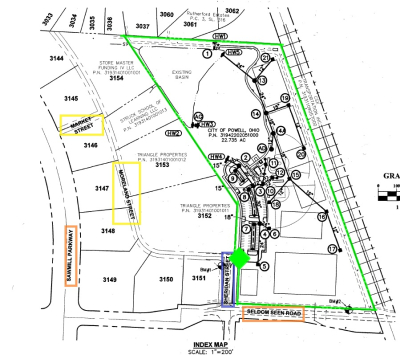
The City built a new 23-acre public park (highlighted in green on the map above), which had been dedicated by the developer, Golf Village North, as a condition of subdivision. A road that led to the one of the park entrances was to be made a public road (blue highlighted). The City’s plans noted that approval of the park construction and opening the blue road to the public were contingent on the City securing easements from Golf Village for public access to the private streets.

The city tried to obtain these easements but Golf Village declined. Notwithstanding the city’s plans required

Continue Reading CA6: City Park Causing Public To Use Private Roads Not A Taking Because Owner Can Erect Roadblock

FrankLUI Co-Chair Prof. Frank Schnidman introducing the faculty

Here are the links to the cases and issues that we just finished speaking about at the 35th Annual Land Use Institute (more information on the LUI here). Today was day 1 of a multi-day remote program and the sessions are available ala carte, so there’s still time to join in and learn.

Supreme Court

  • Cedar Point Nursery: the Supreme Court affirms the “keep out” vibe in property law. Yes, there are three “exceptions” to the presumption that any physical intrusion into property is a taking (torts, entries allowed under “background principles,” and legal exactions), but overall a very strong affirmation of property rights.
  • Pakdel v. San Francisco: the “final decision” ripeness requirement in takings cases is “relatively modest” and turns on “de facto” readiness. Yes, it’s a technical requirement, but let’s not get too technical about it.
  • PennEast Pipeline


Continue Reading Links And Materials From Today’s Land Use Institute Takings/Eminent Domain Session