Here’s an issue that we’ve been following for a while. What will a court do when a condemnor is ordered to pay (the property owner has a judgment in hand), but the condemnor says “no thanks”?

The latest incarnation is the U.S. Court of Appeals’ opinion in Ariyan, Inc. v. Sewerage & Water Board of New Orleans, No. 21-30335 (Mar. 21, 2022). There, a group of property owners successfully brought Louisiana law takings claims against the Board after its flood control project caused “property damage and economic loss.” In the various cases, verdicts were rendered, and judgments were issued from 2018 through 2020.

Well, you know what is supposed to happen next. Judgment debtors are supposed to pay up, or else the judgment creditor may satisfy the judgment by other means.

But when the government is the judgment debtor, the creditor can’t just put a lien on City

Continue Reading What Can A Property Owner Do When A Condemnor Doesn’t Pay? (Fifth Circuit: Nothing)

Check out the U.S. Court of Appeals for the Eighth Circuit’s opinion in 301, 712, 2103 and 3141 LLC v. City of Minneapolis, No. 20-3493 (Mar. 14, 2022), in which the court held that a Minneapolis ordinance prohibiting property owners from rejecting a prospective tenant because of the applicant’s criminal, credit, or rental history isn’t a taking.

The challenged ordinance “requires landlords to evaluate applicants for rental housing by either (1) ‘inclusive screening criteria’ or (2) ‘individualized assessment.'” Slip op. at 2. That’s a roundabout way of saying that a property owner cannot reject an applicant for their criminal or credit background, unless the owner first considers other “supplemental evidence” to justify why the applicant should become a tenant in spite of these problems, and notifies the tenant why this evidence isn’t enough to outweigh the problems. 

The court first rejected the owners’ claim that the ordinance allows third

Continue Reading CA8: Ordinance Making It Really Really Hard To Reject Tenants Isn’t A Physical Taking

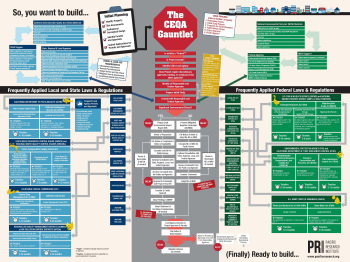
CEQAflowchartSee if you can navigate this maze.

Even if you are not in California, this thing called “CEQA” (the California Environmental Quality Act) is something you might have heard of. An environmental reporting statute on steroids, CEQA is, according to this new report from the Pacific Research Institute, the main reason why California is home to the unbeatable combination of sky-high home prices and nation-leading poverty rate, and has become as famous for its homeless problem as its beaches

In “The CEQA Gauntlet,” the authors report that the above problems are products of the fact that it is “very, very hard to build homes in California.” And the reason it is hard to build homes in California? That’s right, CEQA.

What started off as a data-gathering and informational requirement (so that the decision makers could incorporate environmental considerations) has become the tail that wags the dog

Continue Reading Death By A Thousand Days: Presenting “The CEQA Gauntlet” Report

Well, that was quick. Last month, as we reported here, the a Ninth Circuit panel held that the City of Oakland, California, could require property owners to pay thousands of dollars in what is branded “relocation fee” to their tenants as a precondition of the owner moving into their own property. This isn’t an “exaction” subject to the nexus and rough proportionality requirements applicable to such demands when they are in land use permits. This was merely a regulation of the landlord-tenant relationship.

Now, our colleagues Dave Breemer and Brian Hodges (the team responsible for Knick v. Township of Scott) have produced this cert petition.

As this is a case in which our firm has an active part, we won’t be doing much more here than posting the petition, and the Question Presented. You can read the petition yourself and get the idea of what the issues

Continue Reading New Cert Petition: Are Generally-Applicable Requirements Subject To Nollan-Dollan Analysis?

Lately, we’ve been zeroing in on one of the lesser known parts of the Supreme Court’s takings canon, Yee v. City of Escondido, 503 U.S. 519 (1992), where the Court concluded that a city ordinance that limited the amount a property owner could charge a tenant for rent was not a physical invasion taking.

In Yee, the Court held that the ordinance did not intrude on the owner’s right to exclude because the owners had invited their tenants to intrude on their property when they let them become tenants. Yeah, that invitation and resulting intrusion was conditioned on the tenant paying each month a specific amount of rent and the ordinance effectively rewrote that agreement, but the plaintiff raised only a facial categorical takings claim (and thus the question of whether the city-mandated lower rent prohibited a fair return to the owner was an issue that the owners could

Continue Reading Wash App: No Taking Of Right To Exclude Because Eviction Moratorium Merely Lets Tenants Remain

CedarpointPRELcoverpage

Thank you to the editors over at The Practical Real Estate Lawyer for publishing my missive on Cedar Point Nursery v. Hassid, the U.S. Supreme Court’s recent blockbuster regulatory takings decision (and for letting me post a copy of the article here so it is available even if you are not a PREL subscriber). And you know this, but I’m going to disclose it again: my law firm represented the property owner in that case, so yes, I do have a viewpoint; take that into account while reading. 

By the way, you might consider becoming a subscriber. The journal publishes just what the title suggests it does – practice-oriented articles about dirt lawyering. Good stuff.

Thomas, Common Sense and Common Law: Defining “Property” in Cedar Point v. Hassid, 38 Prac. Real Estate Law…

Continue Reading New Article: Common Sense and Common Law: Defining “Property” in Cedar Point v. Hassid

IMG_20170323_142813

Sorry about the headline, but come on, man! We have to use clickbaity headlines every now and then to get your attention. Here’s the latest in a case we’ve been following.

Yesterday, the Supreme Court of Canada heard oral arguments in Annapolis Group Inc v. Halifax Regional Municipality, a case involving “de facto expropriation,” or what we in the U.S. might think of as a regulatory taking.

We watched the livestream (along with a few of our northern colleagues), and if you missed it, the recording of the (2-hours and 30-minutes!) arguments can be found here — in English, with simultaneous French translation, if you want to have some extra fun.

Screenshot 2022-02-17 at 07-50-43 Supreme Court of Canada - SCC Case Information - Webcast of the Hearing on 2022-02-16 - 3[...]

Yes, there really are that many Justices
and lawyers on the argument

The Supreme Court is considering whether Halifax’s refusal to approve Annapolis Group’s development applications (consistent with its residential zoning, more specifically “future serviced development”) on

Continue Reading Important Developments In Canada (No, Not That!): Supreme Court Hears Argument In “Takings” Case

Screenshot 2022-02-15 at 07-42-11 Eminent Domain Reports - Publications IRWA

Check this out: the International Right of Way Association’s Real Estate Law Committee produces twice-a-year reports “which contain summaries of eminent domain decisions and legislation within the United States.” (This is the “international” right of way association, so that last qualifier is important.)

And what is really nice is that they make the report available

We’re posting it here because we’re one of the co-authors. The laboring oars on this are really Brad Kuhn and Jullian Friess Leivas (both from the Nossaman firm), but they were kind enough to ask me for some input.

Brad and Jillian wrote up more at the California Eminent Domain Report.

The report is short, and doesn’t have a lot of fluff. Just what you wanted.Continue Reading IRWA’s Summary Of Major Eminent Domain Cases & Legislation (June-Dec 2021)

PXL_20220127_144224442

After a two-year absence in which we went remote, in the last week of last month (our usual spot on the calendar, between the playoffs and Super Bowl), we once again met in-person for the American Law Institute-CLE Eminent Domain and Land Valuation Litigation Conference.

Approximately 200 lawyers, judges, legal scholars, appraisers, law students, right-of-way agents, relocation experts, property owners, and other related professionals gathered in-person–yes, in-person–at the Scottsdale (Arizona) Resort at McCormick Ranch, to get reacquainted, learn stuff, and renew ties last made in-person in Nashville in 2020. In addition to the live attendance, we also welcomed about 50 remote colleagues, who joined the live webstream.

This was the 39th edition of the Conference, one of the most-established and successful conferences in the ALI-CLE stable of programs.

To those who joined us – thank you. This conference reminded us of why this program is so

Continue Reading 2022 ALI-CLE Eminent Domain And Land Valuation Litigation Conference, Scottsdale: You Should Have Been There!

Before we go further into the Ninth Circuit’s opinion in Ballinger v. City of Oakland, No. 19-16-550 (Feb. 2, 2022), this disclosure: this is a case in which our law firm represents the property owners. So take that into account as you read our take on the case.

The Ballingers own a home in Oakland, California, and were called away for a year while on active duty with the military. They rented their home with a one-year lease. Oakland makes property owners who want to move back into their own homes at the expiration of a lease to pay tenants a “relocation fee.” The Ballingers paid $6.5k to the tenant for the relocation fee, and sued the city for, inter alia, a physical taking of their money, and for an unconstitutional exaction of their home. The district court dismissed for failure to state a claim because the

Continue Reading CA9: We Reject Legislative/Administrative Distinction In Exactions, But City Requirement That Owners Pay Tenant To Move Back Into Their Home Isn’t A Taking