Skip to content

1000002646

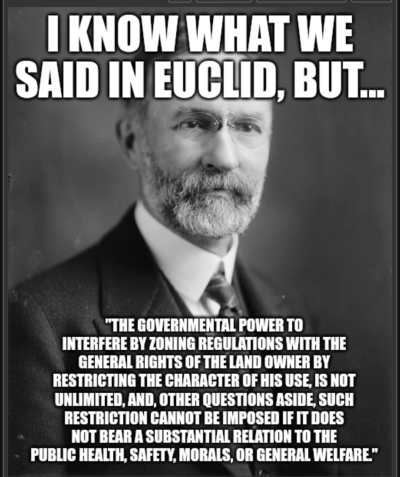
It was on this day in 1928 when the U.S. Supreme Court issued its second most famous decision about zoning, Nectow v. City of Cambridge., 277 U.S. 183 (1928). 

We say “second” because everyone knows that the first is the Court’s decision issued just two years earlier which generally upheld comprehensive use, height, and density regulations as a valid exercise of the government’s police power to regulate property uses to further the public health, safety, welfare, or morals. See Village of Euclid v. Ambler Realty Co., 272 U S. 365 (1926). 

Partly because of the hype surrounding Euclid and the broad governmental embrace of exclusionary land use policies that Euclid unleashed, we think that Nectow has not received the attention it is due. After all, it should be seen as the companion case to Euclid: it was authored by same Justice who wrote Euclid (Justice Sutherland)

Continue Reading Happy 97th Birthday, Nectow v. City of Cambridge!

We’ve had this one in our queue for a bit, but it seems now is a good time to lay out the U.S. Court of Appeals for the Sixth Circuit’s opinion in McIntosh v. Madisonville, No. 24-5383 (Jan. 21, 2025). After all, the Due Process Clause seems to be in the news a lot lately, and this case explains what process is due property owners before they are deprived of that property.

Here’s the story. The city, after a code enforcement officer’s inspection (responding to a tenant complaint) declared that one of McIntosh’s mobile homes had mold and deemed it unsafe and unsalvageable. Letter followed notifying the owner of the city’s condemnation of the property, advising him that he had 30 days to submit plans for getting things in order, or else the city was going to tear it down. The city also put notice on the property itself.

Continue Reading CA6: The Predeprivation Hearing Required By Due Process Can’t Just Exist On Paper (And An Informal, And Possibly Made-Up Chance To Negotiate Isn’t Enough)

The key quote from the Illinois Appellate Court’s recent opinion in Robinson v. City of Chicago, No. 1-23-2174 (Mar. 24, 2025), in which a property owner challenged the inclusion of his property in a new Chicago historic preservation district? This seemingly innocuous sentence setting out the standard of review:

The plaintiff acknowledges that his substantive due process and equal protection challenges to the ordinance designating the District as a Chicago landmark are subject to rational basis review.

Slip op. at 13.

Those of you for whom this ain’t your first rodeo know that rational basis review (aka aliens might have done it) being invoked isn’t a good sign for a challenger. It nearly always tells the challenger “you lose, no matter what.” And here, that prediction plays out: the court rejected the property owner’s arguments that the city’s designation of his small neighborhood — a neighborhood that

Continue Reading Who Cares Your “Evidence” Shows This Is Just An Old Part Of Chicago – All That Matters Is The City Says It’s Historic

Here’s the latest in a case we’ve been following closely (and disclosure: our firm filed an amicus brief in the Texas Supreme Court).

First, the bottom line: in The Commons at Lake Houston, Ltd. v. City of Houston, No. 23-0474 (Mar. 21, 2025), the Texas Supreme Court held that merely because a regulation is a justified exercise of police power does not insulate it from a claim that it goes too far and is also a taking requiring compensation. 

The Texas Court of Appeals held that the city could not be liable for a taking for an ordinance that limited development and use within the city’s 100-and-500-year floodplains because the ordinance was a valid exercise of police power and otherwise survived the rational basis test.

As we wrote here, that seems like utter nonsense to say that a valid police power reason categorically insulates a government action

Continue Reading Breaking: Texas Takings Law Enters The 20th Century!

Wondering what happened to that case we posted about last week, where our outfit is representing property owners in a federal court challenge to a Rhode Island town’s efforts to take their land by eminent domain?

Well, here’s the latest. The court just issued this Temporary Restraining Order. Read it for the details. This is our case, so we’re not going to say more here.

But for further details about what brought this about, read Christian Britschgi’s piece at Reason, “Town Secretly Seizes Developers’ Property Then Threatens Them With Trespassing Citation” (Mar. 18, 2025).

Temporary Restraining Order, SCLS Realty, LLC v. Town of Johnston, No. 25-00088-MRD-PAS (D. R.I. Mar. 19, 2…

Continue Reading Latest In Public Use Eminent Domain Pretext Challenge: Federal Court TRO

Today we have a guest post by New York colleague Jennifer Polovetsky, who writes about an exactions case that is headed for the New York Court of Appeals. Disclosure: our firm represents the property owners in that court. 

Thanks to Jennifer (and to the New York Law Journal) for allowing us to republish her intriguing piece.

_____________________________

NY Zoning Law Mandating Contributions Deemed an Unconstitutional Taking

by Jennifer Polovetsky

A few years ago, on December 15, 2021, the City of New York (the City) amended §143–13 of the City Zoning Resolution (the ZR Amendment). A portion of this ZR Amendment required property owners to pay a mandatory, nonrefundable contribution to the SoHo–NoHo Arts Fund (Arts Fund), as a precondition to filing for a permit to convert joint living-work quarters for artists (JLWQA) to unlimited residential use.

What is the problem with the ZR Amendment, you may ask? Well, according


Continue Reading Guest Post (Jennifer Polovetsky): “NY Zoning Law Mandating Contributions Deemed an Unconstitutional Taking”

Purpose

Before we go further, a disclosure: this is one of ours.

Here’s the Complaint for Violations of Constitutional and Civil Rights, filed yesterday by the Santoro Family in federal court in Rhode Island. This lawsuit challenges, under the Public Use Clause, a RI town’s eminent domaining the family’s land for the ostensible purpose of building a new municipal campus

Sounds like a “classic” public use, you say? Not so fast. As alleged in the complaint, the actual use, purpose, and necessity for the taking is something else: to stop the Santoros from building 250+ low- to moderate-income housing.

Because this is one of ours, we won’t say more. But here’s the story, from the Complaint:

1. SCLS Realty, LLC, and Sixty Three Johnston, LLC, family-owned homebuilders whose members are Lucille Santoro, Salvatore Compagnone, Ralph Santoro, and Suzanne Santoro (the plaintiff LLCs are referred to herein jointly as

Continue Reading Challenge To Sham Eminent Domain: The Government Can’t Lie About Why It Takes Property

Here’s the latest in a case we’ve been following. This is GHP Management Corp. v. City of Los Angeles, No. 24-435, the cert petition which asks whether a local ordinance which allowed non-paying tenants to remain in the lessor’s property is a physical taking, or merely the regulation of the lessor/lessee relationship under the Yee theory, which posits that once an owner voluntarily rents property to a tenant, the government then allowing that tenant to remain rent free isn’t facilitating an unauthorized physical occupation, but rather is merely a regulation of the existing lessor/lessee relationship. 

The petitioner property owner has filed its cert stage Reply, which means that all the briefing is in, and next up is for the Supreme Court to set the conference date. Here’s the summary of the issues from the Reply:

Respondents prefer a world where government enjoys absolute immunity from

Continue Reading Eviction Moratorium As A Physical Taking All Teed Up

You should already know Short Circuit is the Institute for Justice’s frequently-updated podcast on important and interesting decisions from the federal courts of appeals (the “Circuit” part of the title, we assume).

If you are not already a regular listener you are missing out, because it is a fantastic and easy way to keep up with what is going on, and to hear insightful analysis.

We’ve visited the SC studios in the past, and this week made a return visit, joining host Anthony Sanders (Director of the Center for Judicial Engagement), and guest Justin Pearson (Managing Attorney of IJ’s Florida offices), to talk cattle feedlots, “new” vs. “old” property, North Carolina’s Law of the Land Clause, and methods of constitutional interpretation.

Here’s the episode summary, and show notes, from the Short Circuit site:

A long-time friend of the Institute for Justice, Robert Thomas, joins us this week. For

Continue Reading “I Like Old Property” – We Return To The “Short Circuit” Podcast To Talk Law Of The Land & Magna Carta

2025RMLUI_750x550_FNL

Registration is open and underway for this year’s edition of the Rocky Mountain Land Use Institute in Denver, March 5-7, 2025. Location: University of Denver Sturm College of Law.

This conference is more what we’ll call “land usey” than ALI-CLE’s Eminent Domain & Land Valuation Litigation Conference (as the respective titles suggest), but there’s a lot at RMLUI for those whose practices lean more on the eminent domain side than the land usey. As we know, any attempt to draw a clean line between these practices is futile, and there’s tons of crossover. That’s why we’ll be there, downloading the latest.

As always, there’s a great a la carte menu of programs and tracks for attendees to choose from, including sessions on “Sheetz and Exactions,” “Brownfields Re-Re-Development,” “Managing Growth and Infrastructure in the Southwest,” “ADUs for Aging in Place,” and, thankfully, “Legal Ethics.” And some add-on workshops the day

Continue Reading 2025 Rocky Mountain Land Use Institute, Denver (March 5-7, Denver U. Law School)