Check this out, a recent Fourth Branch pod featuring lawprof Donald Kochan and our law firm colleague Jeremy Talcott, “Explainer Episode 85 – Rebuilding California: Lessons from the Pacific Palisades Fire.”

Here’s the description:

The 2025 Pacific Palisades Fire has underscored the challenges of building in California’s complex regulatory landscape. In response, Governor Newsom issued an executive order suspending CEQA and Coastal Act requirements to expedite reconstruction, raising important questions about the future of development in the state. In this podcast, experts Jeremy Talcott and Donald Kochan examine California’s regulatory environment before the disaster and the broader implications of its permitting processes in the effort to rebuild. Join us for an in-depth discussion on balancing efficient recovery with long-term regulatory considerations.

The money quote from Jeremy:

And I think this fire really offers a very good inflection point for a reimagining or a revisiting of the utility
Continue Reading Fourth Branch Podcast: Talcott & Kochan On “Rebuilding California: Lessons from the Pacific Palisades Fire”

PXL_20230509_183011703

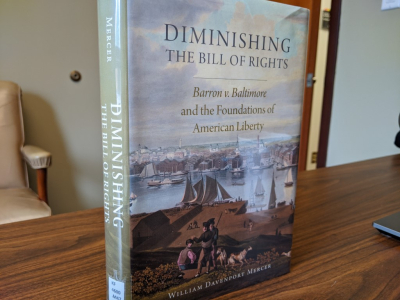
This Sunday, February 16, 2025, will be the day, 192 years ago, when — a mere 5 days after oral arguments — the U.S. Supreme Court issued its (in)famous opinion in Barron ex rel. Tiernan v. Mayor and City Council of Baltimore, 32 U.S. 243 (1833).

Generations of law students study this decision in their Con Law classes, and it is mostly known as the case in which the Court held that the Bill of Rights limits only the federal government and does not limit the power of states. For the latter, one must look to state constitutions. Barron, of course, was overruled or otherwise neutralized by the Fourteenth Amendment (privileges or immunities clause or the due process clause, take your pick). And it was formally abrogated in Chicago, Burlington and Quincy Railroad Co. v. City of Chicago, 166 U.S. 226 (1897) (states and their instrumentalities are bound

Continue Reading Feb. 16, 1833: Unhappy 192d Birthday To The First SCOTUS Takings Case, Barron v. Baltimore

Screenshot 2025-01-23 at 15-10-58 Takings and Choice of Law After i Tyler v. Hennepin County _i by Eric R. Claeys SSRN

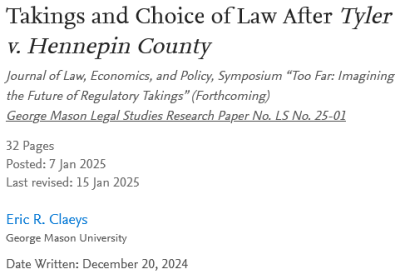
Check out this article, forthcoming in the George Mason Journal of Law, Economics, and Policy from lawprof Eric Claeys, “Takings and Choice of Law After Tyler v. Hennepin County.”

This is one of the pieces coming out of the recent symposium “Imaging the Future of Regulatory Takings” at George Mason Law School.

Here’s the Abstract:

This Essay contributes to a symposium on the future of regulatory takings. It focuses on choice of law in eminent domain disputes. When claimants bring eminent domain claims in federal courts, the courts must determine whether the claimants have constitutional “private property” in the entitlements allegedly taken. Should that determination be made with federal law, with the law of the state allegedly taking property, or law from some other source?

The 2023 Supreme Court decision Tyler v. Hennepin County addressed that issue. Under Tyler, it is a federal question whether an eminent domain claimant has constitutional private property. To answer the question, federal courts usually consult the law of the state where the alleged taking took place. But that presumption applies only if state law seems to secure and not to circumvent the federal right. And if that reservation is not satisfied, federal courts may consult a wider pattern of legal sources—Anglo-American history, the general law of the several United States, federal court precedents, and a broader cross-section of law from the state allegedly taking property. That approach resembles the approach taken generally for federal constitutional rights—especially in Indiana ex rel. Anderson v. Brand (1938)—but varies from the general approach in the sources it makes relevant to settle what counts as private property under the Fifth Amendment. This Essay interprets Tyler, and it offers a normative justification for Tyler’s approach to choice of law in eminent domain. 

Don’t miss this one.

Continue Reading New Article (Eric Claeys): “Takings and Choice of Law After Tyler v. Hennepin County”

20180720_150853_HDR
The only courthouse we know where the Supreme Court
is
below the Court of Appeals (SJC on the second floor,
appellate court on the third)

A brief one from the Supreme Judicial Court of Massachusetts.

In Attorney General v. Town of Milton, No. SJC-13580 (Jan. 8, 2025), the court rejected a challenge to a state statue which allowed the Massachusetts Bay Transportation Authority, the public transit authority in the Boston area, to require municipalities which access the T loosen their zoning regimes to “provide for at least one district of multifamily housing ‘as of right’ near their local MTBA facilities.” Slip op. at 3. One town declined to do so, and the state AG sued to enforce the statute.

The town responded by challenging the statute’s validity and the AG’s authority to sue to enforce it. Yes on both counts held the SJC. But (and there’s a

Continue Reading Mass SJC: State Requiring Municipalities To Adopt Multi-Family Zoning Is Enforceable By AG…But

The facts in D.A. Realestate Inv., LLC v. City of Norfolk, No. 23-1863 (Jan. 16, 2025), a recent decision from the U.S. Court of Appeals for the Fourth Circuit, are fairly sympathetic. And the opinion starts off with a tantalizing quote:

In 1761, Massachusetts lawyer James Otis exclaimed “one of the most essential branches of English liberty is the freedom of one’s house. A man’s house is his castle.” John Adams’s Reconstruction of Otis’s Speech in the Writs of Assistance Case, in Collected Political Writings of James Otis 12–13 (Richard Samuelson, ed. 2015). American law has embraced that principle since our nation’s founding. U.S. Const. amend. V. But we have also long recognized that “all property in this country is held under the implied obligation that the owner’s use of it shall not be injurious to the community.” Mugler v. Kansas, 123 U.S. 623, 665 (1887).

Slip op.

Continue Reading CA4: Challenge Public Use/Pretext Under Due Process And § 1983, Not Inverse

Two — count ’em two! — cert petitions from our shop, filed today. Both call for “clarifying or overruling” Penn Central.

Oh, have I got your attention now?

Both arise out of the Michigan governor’s orders shuttering some, but not all, businesses during Co-19. These had devastating consequences, and owners sued for, inter alia, a taking, asserting a Penn Central theory. As we noted here, the Gym 24/7 case went up through the Michigan court system, with the Supreme Court eventually denying discretionary review over an extensive dissent. The Mount Clemens Recreational Bowl case took pretty much the same path. 

We’re not going to say much more because

Continue Reading Two New Cert Petitions (Ours) – 50 Years Of Fruitless Trying Is Enough: Overrule Or Clarify Penn Central!

If you thought the issue of whether it is a Fifth Amendment taking for a state or local government to “keep the change” after satisfying a tax debt was settled by the U.S. Supreme Court in Tyler v. Hennepin County, 598 U.S. 631 (2023), you’d be right.

Then what was there left for the New Jersey Supreme Court to decide in 257-261 20th Avenue Realty, LLC v. Roberto, No. A-29-23 (Jan. 9, 2025)? Some interesting stuff, it turns out.

And before you conclude that this is just piling-on, remember — they wanted this: after Tyler, instead of reading the U.S. Supreme Court’s decision and the writing on the wall, some state and local governments, unhappy with being cut off from a source of easy money, tried to figure ways to avoid or negate the rule that if there’s money left over after you satisfy a tax debt

Continue Reading NJ’s Forfeiture Statute Is A Taking Of Surplus Home Equity

With our tongues firmly planted in cheeks, the Planning Chairs for the upcoming 42d edition of this popular and venerable Conference bring you this “breaking news” report from San Diego!

As you know, in addition to being the best nationally-focused conference on the subjects that we love and a venue that is nearly certain to have some of the warmest winter weather in the continental United States, and we went on-location from some of the local highlights: the beaches, Torrey Pines, the Zoo, Balboa Park, the Gaslamp Quarter, and Coronado to name but a few.

More about the Conference here, including registration information.

Here are some of the highlights:

  • Property Rights at the Supreme Court: DeVillier and Sheetz and What’s Next
  • Slow Take: Possession, Rent, Relocation, and Offset
  • The Jury’s View: How Jurors See Your Case
  • From Penn Coal to Penn Central: How to


Continue Reading Breaking News: Come Join Us For The 42d ALI-CLE Eminent Domain & Land Valuation Litigation Conference, San Diego, Jan 30-Feb 1

It’s been a couple of weeks, but we’re still trying to wrap our head around the Iowa Supreme Court’s opinion in Singer v. City of Orange City, No. 23-1600 (Dec. 20, 2024).

The court rejected a facial challenge under the Iowa Constitution’s search-and-seizure clause to a city ordinance requiring the owner of rental units to have a rental permit and to submit to “regular inspections” of those properties. The ordinance purports to create a “right of entry” for a “code official,” and if the owner refuses to voluntarily allow inspection, the inspector may obtain an “administrative search warrant” to enter and search. An owner can exempt itself from inspection by a city inspector if a unit is “inspected by a certified third-party inspection organization[.]” And the ordinance says nothing about probable cause.

Several owners sued, and after discovery, the court granted the plaintiff-owners summary judgment. It declared the ordinance

Continue Reading Iowa: Mandatory Inspection Of Rental Units Without A Warrant Is Not Facially Unconstitutional, Because Private Inspectors Might Barge In

Heads up law students and young lawyers: the American Bar Association’s Section of State & Local Government Law has called for submissions for its annual writing competition.

Topics which the Urban Lawyer publish pieces about include land use, takings, eminent domain, housing, RLUIPA, exactions … and more. 

Here’s the announcement: 

The State and Local Government Law Section of the ABA is holding its annual Writing Competition, with the winner to be published in the Section’s Law Review, The Urban Lawyer.

The Section invites all those who qualify as young lawyers (less than 36 years old or in practice for less than 10 years) and law students to submit articles of 25-50 pages in length, and properly footnoted, on any topic of state or local government law of their choice.

Membership in the ABA as a Law Student or in the ABA Young Lawyer Division is encouraged but is not

Continue Reading Announcement: State & Local Govt Law Writing Competition