Order

This In Chambers Order recently issued by a federal district judge may just be the most unusual, flat-out wild judicial opinion we have ever read.

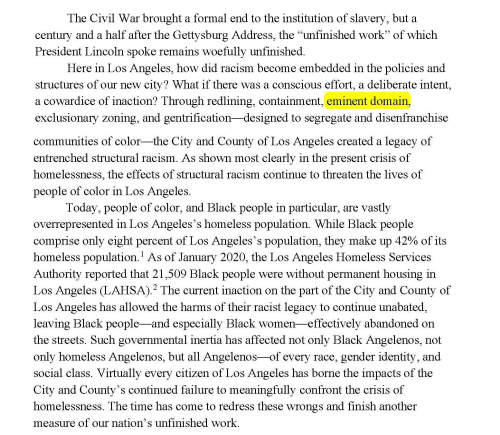
Citing the Gettysburg Address, Brown v. Board of Education, systemic racism (including eminent domain) systemic sexism, and a slew of newspaper articles, the Central District of California (without even holding a hearing), issued a preliminary injunction ordering Los Angeles to immediately address the homeless problem, including ordering that “$1 billion, as represented by Mayor Garcetti, will be placed in escrow forthwith, with funding streams accounted for and reported to the Court within 7 days.” Order at 107.

The city is also ordered to halt any public land sales, figure out how to use said land for the homeless, and report to the court how to address “structural barriers (including but not limited to redlining, highway construction, eminent domain, and health exposure)[.]” Id. at 108.

Continue Reading A Federal Court’s Extraordinary Shot Across The Bow: LA’s Massive Homeless Problem Is Caused (In Part) By Eminent Domain

IMG_20180720_152126_1

Under a Massachusetts statute, local redevelopment agencies have the power to respond to “decadent, substandard, and blighted open areas” either by creating an urban renewal project (redeveloping an area pursuant to a “detailed” and “comprehensive” plan; the statute expressly includes the power of eminent domain for urban renewal projects), or by a “demonstration” development (a term not defined by the statute, and therefore lacks an express delegation of eminent domain power).

In Cobble Hill Center LLC v. Somerville Redev. Auth., No. SJC13028 (Apr. 22, 2021), the Supreme Judicial Court addressed an issue left open the last time it dealt with the power of redevelopment agencies: do they have the power to take property by eminent domain when they choose to undertake a “demonstration?” 

Cobble Hill had intended to do its own private redevelopment on its vacant property in Somerville, Massachusetts. But due to some internal disputes, construction

Continue Reading Mass SJC: New And Improved Means For Blight Elimination Uses Old And Worn Method: Eminent Domain

IMG_4261
Come at me!
(Bolick, J., dissenting)

We have a Wexis alert for “Kelo,” because that’s one of the ways we keep up on the latest developments in this area. That alert doesn’t ping all that often, so we were all excited when yesterday, we received an alert notifying us of the Arizona Supreme Court’s opinion in State of Arizona v. City of Tucson, No. CV-20-0244-SA (Apr. 14, 2021)? Was it a case of government-to-government takings? Prior public use? 

So imagine our disappointment when in reading the opinion, it turns out to be a question of municipal home rule, and election law. Now don’t get us wrong: we are muni law nerds as well as takings nerds, so we dig any opinion in which a court is looking at a local government’s power to frame its own “constitution” and how (or whether) it conflicts with state law. But

Continue Reading What Is A Kelo Reference Doing In An Opinion About Elections And Municipal Home Rule?

In which we join the Pendulum Land Podcast (again, thank you hosts!) to talk about the Virginia Supreme Court’s recent opinion in Johnson v. City of Suffolk, the case we label the “oyster takings” case in which Hampton Roads oystermen claimed that their property was taken when the City of Suffolk and the Sanitation District dumped sewage into the river and declared a “condemnation zone” (i.e., no oyster harvesting).

Short story: the court concluded that the leases of Commonwealth-owned bottomlands in the Nansemond River did not confer a property interest. Or at least not a property interest worthy of constitutional protection. Thus, no takings claim when Suffolk and the Sanitation District dumped sewage into the river and pretty plainly interfered with some kind of right the plaintiffs owned in the lease. Just not enough of a right to require compensation.  

Our thoughts on the court’s decision

Continue Reading We Join Pendulum Podcast To Debate Oysters, Property Rights, Takings

PICT1199

Here’s the recorded arguments.

  1. California will try and push the Court to seeing this as an “anti-union” lawsuit: this is not that big of an intrusion, we’ve been doing it for 50 years under both Cal and federal law, and a ruling for the property owners will upset this apple cart and prevent unions from organizing.
  1. The property owners will try and push the Court to seeing the case as one upholding the “keep out” nature of private property. There are other means of contacting the workers, so why need to do it on this private property? Convenience? [Disclosure: my law firm, Pacific Legal Foundation, represents the property owners.]
  1. Is this case different from Kaiser and Nollan in that California’s invitation to access the nursery property is not to the general public and only to union organizers?
  1. Is this case different from PruneYard in that the owner did not


Continue Reading In California, Can A Landowner Really Say “Keep Out?” Things To Look For In Today’s SCOTUS Cedar Point Nursery Arguments

Dig this: property owners assert that the County’s right of way dedication ordinance is an unlawful exaction. You know the drill – logical nexus, rough proportionality, etc. Nollan, Dolan, Koontz. Here’s the short story: the owners sought subdivision plat approval without the dedication for public roads required by the ordinance. No deal. The County’s process allows for consideration of variances based on extraordinary hardship. The owners assert that the variance procedures violate their right to procedural due process. The District Court granted the County summary judgment.

In Pietsch v. Ward County, No. 20-1728 (Mar. 16, 2021), the Eighth Circuit affirmed. This is a Nollan/Dolan/Koontz claim. The property owners disavow that they are raising a takings claim. But you can’t fool us, property owners, we know a takings claim when we see one. “Plaintiffs’ due process and unconstitutional conditions claims are an impermissible attempt to recast a Takings claim.” Slip

Continue Reading CA8: You Can’t Fool Us, Property Owner, We Know That Nollan/Dollan/Koontz Claim Isn’t A Due Process Or Unconstitutional Conditions Claim, But Really A Takings Claim

We don’t usually post trial court rulings, but this one is very interesting, so we’re going to break our own rule.

New Orleans had a traffic camera program. Not popular, we’d suppose. People who were caught on camera brought a class action suit in Louisiana state court, arguing that the city didn’t have the legal authority to collect the fees and fines. They won, both in the trial court and in the court of appeals. The Louisiana Supreme Court declined to review the case. Meaning the judgment ordering the city to return the money illegally collected was final.

Apparently, the city didn’t do so.

So the judgment creditors sued for a taking in federal court under 42 U.S.C. § 1983. The predictable procedural arguments followed: Rooker/Feldman (nope), res judicata (nope), statute of limitations (nope).

But what about the takings claim itself? The city moved to dismiss for

Continue Reading Ipse Dixit: City’s Noncompliance With State Court Judgment Ordering Return Of Illegally-Collected Traffic Cam Fees Could Be A Taking

Read the allegations in the complaint that the Illinois Appellate Court recounted in Strauss v. City of Chicago, No. 1-19-1977 (Mar. 5, 2021), and they will make your hair curl in horror.

In short: a family rented the ground floor of its mixed residential-commercial building in Chicago to Double Door Liquors (a live music venue). The local alderman “had a personal and financial relationship with the Double Door’s owners.” Slip op. at 3. He “told defendant that only Double Door would be allowed in the building.” Id. (It’s good to have friends, no?) But Double Door was not an ideal tenant, and the noise, drug and alcohol use, and property damage by patrons were a problem to the owners and neighbors. So the owners evicted the club. 

So, according to the family’s complaint, the alderman struck back. Read pages 3- 6 for the details. If true, the allegations are

Continue Reading Complaint Alleged That Chicago Pol Zoned The Chicago Way – But Still No Taking Because Family Owners Only Lost $1 Million

For you original MTV folks

Here’s the latest in a case we’ve been following for a while (even since before the last time it went up to the Court). See this post (“The Chicago Way: City Taking Non-Blighted Property For Economic Development Was Not Pretextual Because…Studies“) and this one (“Illinois App: We Haven’t Changed Our Mind – Chicago’s Sketchy Redevelopment Taking Is Still For Public Use“), for example.

After the latest ruling from the Illinois Appellate Court, we guessed that we had not seen the last of the case. And it turns out that our prognostications were accurate: the property owner has filed a cert petition asking once again for the Supreme Court to take up (ha) a Public Use Clause case.

Have I got your attention now?

Five years ago, in City of Chicago v. Eychaner, 26 N.E.3d 501 (Ill. Ct. App. 2015), the

Continue Reading The Future’s So Blight, I Gotta Wear Shades: New Cert Petition Asks To Reconsider Kelo In A Case Where The Stated Public Use Is To Avoid Possible Future Blight

How about buying what you thought was a retirement home, only to be told that if you want the local government’s ok change the form of ownership of the property you’ve got to offer any tenant a lifetime lease? Here’s the cert petition, filed today in a case we’ve been following for a while, first as an outside observer, now as a (minor) participant.

This one seeks review of the Ninth Circuit’s ruling in Pakel v. City and County of San Francisco, in which a 2-1 panel affirmed the dismissal of a regulatory takings claim which the District Court threw out for not being ripe under Williamson County‘s “state procedures” requirement, and because the exaction imposed was accomplished by a generally-applicable legislative requirement and not via an administrative action. The Ninth Circuit rejected en banc review with beaucoup judges dissentaling.

Here are the Questions Presented:

Continue Reading New Cert Petition: “Final Decision” Takings Ripeness, Exhaustion; Unconstitutional Conditions & Legislative Exactions