


We can’t pretend that we understand everything that is going on in the Supreme Court of India’s recent opinion in Hari Krishna Mandir Trust v. State of Maharashtra, No. 2013-6156 (Aug. 7, 2020) (but when has that ever stopped us before?), but after reviewing the decision, we thought we would post it because of the court’s holding:

96. The right to property may not be a fundamental right any longer, but it is still a constitutional right under Article 300A and a human right as observed by this Court in Vimlaben Ajitbhai Patel v. Vatslaben Ashokbhai Patel and Others. In view of the mandate of Article 300A of the Constitution of India, no person is to be deprived of his property save by the authority of law. The appellant trust cannot be deprived of its property save in accordance with law.

97. Article 300A of the Constitution of
Continue Reading Supreme Court Of India Channels Magna Carta: Although Compensation Is Not Expressly Required By Constitution, When Govt Takes Property, It Has Obligation To Pay

Title

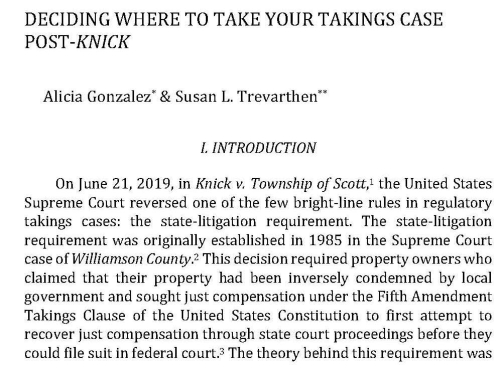
Check this out, a newly-published article on takings by two eminent Florida takings practitioners, Alicia Gonzalez & Susan L. Trevarthen, Deciding Where to Take Your Takings Case Post-Knick, 49 Stetson L. Rev. 539 (2020).

If the title isn’t enough to grab your interest, here’s the description in the Introduction,

Post-Knick,both plaintiffs and defendants have an option available to them that was previously unavailable. This Article will discuss the options that litigants on either side now have in federal takings cases and evaluate which options are desirable depending on the objectives of a particular litigant. Part II will discuss the history of the state-litigation requirement and the theoretical underpinnings of the Williamson County decision in which the state-litigation requirement was imposed. Part III will discuss Knick and the Supreme Court’s reasoning for reversing its own precedent in Williamson County. Part IV will discuss the new options

Continue Reading New Law Review Article: “Deciding Where to Take Your Takings Case Post-Knick

Here’s the Virginia Supreme Court’s order (over vociferous dissents) extending a ban on state courts issuing writs of eviction and processing unlawful detainer (eviction) proceedings:

“Effective August 10,2020, and through September 7,2020, pursuant to Va. Code § 17.1-330, the issuance of writs of eviction pursuant to unlawful detainer actions is suspended and continued. However, this suspension and continuation shall not apply to writs of eviction in unlawful detainer actions that are unrelated to the failure to pay rent.”

Order at 2.

Remind us again why there’s no such thing as a “judicial taking?”

As if the dissenters are reading our minds, you should jump forward to page 12 of the dissent by Justice Kelsey (joined by Chief Justice Lemons and Justice Chafin), who focus on the takings issues:

Next, prohibiting the issuance of a writ of eviction to a landlord with an unlawful detainer judgment arguably sanctions a continuing trespass

Continue Reading Dissenting Virginia Supreme Court Justices: By Suspending Evictions, Courts May Be Liable For Judicial Takings

California law has decriminalized weed. Local governments, however, may regulate the use, sale, possession, and other things (like it can regulate other perfectly legal things). You know, police power kind of regulation.

Under that latter authority, the County of Santa Cruz adopted an ordinance that prohibits a medical weed facility from growing more than 99 plants. A dispensary was growing way more than 99 plants: more like 2,200 to be precise. This is Santa Cruz, man. 

Well, the Sheriff’s Department didn’t quite see it the same way. Under the authority of the ordinance, they seized the weed, and issued a notice of violation of the law. The dispensary sued for a taking (and other causes of action), and among the remedies sought was a return of the plants. The trial court demurred (without leave to amend, for all you California practitioners), on the basis that it isn’t a taking for

Continue Reading Is It A Taking When Five-O Bogarts Your (Legal) Weed?

The Louisiana Court of Appeal’s opinion in Lowenburg v. Sewerage & Water Board of New Orleans, No. 2019-CA-0524 (July 29, 2020) is long (54 pages) and detailed. But for those of you interested in inverse condemnation liability stemming from the impacts on property owners from public construction projects, this is your case.

This consolidated appeal involves a group of homeowners, Plaintiffs-
Appellees (“Lowenburg Appellees”) and a non-profit church with a daycare center Plaintiff-Appellee, Watson Memorial Spiritual Temple of Christ d/b/a Watson Memorial Teaching Ministries, (“Watson Appellee”) who claim that they, along with their properties, sustained various types of damages as a result of the construction of the Southeast Louisiana Urban Drainage Project (SELA Project). This federally sponsored and funded project involved the construction of multiple drainage canals and was carried out by the United States Army Corps of Engineers (“USACE”) and Defendant-Appellant, Sewerage and Water Board (“Appellant”).

Slip op.

Continue Reading Construction Impacts From Public Project Are Not “Quality Of Life” General Damages, But Takings Requiring Compensation

Check out the U.S. Court of  Appeals’ opinion in Oneida Nation v. Village of Hobart, No. 19-1981 (July 30, 2020). The question was whether a local municipality has the power to regulate activity within the Village’s jurisdiction when that municipality is also wholly within the Oneida Nation.

The Nation runs the Big Apple Fest. The Village asserted that the Nation needed a Special Event Permit. Nope, the Nation responded, the Village is entirely within the reservation boundary, and this is taking place in Indian Country where local laws don’t apply. The Village asserted that the Nation had been diminished because allotted land had passed into fee simple ownership, and those portions were not in Indian Country.

After the Nation sought a declaratory judgment on these issues, the district court agreed with the Village. In the first post-McGirt decision, the Seventh Circuit reversed, concluding that the Nation —

Continue Reading CA7: Municipality Can’t Regulate Activity On Oneida Land Because 1838 Treaty Remains Intact

Nothing much to see in the Massachusetts Court of Appeals’ opinion in Comstock v. Zoning Board of Appeals of Gloucester, No. 19-P-1163 (Aug. 3, 2020), a somewhat typical zoning dispute.

Neighbor vs neighbor, over whether permits issued by a municipality (and approved by the ZBA) to renovate and replace an existing — but dilapidated — residential garage, were valid. The replacement garage was to be built on the same footprint as the old garage, even though some elements of the design were different.

Issue: is the separate garage covered as a pre-existing nonconforming use under Massachusetts statutes? 

Short answer: yes, the nonconforming use statute covers separate buildings. The term “single-family residence” includes accessory structures. Nothing too surprising there.

But what caught our eye and makes us post this case here is footnote 11 on page 8 of the slip opinion, about the “certain level of protection to all structures

Continue Reading Mass App: “Grandfathering” Is Term We’re Not Going To Use Because “it has racist origins”

California eminent domain law requires that if property taken isn’t used for the intended public use “within 10 years” of the adoption of the resolution of necessity, then the condemnor must offer to sell the property back to the (former) owner. Unless, that is, the condemnor adopts a new resolution “reauthorizing the existing stated public use.” In Rutgard v. City of Los Angeles, No. B297655 (July 30, 2020), the California Court of Appeal put some meat on the bones of the statute.

We suspect that this situation doesn’t arise all that often. Thus, from the eminent domain perspective, this one seems more interesting than important. But we also think that muni law mavens may find this important, because the court’s analysis focuses on local law:

This appeal presents four cascading questions:

First, does a public entity desiring to retain condemned property under section 1245.245 have to “adopt” its initial

Continue Reading Cal App: When Condemnor Doesn’t Fish Within 10 Years Under Anti-Land Banking Statute, It Better Cut Bait Correctly

There’s a lot going on in the Michigan Supreme Court’s opinion in Mays v. Governor, No. 157335 (July 29, 2020). After all, the case involves claims for personal and property damages resulting from the Flint (Michigan) water crisis. That’s an issue we’ve been following that has also grabbed national headlines.

But if you takings mavens don’t want to take a deep dive into the non-takings parts of the opinions (that resulted in an “affirmed by an equally divided court” situation on the plaintiffs’ bodily injury claims and Bivens-type damage remedy), here are the takings highlights. We thought the most interesting part of the opinion is at pages 11 through 15, where the three-Justice plurality/majority concluded that the plaintiffs alleged property damage and injuries different from the public, and alleged enough to avoid the government’s motion for summary judgment.

The class action complaint in Mays alleged:

Plaintiffs brought

Continue Reading Michigan SCT: Flint Takings Plaintiffs Alleged Unique Property Injuries, And That’s Enough To Survive Summary Judgment

Here’s the cert petition that we’ve been waiting to drop in a case we’ve been following. Last we checked in, the Ninth Circuit (with concurral) had denied en banc review, over a dissental.

In Cedar Point Nursery v. Shiroma, 923 F.3d 524 (May 8, 2019), a 2-1 panel of the Ninth Circuit affirmed the dismissal of a complaint for failure to plausibly state a takings claim under Twombly/Iqbal.  At issue was a regulation adopted by California’s Agricultural Labor Relations Board which requires agricultural employees to open their land to labor union organizers. The regulation is framed as protecting the rights of ag employees to “access by union organizers to the premises of an agricultural employer for the purpose of meeting and talking with employees and soliciting their support.”

The panel majority viewed the complaint as alleging a Loretto physical invasion taking, and held the

Continue Reading New Cert Petition: Does A Physical Invasion Taking Require 24/7 Occupation?