0412191003c_HDR

Here are the links from today’s two sessions (the first, federal water issues impacting local land use; the second, Bringing and Defending a Takings Case):

The morning started off with a talk by former Detroit Mayor (and Michigan Supreme Court justice) Dennis Archer, about Poletown, eminent domain, and economic

Continue Reading Links And Materials From Today’s Land Use Institute Sessions, Baltimore
Photoskidrow

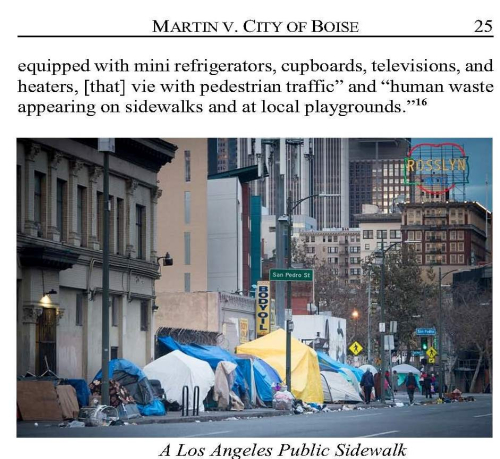
As we’ve noted before, the growing homeless and “urban camping” situation seems to be getting worse, and in our perception is reaching the point of being intractable. A trip down the sidewalk of any major city  — if you dare, particularly in the west — will confirm. And there are no easy answers, except maybe “get used to living with it.” Nor is there a consensus whether the law can do anything to remedy the problem.  

The Ninth Circuit’s latest foray into this area, this order denying rehearing and rehearing en banc of a panel opinion in a case out of Idaho, confirms. The case is a challenge to Boise’s ordinance under the Eighth Amendment’s prohibition on cruel and unusual punishments. The panel concluded that the city could not prosecute people for sleeping outside on public property because they have nowhere else to go. Until the

Continue Reading Ninth Circuit: Local Governments Cannot Enforce 24/7 Ban On Sleeping Or Camping On The Sidewalk If Nowhere Else To Go

2wnyt3

Pop quiz: Quick! Name the races in the Triple Crown of horse racing… There’s the Kentucky Derby (check) … the Belmont Stakes (check) … and … oh yeah, the Preakness Stakes. We always almost forget that last one. 

But the City of Baltimore sure hasn’t. Because the home city of Pimlico racetrack and the aforementioned Preakness Stakes has sued the owner of the race and track in eminent domain, to take the race so it doesn’t leave town like the Colts did when they bolted for Indianapolis literally in the middle of the nightFool me twice, says Baltimore … shame on me!

Read that again. Baltimore is trying to condemn a horse race. A freaking horse race. (Before we posted this, we checked our calendar to make sure it wasn’t April 1. Suspected we were getting pranked. Nope. Then we checked with news sources. Found a bunch.

Continue Reading All Your Race Are Belong To Us: Baltimore Is Condemning The Preakness Stakes (We’re Serious)

We’ve been meaning to post the U.S. Court of Appeals for the Eleventh Circuit’s opinion in Hillcrest Property, LLP v. Pasco County, No. 16-14789 (Feb. 13, 2019), mostly because of the provocative way it starts off: 

The question before us is whether a litigant in this Circuit has a substantive-due-process claim under the Due Process Clause of the Fourteenth Amendment when the alleged conduct is the unlawful application of a land-use ordinance. The answer to that question is a resounding “no”—an answer that this Court delivered in McKinney v. Pate, 20 F.3d 1550 (11th Cir. 1994) (en banc), 24 years ago and has reaffirmed ever since. We held in McKinney that executive action never gives rise to a substantive-due-process claim unless it infringes on a fundamental right. A land-use decision is classic executive, rather than legislative, action—action that, at least here, does not implicate a fundamental right under

Continue Reading 11th Cir: The Use Of Land Isn’t A Fundamental Right, Even If “What happened to [the owner] here was pretty doggone s[tink]y.”

Header image LUI 2019

Come join us at the 33rd Annual Land Use Institute, in Baltimore, Maryland, April 11-12, 2019.

As the brochure notes:

This Annual Land Use Institute program is designed for attorneys, professional planners, and government officials involved in land use planning, zoning, permitting, property development, conservation and environmental protection, and related litigation. It not only addresses and analyzes the state-of-the-art efforts by government to manage land use and development, but also presents the key issues faced by property owners and developers in obtaining necessary governmental approvals. In addition, the entire approach of the program is to provide practice pointers that give immediate “take home value” by focusing on topics relevant to the average practice of the attendee.

The keynote will be delivered by Dennis Archer, former mayor of Detroit (and former Justice of the Michigan Supreme Court, and former President of the ABA), speaking about “Detroit’s New GM Plant from

Continue Reading 33rd Annual Land Use Institute: Baltimore April 11-12, 2019

It’s easy when legal cannabis or medical marijuana is involved to make a joke.

But (for now) we’ll resist that temptation and simply tell you about a webinar our colleagues at the American Planning Association are putting on about our favorite thing … Land use law. (What did you think we might say?)

Thursday, March 21, 2019 from 2:00 – 3:30pm, ET is where you want to be:

This webinar will explore how various land use and natural resource regulations shape the development of the legal cannabis industry. The scope of the conversation will range from regulatory options municipalities may consider as the legal cannabis industry develops to how individual businesses are fostered or stifled as a result of certain regulations. One goal of this webinar is to help practitioners identify key cannabis industry issues they should consider in working with either government officials or business owners.

More information including

Continue Reading Upcoming Webinar: How Land Use and Natural Resource Regulations are Shaping the Legal Cannabis Industry

The bulk of the Indiana Court of Appeals’ opinion in Grdinich v. Plan Comm’n for the Town of Hebron, No. 18A-PL-1050 (Feb. 28, 2019) is devoted to details of land use law, specifically exhaustion of administrative remedies. If that floats your boat, we’ll let you read it. 

What caught our eye was at the very last part of the opinion (page 16), where the court concluded that the property owner did not adequately plead an inverse condemnation claim, when his complaint alleged “that real estate owned by him is encumbered by a 150-foot underground storm water drainage pipeline that is owned and controlled by Hebron for public use without payment for just compensation.” In other words, an uncompensated physical invasion taking. 

The court held this did not state a claim as a matter of law because the allegedly offending pipeline was already in place at the time the plaintiff purchased

Continue Reading Indiana App: No Inverse Claim Where Government’s Permanent Physical Invasion Of Property Happened Before Purchase

Later today (starting at 1pm ET), our colleague Edward Thomas is chairing an ABA-produced webinar on “Low Income Populations: Underrepresented Socially, Overrepresented as Victims of Natural Disasters: Using the Law to Solve a Serious Problem.”

As in other areas of life, when natural disasters strike, it is often the owners of modest means who are the hardest hit. Floods, wildfires, sea level rise, you name it. And Ed has been there: he’s a former FEMA guy, and currently the President of the Natural Hazard Mitigation Association who understands that property rights have to be respected in these situations. 

Find out more information about the program and register hereContinue Reading Webinar Today – Low Income Populations: Underrepresented Socially, Overrepresented as Victims of Natural Disasters

IMG_20180720_151841

Rather than sum up the issue and the Massachusetts Appeals Court’s** conclusion in Smyth v. Conservation Comm’n of Falmouth, No. 17-P-1189 (Feb. 19, 2019), here’s the first part of the opinion:

GREEN, C.J. A land owner brought this action in the Superior Court, claiming that local land use regulation effected a taking of her property, requiring just compensation under the Fifth Amendment to the United States Constitution and art. 10 of the Massachusetts Declaration of Rights. This appeal presents a question of first impression in Massachusetts: whether the land owner is entitled to have her regulatory taking claim decided by a jury. We conclude that the jury right does not attach to such a claim, and that the judge erred in denying the defendants’ motion to submit only the question of damages to a jury. We further conclude that the evidence presented at the trial did not, as matter

Continue Reading Mass App: Regulatory Takings Claims Don’t Get A Jury Trial

The South Carolina Constitution, like the Fifth Amendment and just about every other state constitution, prohibits takings of “private property” without just compensation. See S.C. Const. art. I, § 13(A).

But does that govern the situation where the owner of the property allegedly taken by a city and the State DOT by creating sinkholes is a county? In other words, is property owned by a county “private” property? (We’ve been down this road before, as noted in this post.)

In Georgetown County v. Davis & Floyd, Inc., No. 5627 (Feb. 13, 2019), the South Carolina Court of Appeals answered no. There, the County asserted an inverse condemnation claim against the City of Georgetown and SCDOT, alleging that “while engaged in a joint water drainage project, [they] altered the water table, causing sinkholes to form and damaging public buildings and real property owned by the County.” Slip

Continue Reading SC App: County-Owned Property Isn’t “Private Property,” So No Inverse Claim Against State DOT