BK header

Come join us for one of the best conferences on property rights and property law at the 2018 Brigham-Kanner Property Rights Conference, October 4-5, 2018 at the William and Mary Law School in Williamsburg, Virginia.

Register here

We’ve attended and presented at the Conference in past years, including when it went international in Beijing and at the World Court in The Hague. This year it is back home, and will focus on the work of the 2018 B-K Prize winner, Professor Stewart Sterk of Cardozo Law School

The B-K Prize is awarded to a legal scholar, judge, or practicing lawyer who “has advanced the cause of property rights and has contributed to the overall awareness of the important role property rights occupy in the broader scheme of individual liberty.” The list of past prize winners is a pantheon of property law greats. 

We will be speaking

Continue Reading 2018 Brigham-Kanner Property Rights Conference: Williamsburg, Oct. 4-5, 2018
Ah, the speed of the interwebs: we were all set to write something up about the California Court of Appeal’s recent opinion in Black v. City of Rancho Palos Verdes, No. B285135 (Sep. 6, 2018), when our friend and colleague Bryan Wenter beat us to it.

His post, “Court Rejects Residents’ Takings Lawsuits for Failure to Exhaust Administrative Remedies” pretty much tells the story. This same court a decade earlier concluded the City’s earlier version of a development moratorium was a Lucas taking. As Bryan writes,

Based on their interpretation of Monks II [that 2008 decision noted above], none of the landowners even filed an application for an exclusion from the moratorium. Instead, the landowners argued that Monks II absolved them of the need to exhaust administrative remedies or, alternatively, that exhausting administrative remedies would be futile.

Because the City might allow development if the owners

Continue Reading Cal App: No Taking For Development Moratorium Because Owners Had Not Asked For Development Permits

20180126_111558_HDR

You’ve known for a while that Palm Springs, California, specifically the Renaissance Palm Springs Hotel (a resort facility, but right in town, so you will have many options for “off campus” activities like art museums, the aerial tram, golf, and whatever suits your fancy, and close-in to the Palm Springs Airport), is the venue for our 2019 ALI-CLE Eminent Domain and Land Valuation Litigation, January 24 through 26, 2019.

Of course, you also knew that the programming would be the usual spread of topical and cutting-edge topics, presented by some of the nation’s experts. But we didn’t give you the details. So here are some of the programs we’re having: 

  • Keynote Address: “Property Rights: Foundation for a Free Society” – Taylor Revley, most recently the past President of the College of William and Mary, and also former law school Dean (as well as a


Continue Reading ALI-CLE 2019 Eminent Domain And Land Valuation Litigation Conference, Palm Springs Agenda – Register Now!

Here’s a short but interesting one from the U.S. Court of Appeals for the Sixth Circuit. It isn’t exactly about the usual topics we cover, but is interesting enough that we thought we would post it. 

The case involves old deeds (dated between 1922 and 1957) in the Adams County, Ohio recorder’s office, which contain unenforceable racially restrictive covenants. (You remember back in law school where you learned that these things can’t be enforced because the Supreme Court in Shelley v. Kraemer, 334 U.S. 1 (1948) prohibited courts from doing so, even if the contracts were private.)

The plaintiffs in Mason v. Adams County Recorder, No. 17-3605 (Aug. 28, 2018) objected to the objectionable deed language remaining on public record in the recorder’s office:

Mason maintains that the practice of county recorders to permit documents with restrictive covenants in the chain of title to be recorded or

Continue Reading Damnatio Memoriae Be Damned: “Feeling Unwelcome” By Old Deeds With Racially Restrictive Covenants Isn’t Enough For Article III Standing

Challenging an ordinance that the court characterizes as an “even-handed” zoning regulation, even if it outlaws an existing conditional use, is going to be a tough one for a plaintiff. In theory, it need not be, given the right conditions. But any zoning lawyer will tell you that it is tough to overcome most courts’ presumption that these things are ok. That’s just the way it is. 

The Minnesota Court of Appeals’ opinion in Minnesota Sands, LLC v. County of Winona, No. A18-0090 (July 30, 3018), confirms that vibe. There, the county adopted an ordinance that banned all “industrial-mineral mining, including silica-sand mining.” Slip op. at 1. If that sounds oddly specific, the backstory is that this is the stuff used in fracking. 

Mr. Frick (and here you might think we’d try to work in both “Frick” and “frack” into this post’s title) owned leases to mine silica-sand on

Continue Reading Ordinance Banning Industrial Mineral Mining Not A Regulatory Taking – But What About Palazzolo?

20180803_104034_HDR

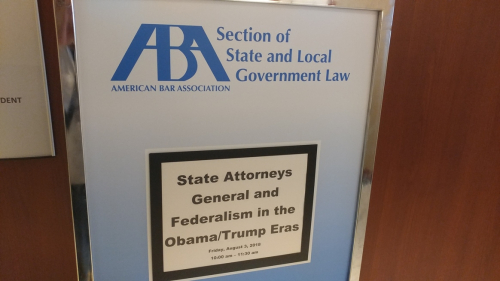
One of our last acts as Chair of the ABA’s Section of State and Local Government Law was to green light a CLE program at the recent Chicago annual meeting entitled “State Attorneys General and Federalism in the Obama and Trump Eras.”

The title kind of gives it away, but the main topic was the implications of the multitudinous lawsuits brought by states and their attorneys general against actions by the president’s administration, first grabbing headlines during President Obama’s tenure, and now during President Trump’s. And then switching playbooks after the election, it seems.  

20180803_104204_HDR

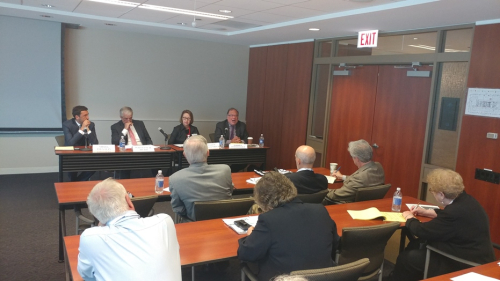
One of the good things about the CLE programming we do in our Section is that we try and get speakers from all sides of the ideological spectrum. We think we did a pretty good job here, with (left-to-right — geographically above, not ideologically) Wisconsin Solicitor General Misha Tseytlin (Madison, WI), William Hurd (past

Continue Reading Litigation As A Substitute For Legislation? Coverage Of Our ABA Section’s Federalism CLE

No surprises in the U.S. Court of Appeals for the Eleventh Circuit’s opinion in Checker Cab Operators, Inc. v. Miami-Dade County, No. 17-11955 (Aug. 6, 2018). As the caption suggests, this is another one of those takings claims brought by “traditional” taxicab operators against a local government for its refusal to keep ridesharing services from the market. 

As in other cases (see our article summarizing several of them here), the court came down on the side of “no taking.” The rationale was that owning a government-issued taxicab medallion, while “property,” does not give the holder a property right to exclude others because the point of the medallion system was to protect consumers, not to give the taxis a monopoly:

Moreover, the main purpose behind the County’s medallion policy was not to enrich medallion holders, but rather to enhance consumer welfare. The County sought to “license and regulate

Continue Reading 11th Cir: No Uber Taking – Taxi Medallion Does Not Give Right To Exclude Others From Transportation Marketplace

My year as the Chair of the ABA’s Section of State and Local Government Law is coming to a close. I’m in Chicago this week at the Annual Meeting, ready to hand over the gavel to my colleague, friend, and successor, Ron Kramer. Below is my 2017-18 report on the Section’s highs and lows, just published in the State and Local Government News

* * * *

2018-18 Chair’s Report: The Year of Living Creatively

It is my pleasure, as Chair of the Section of State & Local Government Law, to report on the 2017-2018 Bar year. When Oregon Attorney General Ellen Rosenblum entrusted me with the Section Chair’s gavel during the ABA Annual Meeting in New York in August 2017, I remarked that the upcoming Bar year would be challenging. It would be a year in which we could experiment; view fundamental organizational changes within ABA as

Continue Reading ABA State And Local Govt Law Section – 2017-18 Chair’s Report: The Year of Living Creatively

Doesnotsimply

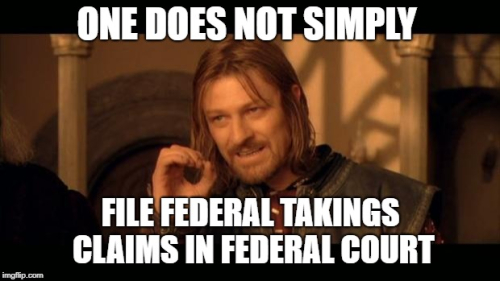
We already knew from its amicus brief brief that the federal government supported the property owner in Knick v. Township of Scott, No. 17-647, the case in which the US. Supreme Court agreed to review the continuing validity of the “state procedures” rule of Williamson County Regional Planning Comm’n v. Hamilton Bank, 473 U.S. 172 (1985). The SG’s brief called for the Court to vacate and remand the dismissal of Knick’s case. We also filed an amicus brief in support of Ms. Knick

But recently, the feds have doubled down by filing a motion to participate in oral argument and to split time with the Petitioner, which notes:

The United States has filed a brief as amicus curiae supporting vacatur and remand. The brief argues that Williamson County correctly recognized that the Fifth Amendment does not “require that just compensation be paid in advance of, or

Continue Reading Federal Govt: Reject Williamson County! Property Owners Whose Property Is Taken By Local Governments Should Be Able To Enforce Fifth Amendment Rights In A Federal Forum