


Clare Trapasso has a Realtor.com piece on what a Justice Kavanaugh could mean for real estate, property, and land use issues, “What Supreme Court Nominee Brett Kavanaugh Could Mean for Real Estate,” where she correctly notes that “while commentators have been scrutinizing Kavanaugh’s record on hot-button topics like abortion and immigration, there’s been little discussion of what a more conservative court could mean for home buyers, sellers, and owners.”

She asked us for input, and here’s what we said:

“The Supreme Court has done some very interesting things on land use law that affect homeowners,” says Robert Thomas, a real estate attorney specializing in land use and eminent domain at the Honolulu-based law firm of Damon Key Leong Kupchak Hastert.

Thomas expects more property-related cases will make their way to the Supreme Court, brought by people hoping that the new bench will increase their odds of a

Continue Reading What Might A Justice Kavanaugh Mean For Takings, Land Use, And Other Issues?
The City’s sewage pipe backed up into several residences. The City has known for decades that these pipes were “cracked, structurally unsound, and that they had significant root intrusion.” The City took measures, but apparently these were not enough, and after “an extremely intense rain and hail storm,” three million gallons of wastewater overflowed into adjacent streams, and backed up into the plaintiffs’ basements. 

They sued the City for negligence, trespass, and for physical takings. 

In Lorman v. City of Rutland, No. 17-158 (June 29, 2018), the court affirmed the dismissal of all of the claims. Slip to page 20 of the slip opinion for the takings analysis, where the court starts off by noting that the takings tests under the U.S. and Vermont Constitutions are “virtually the same,” and (unlike torts) the government is not immune. Slip op. at 20. For a loss of property to be compensable

Continue Reading Vermont: Sewage Backup Wasn’t Permanent, Therefore No Taking

Here’s one that’s been a long time coming (or coming back, more accurately).

In this recently-filed cert petition, the issue is whether an “exaction” imposed by the legislature should be subject to the nexus and rough proportionality requirements of Nollan, Dolan, and Koontz, or is merely subject to rational basis review (i.e., no review at all). 

The last time this issue was presented to the U.S. Supreme Court after the California Supreme Court concluded that an exaction imposed by the City of San Jose wasn’t really and “Exaction,” and was only a land use regulation (as if the label matters), the U.S. Supreme Court declined to consider the issue. Now its back, by way of what looks like a very tight “vehicle” for the Court (the Maryland Court of Appeals decided the issue squarely under federal law). 

Here’s the single Question Presented by Dabbs v. Anne Arundel

Continue Reading New Cert Petition: Legislatively-Imposed Exactions Subject To Nollan-Dolan-Koontz?

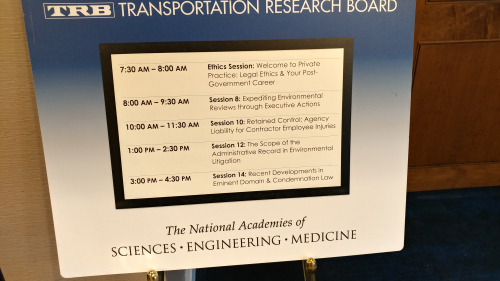
20180717_135234_HDR

Here are the cases and other items I either spoke about or mentioned at today’s Transportation Research Board‘s 57th Annual Workshop on Transportation Law in Cambridge, Massachusetts:


Continue Reading Links And Materials From Today’s Transportation Research Board Session

Here’s the amici brief we’re filing in an important Public Use case we’ve been following.

In St. Bernard Port, Harbor & Terminal District v. Violet Dock Port, Inc., No. 2017-C-0434 (Jan. 30, 2017), the Louisiana Supreme Court upheld the taking by the St. Bernard Port, Harbor, and Terminal District of a Mississippi River docking facility downriver from New Orleans. The Port took the entire VDP facility, made no change in how the property was used, and eventually turned over operation of the facility to a “hand-picked” private operator. The owner challenged the power to take, as well as the compensation awarded. We filed an amicus brief on the issue of compensation, arguing that just compensation isn’t limited to fair market value, but the jury must be allowed to consider replacement cost for a unique property like VDP’s facility. 

The Louisiana Supreme Court held that the Port has the power

Continue Reading SCOTUS Amici Brief: Kelo Revisited – Louisiana Case Is An Opportunity To Clarify Eminent Domain Pretext

Honolulu’s homeless problem is a tough nut to crack. There are no easy answers. People have rights, even if that means they have the freedom to live outside. But when a walk out the door of your downtown office becomes an exercise in dodging human waste, poor unfortunates in various stages of mental illness or addiction, and you pray for rain to wash away the odor, it really crystallizes what that that freedom sometimes means.  

So we follow the legal issues — not because we have any dog in the hunt — but from the perspective of an interested citizen, wondering where this is going. Reporter Gordon Pang, in today’s Honolulu Star-Advertiser has a piece “City lawyers work hard to ensure sidewalk bills will withstand challenges” about the City’s latest efforts to do something. We were asked for our thoughts on two bills, one dealing with an island-wide

Continue Reading Honolulu’s Sidewalk Obstruction Prohibition Goes Island-Wide

The Colorado Supreme Court has agreed to review a public use case we’ve been following with keen interest, Carousel Farms Metropolitan District, No. 18SC30 (July 2, 2018), one we noted was the “most interesting” such case of 2017

The Court of Appeals held that the actual purpose of the taking was private, so it didn’t matter that the public was actually going to use the property being taken. In short: 

When the primary purpose of a condemnation is to advance private interests, even if there will be an eventual public benefit, the condemnation is not for a public purpose

Slip op. at 18. Read our summary of the case here for more details. 

The condemnor sought discretionary review, and the Supreme Court agreed to consider these issues:

[REFRAMED] Whether the court of appeals should review for clear error a trial court’s determination that a condemning authority sufficiently demonstrated

Continue Reading Colorado Supreme Court To Review Major Eminent Domain Case: Does Public Use Save A Taking From A Private Purpose?

Here’s a cert petition we’ve been waiting to drop, in a case we’ve been following out of Florida.

In Town of Ponce Inlet v. Pacetta, LLC, No. 5D14-4520 (Fla. Dist. Ct. App. June 16, 2017), the Florida District Court of Appeal reversed a Lucas takings verdict, concluding the case might not even be ripe under the “final decision” prong of Williamson County (the prong not being directly challenged in Knick), and that the owner needed to prove a Penn Central taking, because as a matter of law, the town had not appropriated all economically beneficial use of the land. The court sent the case back down for another view by the trial court about whether the case was ripe, and if it was, for another takings trial.  

The case presents quite a developmental horror story (we all have ’em, don’t we?). Read the petition for a flavor

Continue Reading New Cert Petition: The Other Williamson County Ripeness Test, Intentional Precondemnation Value Depression

A short, but published, opinion from the U.S. Court of Appeals for the Fifth Circuit.

In Archbold-Garrett v. New Orleans, No. 17-30692 (June 22, 2018), the court held that the plaintiffs’ Fourth Amendment, Fifth Amendment, and Fourteenth Amendment claims (search and seizure, compensation, and procedural due process) were ripe for federal court, even though the plaintiffs had not sought compensation in a Louisiana court under Louisiana law. 

Quick background: the city demolished a building the plaintiffs owned which they had purchased from the city at a lien sale. The prior owner had racked up a bunch of code enforcement fines, and the city claimed the building was dangerous and should come down. But after the sale to the plaintiffs and days before the demolition, the city cancelled the code enforcement lien. Predictably, the city sent the new owners a bill for the demolition. They sued in federal court, arguing

Continue Reading Fifth Circuit: Williamson County Doesn’t Require District Court Dismiss Due Process Or Takings Claim

This one is more for our muni law friends, but today’s post also has two eminent domain angles. 

Anyone who has been to a city council meeting knows at least one fellow like this, considered a pain-in-the-butt by officials. A gadfly, who testifies on seemingly every issue. This is Fane Lozman, eminent domain protester (among other things). Familiar to readers as the Houseboat Guy. Or, more accurately, the “Floating Home” Guy who took the City of Riviera Beach, Florida to the U.S. Supreme Court once before, on the arcane issue of whether his floating home was a houseboat subject to admiralty jurisdiction. The Court held it wasn’t, and wasn’t. 

The houseboat affair wasn’t the end of it for Mr. Lozman, who already was “an outspoken critic of the City’s plan to use its eminent domain power to seize homes along the waterfront for private development,” according to the latest

Continue Reading Arrested Eminent Domain Protester Still Can Sue City For First Amendment Violations