Cover

Two items from land use guru Lawprof Daniel Mandelker:

  • A link to his resource web site, appropriately titled “Land Use Law.” It’s where we go to keep up with all of the land use and related (including takings) stuff.  Includes photos of the sites in key casess (like our “takings piligrimages“), the newest decisions and articles related to land use law, and links to other resources. Frequently updated. We’re adding it to our “Links” sidebar (scroll about halfway down our page on the right). Our suggestion: visit frequently. We’ve done so for a number of years, and you should also.
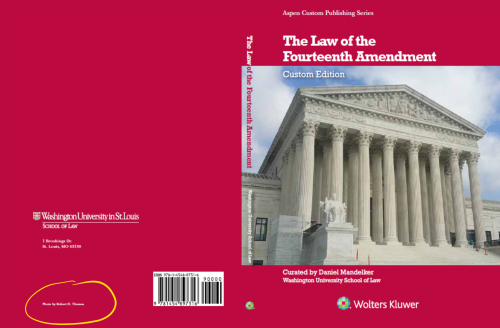
  • Also, Professor Mandelker just published the above book, “The Law of the Fourteenth Amendment.” And we must say that the cover has has the best photo of the U.S. Supreme Court building that we’ve ever seen. Absolutely the best! (All kidding aside, thanks


Continue Reading New Resource, New Book (The Law of the Fourteenth Amendment)
20170814_152652_Richtone(HDR)

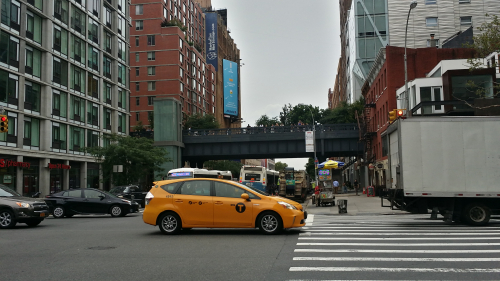
At first, you might not pay much attention to it. After all, it doesn’t really stick out — elevated rail lines aren’t that unusual in a big city. Street-level trains and pedestrians don’t mix well, and in the early 20th Century, New York State adopted a law which moved some of the lines above the street. Indeed, some portions of New York’s subway are still above grade, especially once you are out in the boroughs.

These elevated routes, like many rail lines, were not constructed on land the railroad owned in fee. Instead, the owners of the land granted an easement to the rail lines to use the land “for railroad purposes.” Which meant that the grant of easement remained only as long as the easement holder used the land for a railroad or related purposes. Again, nothing out of the ordinary there.

But then you remember that Manhattan’s

Continue Reading New York City Uncompensated Takings Pilgrimage, High Line Edition

Back in October, the William and Mary Law School awarded U. Hawaii lawprof David Callies the Brigham-Kanner Prize at a two-day conference in Williamsburg. Our summary of the conference is posted here.

We spoke at the conference, at the first panel entitled “The Future of Land Regulation and a Tribute to David Callies,” along with Professors Shelly Saxer and Jim Ely, and past B-K Prize winner Michael Berger. Of course, Professor Callies also delivered his opening remarks.

The law school has posted the audio from that session, which you can listen to here, or stream it above (via Soundcloud). 

We’re in the process of transforming our remarks into a short essay, to be submitted to the Brigham-Kanner Property Conference Journal if you want to wait for the expanded version. (Feb. 13, 2018 update: here’s the draft article.)Continue Reading Brigham-Kanner Podcast: “The Future Of Land Regulations And A Tribute To David Callies”

 A short one, an unpublished and unsigned opinion from the U.S. Court of Appeals for the Eleventh Circuit, Warner v. City of Marathon, No. 16-10086 (Dec. 8, 2017).

As the title of this post indicates, the claims made by the plaintiff included a regulatory takings claim. The facts and details of their claims are in the opinion if you want to read them, but for our purposes today, they aren’t really important. It’s enough to note that the plaintiffs brought their takings claim in Florida state court. A prudent move, given Williamson County requires a property owner to first seek and be denied compensation through available state court procedures before the federal takings claim becomes ripe. 

The City of Marathon removed the case to federal court, as it can do under City of Chicago v. International College of Surgeons, 522 U.S. 156 (1997). That case gives the governmental

Continue Reading Williamson County Farce: 11th Circuit Bounces Case Removed From State Court, Because Plaintiff Didn’t Seek Compensation In State Court

Here’s a case about the denominator in a regulatory takings case from July 2017, just after the U.S. Supreme Court issued its opinion in Murr v. Wisconsin. We somehow missed the opinion when it was issued, but since we think it must be the first case which attempted to apply the Murr majority’s multi-factor test, figured we better post it.

In Quinn v. Board of County Commissioners, Queen Anne’s County, No. 16-1890 (July 7, 2017), a panel of the U.S. Court of Appeals for the Fourth Circuit upheld the district court’s dismissal of a regulatory takings claim that the County’s regulations, “designed to limit overdevelopment of the area” on South Kent Island. Slip op. at 3. But not as you might expect (on Williamson County ripeness grounds), but on the merits.

Practice note: when you are the property owner’s lawyer and an opinion starts by characterizing your

Continue Reading The First Post-Murr Case? Fourth Circuit: No Taking Because Anti-Development Merger Regulations Actually Make Property Developable

In Long v. Liquor Control Comm’n, No. 16-069125-CC (Nov. 16, 2017), the Michigan Court of Appeals addressed an issue that we’ve been following — takings claims arising from government issued licenses or regulated industries. We wrote about these claims in sharing economy cases recently. See “Property” and Investment-Backed Expectations in Ridesharing Regulatory Takings Cases, 39 U. Haw. L. Rev. 301 (2017). These type of cases typically arise where the holder of a government license or permit claims that the government’s failure to require competitors similarly situated to obtain the same license or permit, or granting an additional license, is a taking. This case is among the latter.

Long possessed a liquor license entitling him to sell alcohol for off-premises consumption. But the Commission later issued a similar license to a nearby supermarket, and did so without abiding by the quota and distance restrictions which usually apply in these

Continue Reading Liquor License Isn’t A Right To Be Free From Competition

An interesting read from the South Dakota Supreme Court, on the often fine line between tort liability and inverse condemnation claims.

A big rain, just weeks after the State completed a highway improvement project which included drainage culverts originally installed in 1949, which could not adequately drain an 8-year rain event. Nearby private property flooded. And you know what that means: inverse condemnation, against both the State, and the City of Sioux Falls. The City eventually settled, and the State cross-claimed against the City seeking indemnity if the City was deemed liable to the property owners.

The trial court bifurcated liability and damages, and eventually concluded the State was liable in inverse condemnation for the flooding. The court also dismissed the cross claim against the City, concluding that the City’s permitting nearby development did not contribute to the run-off which flooded the plaintiffs’ land. The jury got the damage issue, and

Continue Reading The Difference Between Tort And Inverse Condemnation

HNLrail

The work on what turned out to be the first phase on Honolulu’s billions-of-dollars rail project from Kapolei to the Ala Moana Shopping Center isn’t even close to being done yet, but the Honolulu Authority for Rapid Transportation looks like it is thinking ahead to Phase 2, and extending the line from the shopping center to the University of Hawaii in Manoa (where the commuting students are), or maybe Waikiki (where the tourists are). 

We say “what turned out to be the first phase,” because you will recall that as originally conceived the rail would run from Kapolei to the UH, but was then scaled back when that plan was too expensive, too ambitious. Now that the election is behind us, and the money sort of is flowing again, maybe not. 

Problem is, there’s a lot of residential and commercial development between the shopping center and the UH and Waikiki

Continue Reading Project Announcement: Honolulu Rail May Be Coming To A Neighborhood Near You

Here’s the cert petition in a case we’ve been following from the Third Circuit, Knick v. Township of Scott. 

Read more about the case’s background here. The short story is that the court concluded the Township’s ordinance which requires owners of all cemeteries, public or private, to maintain them was “constitutionally suspect,” but also held that the owner had not ripened it under Williamson County.

What’s the big deal, you ask? Well, the problem is that apparently many landowners don’t know they own a cemetery. So the ordinance allows the Township’s code inspectors to enter “any property” to inspect and see if it is in compliance with the ordinance. When zoning inspectors came round and told Ms. Knick to clean up her cemetery, her response was “what cemetery? She sued, claiming among other things a facial takings claim. She did not file a state court inverse condemnation case for

Continue Reading New Cert Petition: Reconsider Williamson County’s “State Remedies” Prong, Or Just Overrule It

The Georgia Supreme Court’s analysis in Diversified Holdings, LLP v. City of Suwanee, No. S17A1140 (Nov. 2, 2017) reminded us of that old trope from logic, “no true Scotsman.” 

According to a completely reliable source (Wikipedia):

No true Scotsman is a kind of informal fallacy in which one attempts to protect a universal generalization from counterexamples by changing the definition in an ad hoc fashion to exclude the counterexample. Rather than denying the counterexample or rejecting the original claim, this fallacy modifies the subject of the assertion to exclude the specific case or others like it by rhetoric, without reference to any specific objective rule (“no true Scotsman would do such a thing”; i.e., those who perform that action are not part of our group and thus criticism of that action is not criticism of the group).

(And, in case you were wondering, “For the practice of

Continue Reading Georgia: No True Taking – Challenge To City’s Refusal To Rezone Isn’t Really Inverse Condemnation