ZPLR front page

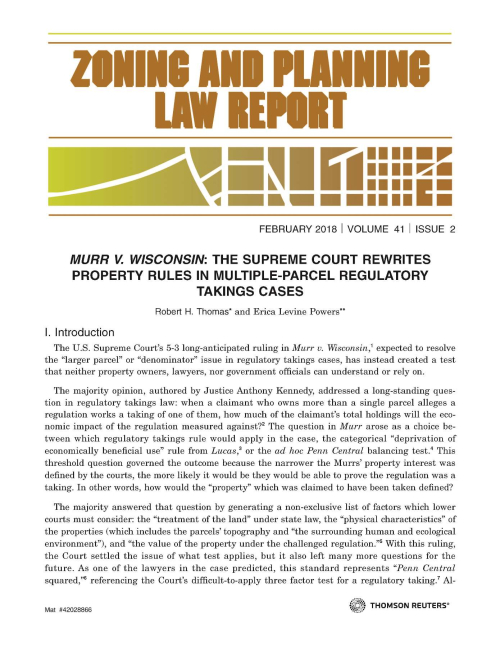
Here’s an article (“Murr v. Wisconsin: The Supreme Court Rewrites Property Rules in Multiple-Parcel Regulatory Takings Cases“), which we authored along with a colleague, published in February 2018’s Zoning and Planning Law Report, about the U.S. Supreme Court’s decision in Murr v. Wisconsin, the case about the “larger parcel” in regulatory takings.

As you might predict, we concluded that the Murr majority’s analysis was vague, unsatisfying, and generally not helpful. Strong letter to follow!

Here’s a passage from the Introduction:

The U.S. Supreme Court’s 5-3 long-anticipated ruling in Murr v. Wisconsin, expected to resolve the “larger parcel” or “denominator” issue in regulatory takings cases, has instead created a test that neither property owners, lawyers, nor government officials can understand or rely on.

The majority opinion, authored by Justice Anthony Kennedy, addressed a long-standing question in regulatory takings law: when a claimant who owns more

Continue Reading New Article: Murr And Other “Blurred Lines”
Rogerspointmaine

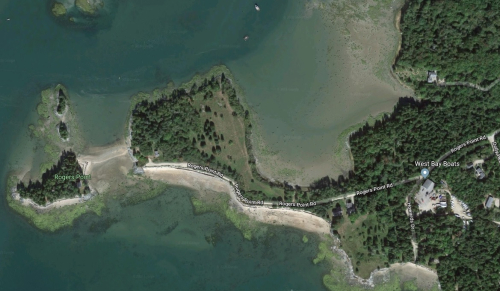
In Bayberry Cove Children’s Land Trust v. Town of Steuben, No. Was-17-258 (Feb. 27, 2018), the Maine Supreme Judicial Court considered whether the Town’s exercise of eminent domain to take an interest to a road the public had apparently been using for decades (if not centuries) was for public use.

A 2013 survey, however, concluded that a part of the road “strayed outside the the bounds of the right of way as laid out by the Town in 1825, 1887 and 1944.” Slip op. at 3. The Trust, which owned the land on which that portion of the road was located, filed a quiet title action. In response, the voters of the Town, in a Town meeting (how very New England of them), rejected the Trust’s offer to pay the Town $150,000 in return for “discontinuing the road” (we presume that means discontinuing the public use of the

Continue Reading Maine: Condemnation To Wipe Out Quiet Title Action Is A Taking For Public Use

2018 LUI header Detroit-1

Mark your calendars, plan to come: Detroit, April 19-20, 2018. For what is perhaps the best deal in CLE (tuition as low as $400), the 32d Annual Land Use Institute, sponsored by our section of the ABA, the Section of State and Local Government Law.

The venue is the Detroit Mercy School of Law, and the conference hotel is the historic Westin Book Cadillac in downtown Detroit. The Land Use Institute is being held in conjunction with the Section’s Spring State and Local Law Conference. Register for one conference, and you are free to move between sessions (no additional registration fees).

Planning Chairs Frank Schnidman and Dean Patrica Salkin have assembled an excellent faculty and program for the two days. Topics include: “Nuts and Bolts of Land Use Practice: Vested Rights and Regulatory Takings,” “Public-Private Partnerships,” “Climate Change and Resilient Development,” “Client

Continue Reading 32nd Annual Land Use Institute: Detroit, April 19-20, 2018

At the recent ALI-CLE Eminent Domain and Land Valuation Litigation Conference in Charleston, South Carolina, we held an after-hours preview of the upcoming feature film about the Kelo case, “Little Pink House.” (Based on Jeff Benedict’s book, which we reviewed here.)

The filmmakers graciously allowed us to preview it at the Conference, and we screened selected clips from the film (along with a few others from other eminent domain movies for comparison), and asked one of the lawyers depicted in the film (the Institute for Justice’s Dana Berliner) to comment: reality? Fiction? Somewhere in between? We’ll post a full review of the film soon, and let you know. 

Well, your chance to decide for yourself is coming soon. The producers have announced that the film has a release date, April 20, 2018. As the Hollywood Reporter noted:

The movie will be released in theaters

Continue Reading Coming Soon To A Theater Near You: “Little Pink House”

Here’s the latest in a case we’ve been following out of Louisiana, involving a local Port’s power to seize a Mississippi River docking facility downriver from New Orleans. The Port took the entire VDP facility, made no change in how the property was used, and eventually turned over operation of the facility to a “hand-picked” private operator. 

In St. Bernard Port, Harbor & Terminal District v. Violet Dock Port, Inc., No. 2017-C-0434 (Jan. 30, 2017), the Louisiana Supreme Court upheld the taking of VDP’s property by the Port so that the Port could run it itself. The owner challenged the power to take, as well as the compensation awarded. The Supreme Court held that the Port has the power to take the docking facility so that the Port could operate the facility, but on the issue of just compensation, the court agreed with the owner that it

Continue Reading Rehearing Sought In Major Public Use Case From Louisiana

Sketch

Here’s the (draft) article from our poriton of the first panel at the 2017 Brigham-Kanner Conference, “Back to the Future of Land Use Regulation.” (Also posted on SSRN here.)

This is an expanded version of our talk (listen to the audio here) during the Conference during which the William and Mary Law School awarded U. Hawaii lawprof David Callies the Brigham-Kanner Prize. Our summary of the conference is posted here.

We were part of the panel entitled “The Future of Land Regulation and a Tribute to David Callies,” along with Professors Shelly Saxer and Jim Ely, and past B-K Prize winner Michael Berger. Professor Callies also delivered his opening remarks during this session.

This article has been submitted to the Brigham-Kanner Property Conference Journal which should be published later this year. 

Back to the Future of Land Use Regulation (draft Feb 11, 2018) Continue Reading Back to the Future of Land Use Regulation – Brigham-Kanner Article

Urban_lawyer3.jpg.imagep.980x179

For you land-users out there, be sure to check your inboxes for the link to the latest issue of The Urban Lawyer, the law review published by my section of the ABA, the Section of State and Local Government Law. With articles on privacy and public real estate records, neighborhood opposition to zoning changes, greenhouse gas regulation, planned communities, land use and cannabis, RLUIPA, and more.

If you are not a member of our Section, you really should be because in addition to a subscription to UL, you get to hang with a crew of lawyers, judges, and legal scholars who are smart, fun, and generous with their time. See this post for more on the reasons you should join us.

Want to see what we’re all about? Plan on joining us for our next in-person conference, the 32d Annual Land Use Institute and Spring State and Local

Continue Reading Latest Issue Of The Urban Lawyer

2012-02-06_11-19-58_634

Here’s an important case we’ve been following out of Louisiana. 

The case is an appeal to the Louisiana Supreme Court in an expropriation case from a quick-take of a Mississippi River docking facility downriver from New Orleans. The Port took the entire VDP facility, made no change in how the property was used, and eventually turned over operation of the facility to a “hand-picked” private operator.

In St. Bernard Port, Harbor & Terminal District v. Violet Dock Port, Inc., No. 2017-C-0434 (Jan. 30, 2017), the Louisiana Supreme Court upheld the taking  of VDP’s property by the Port so that the Port could run it itself. The owner challenged the power to take, as well as the compensation awarded. The Supreme Court held that the Port has the power to take the docking facility so that the Port could operate the facility: 

Consistent with the authority given to

Continue Reading Louisiana Supreme Court: Port Can Take Docking Facility To Run It Itself, But Fell Short Of Fully And Fairly Compensating Owner

Here’s the first post-Murr cert petition (as far as we can tell), in a case we’ve been following. As we wrote in “The First Post-Murr Case? Fourth Circuit: No Taking Because Anti-Development Merger Regulations Actually Make Property Developable,” the Fourth Circuit concluded:

[T]he County’s regulations were run-of-the-mill zoning/land use ordinances, and thus were not a taking, nor violations of the related substantive due process and equal protection claims. Because the County had no obligation to extend sewer services to the plaintiff’s parcels, he had no property interest that was taken by the development prohibition. 

The court rejected the owner’s attempt to distinguish Murr. He pointed out that he purchased his property before the restrictive regulations were adopted, and not afterwards like the Murr children. See Murr, 137 S. Ct. at 1945 (“the “expectations . . . an acquirer of land must acknowledge legitimate restrictions affecting

Continue Reading First Post-Murr Cert Petition

What to make of this? A blog aimed at condemning authorities, with advice on how to avoid a claim for precondemnation damages. Okay, nothing wrong with that. Condemnors deserve good legal counsel as much as other parties. Indeed, having inexperienced counsel for the condemnor often makes resolving cases harder than it should be.

But check this out, a recent post entitled “Practice Tip to Avoid the Potential for Precondemnation Damages,” which notes (in its entirety):

This is a practice tip to avoid the potential for precondemnation damages.  In all project documents, refer to future land acquisitions in noncommittal, tentative, conditional language.

Examples:

  • “The proposed acquisition”
  • “The acquisition under staff consideration”
  • “The recommended acquisition”
  • “No decision has been made to acquire the property”
  • “Only the governing board can make the decision to acquire the property by eminent domain”

Project maps showing required acquisitions should be referred

Continue Reading Protip For Condemnors: For Planned Projects, Play Hide The Ball: “Project maps showing required acquisitions should be referred to as ‘studies,’” And “[b]oth in reality and in appearance, advise staff not to leave a paper trail”