BK-plaque-2015

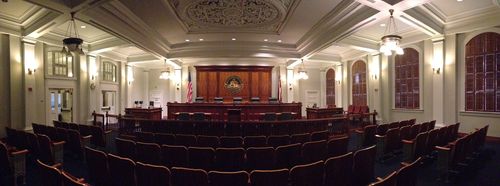
As we’ve done every year lately, we’re soon headed to the Brigham-Kanner Property Rights Conference at the William and Mary Law School in Williamsburg, Virginia.

This year, the B-K Property Rights Prize will be awarded to Harvard lawprof Joseph Singer, who is, shall we say, an interesting choice, given his theory that a “robust regulatory structure” goes hand-in-hand with property rights, liberty, and the free market. Robust regulation isn’t exactly what you might think of when you think “property rights,” is it? So it should make for an interesting conference.

Professor Singer publishes a blog that is worth following, “Property Law Developments.” It is not one of those blogs that are heavy on the analysis, but its a good place to keep up on recent developments in all things property law. 

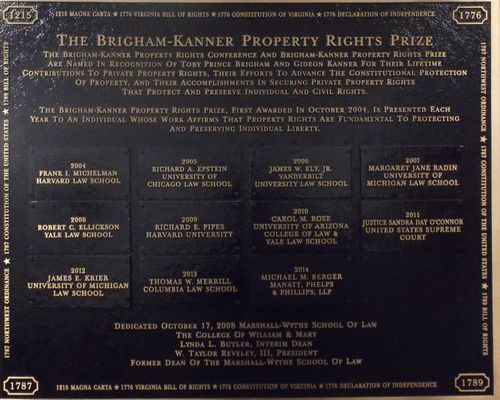
The plaque pictured above is a list of prior prize winners.

Here are the conference details:

Continue Reading Join Us: 2015 Brigham-Kanner Conference At William And Mary Law School

We have learned that the North Carolina Supreme Court has granted the State’s request to review Kirby v. North Carolina Dep’t of Transportation, No. COA14-184 (Feb. 17, 2015).

That’s the case in which the Court of Appeals not only held that the property owners’ claims were ripe, but that the Map Act — which gives the DOT the ability to designate property for future highway use and prevent its development in the meantime — effected a taking. The appeals court reversed the trial court’s dismissal and sent the case back down for a calculation of the compensation owed to each property owner.

This is one to watch, for sure. We’ll keep on doing so and let you know as things develop. 

Continue Reading NC Supreme Court To Review “Map Act” Takings Case

There are many ways to keep nuisance birds off of your building or away from your crops.

There’s this one, a plastic owl perched on the 4th floor of the Maui courthouse.

6a00d83451707369e201bb08668850970d-800wi

There are other devices: scarecrows, balloons, and even dead birds. But our favorite is the scare gun, a “propane powered gas gun which produces a periodic loud explosion.” Sounds like fun.

But not to the powers-that-be in the Town of Trempealeau, Wisconsin. In 2013, the Town adopted an ordinance, amended the following year, which requires anyone who wants to use a scare gun to get a permit. These permits restrict the time, place, and manner in which the owner can employ said gun. 

Farmer Klein had used a scare gun on his property since 1962 to keep blackbirds from devouring his crops. He obtained a permit, but apparently didn’t follow the ordinance closely enough because he

Continue Reading Wisconsin App: Town’s “Scare Gun” Permit Requirement Not A Taking

A piece on the humor site Cracked, “4 Thriving Communities That Rich People Destroyed On Purpose,” tells an old story: modest-but-decent places “redeveloped” into (1) Dodger Stadium, (2) Brazil’s Olympic venues; (3) the Salton Sea, and (4) Central Park, respectively.

(We note that the segment on the Salton Sea is the odd man out, and we can’t figure out how that one fits with the other three. But no matter.)

In telling the story of the destruction of Los Angeles’ Chavez Ravine to make way for the ballpark, the piece links to the above video, which contains interviews with many of the Ravine’s former residents. The video also recounts how, using eminent domain, the City of Los Angeles condemned the homes in the village, supposedly to make way for a new, modern housing project.

The homeowners were offered about $10,000 for their homes and promised

Continue Reading Breaking Up Communities For Redevelopment

Photo

Enviro Wars Episode IV: A New Court

You may have heard that the Hawaii Legislature, after an intensive years-long effort by environmental groups, recently created a new court with specialized jurisdiction that could have a big impact on how property and business owners are treated by Hawaii’s courts. 

Known as the “Environmental Court,” this new court has been given the exclusive jurisdiction to hear most civil and criminal cases affecting the environment. Because Hawaii’s court is only just getting off the ground and is in uncharted territory (only one other state—Vermont—has a court with a similar statewide mandate), those who stand to lose the most in this new court—property and business owners—have many unanswered questions.

Here’s what you need to know.

Why A New Court?

According to its proponents, the new Environmental Court is not expressly intended to change outcomes in environmental cases, and is merely designed

Continue Reading What You Need To Know About Hawaii’s New Environmental Court

Here’s a short (approx. 10 minute) summary of the recent decision by the California Supreme Court in California Building Industry Ass’n v. City of San Jose, No. S212072 (June 15, 2015).

In that case, the court upheld the city’s “inclusionary housing” requirement against a NollanDolanKoontz challenge. The court concluded the ordinance did not impose an “exaction” because it did not demand the owner surrender land — or money in lieu of land — and thus was only subject to rational basis scrutiny and not the N-D-K nexus and rough proportionality requirements. 

The podcast is an excerpt of last week’s IMLA webinar on this case and others. 

Continue Reading Podcast: Cal. Building Industry Ass’n v. City of San Jose – Is An “Inclusionary” Housing Requirement An Exaction, Or Mere Zoning?

The headline of this post shouldn’t be that surprising, especially when the the property owner purchased the land already subject to a floodplain designation, and those regulations effectively prohibited development.

But the two twists in the South Carolina Supreme Court’s opinion in Columbia Venture, LLC v. Richland County, No. 27563 (Aug. 12, 2015), were (1) when Columbia Venture purchased the land, the floodplain designation didn’t encompass as much of the land as it eventually did, and the larger area was only preliminarily designated, and (2) various county agencies had informed Columbia that there was a chance it might get permission to build even if the regulations were eventually adopted.   

Those twists, however, were not enough to save Columbia’s takings claim, and the court rejected both its categorical and Penn Central arguments.  

The facts of the case are somewhat dense, but here’s what you need to know. Columbia

Continue Reading No Taking When Owner Prohibited From Developing In Floodplain

To those able to join us today for IMLA’s “The Takings Issue” webinar, thank you. Here are the links to the items which I discussed:

On Koontz:

On California Building Industry Ass’n v. City of San Jose:


Continue Reading Links From Today’s “The Takings Issue” Webinar

Hawaii Business magazine has a new report about Honolulu rail. The headline asks, “How Much Will It Cost Us In The End?” 

There are questions of how much over original projections the rail project currently is. Or whether it is really over budget at all. Anywhere from zero (according to HART), to $1 billion. And, of course, whether there is an upper limit on how high the costs could go. Anyone with an interest in rail should read the story.

The only thing we have to add is that in our view (as we wrote here), the only honest answer is “as much as it takes.”

The project is already being built, and they aren’t going to simply stop now that they’ve started to pour concrete. In addition to having commenced construction, the legal machinery of the project is well underway, with properties being acquired and

Continue Reading Hawaii Business Magazine Asks: “How Much Will Rail Cost Us In the End?” Our Answer: As Much As It Takes

We’re in Chicago this week participating in the ABA Annual Meeting. While we really are looking forward to a slate of thrilling committee meetings, what we’re really anticipating is the CLE programming. Here are what we think are the highlights:

  • Looming Land Use Constitutional Issues –  Friday, July 31, 2:45 – 4:15 pm, Westin Chicago River North Grand Ballroom B –  Four hot land use issues: land use aspects of medical marijuana legislation; takings and exactions in San Francisco’s requirement for owners to pay departing tenants huge sums; Horne and takingsNew Jersey’s dune program. With Tony Della Pelle and Stephen Schwartz (one of the counsel for the Hornes), among others. 
  • The 2014 Supreme Court Term in Review – Friday, July 31, 2015, 10am – noon, Westin Chicago River North Promenade Ballroom C – “This panel of noted legal professionals, academics and journalists provides an overview of the Supreme Court


Continue Reading ABA Annual Meeting Programming: Takings, Land Use, Supreme Court, Election Law, Appellate Traps