If you need CLE credits, you are in luck. There’s a plethora of upcoming programs that may be of interest to readers. 

First, the ones we’re involved with:

  • The Takings Issue – August 10, 2015, 1 – 2pm ET (webinar) – from the International Municipal Lawyers Association. We’re joining Professors Dan Mandelker and John Echeverria, and land use lawyer Michael Giairno, to talk takings. “Two titans of takings, who just happen to have profoundly opposing views of the world, have graciously agreed to discuss the latest developments and spar. This will be the Great Debate of 2015.” Sounds like fun, no? Registration free for IMLA members, $99 for everyone else. More information, including registration, here
  • Is Sharing Really Caring? The Law of Transportation Sharing: Uber, Lyft, and the Sharing Economy – July 30, 2015, 2:15-3:45pm CT (in-person) –  at the ABA Annual Meeting in Chicago. We’re moderating a session

Continue Reading Mark Your Calendars For Upcoming Events: Takings, Sharing Economy, Fair Housing, etc.

We’ve covered this topic before (see here, here, and here), but we haven’t heard much about it lately. But thanks to this new article by colleague Dwight H. Merriam, we can get back up to speed.

In “Eminent Domain for Underwater Mortgages: Already on the Way to the Bottom of the Sea of Bad Ideas,” from the Virginia State Bar’s Real Property Section’s journal, The Fee Simple (Spring 2015), Dwight discusses “the foreclosure crisis and how so many homeowners became victims of bad lending practices and a deep economic recession. Many are stuck in their homes, which are underwater with a value far below what was owed on them.” The article explores the question: can eminent domain bail out underwater mortgages?

Short answer: no.

To learn more, click here to view the article.

And what’s the latest that Richmond, California, which was leading the

Continue Reading New Article: “Eminent Domain for Underwater Mortgages: Already on the Way to the Bottom of the Sea of Bad Ideas”

20150422_112618
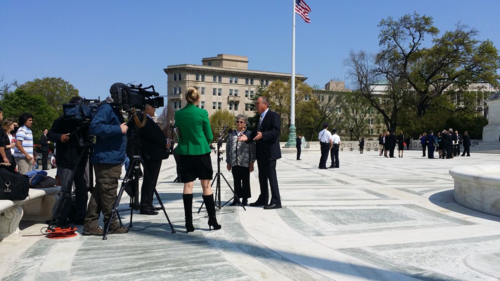
The Hornes outside the Supreme Court

“Separate educational facilities are inherently unequal.”
Chief Justice Earl Warren,
Brown v. Board of Education

“The Fourteenth Amendment does not enact
Mr. Herbert Spencer’s Social Statics.”
Justice Oliver Wendell Holmes,
dissenting in Lochner v. New York

“…prejudice against discrete and insular minorities…”
Justice Harlan Fiske Stone, in footnote 4,
United States v. Carolene Products Co.

“Raisins … are a healthy snack.”
Chief Justice John G. Roberts,
Horne v. Dep’t of Agriculture

A Supreme Court win is a win, particularly by a margin of 8-1, so we’re not going to complain too much about the Court’s opinion in Horne v. Department of Agriculture, No. 14-275 (U.S. June 22, 2015), holding that the USDA’s requirement that raisin producers physically turn over a percentage of their yearly crops to the government without being provided compensation is a taking in violation of the Fifth Amendment.

I

Continue Reading Horne v. USDA: Way More Than Silly Raisin Jokes

There’s nothing new in the California Court of Appeal’s opinion in Rancho de Calistoga v. City of Calistoga, No. A138301 (July 7, 2015), which is probably why the court didn’t designate it for publication. 

But read it anyway, since there’s some interesting bits. Nothing in the details, mind you, but in the overall vibe of the opinion. 

It’s a mobile home rent control case, so you shouldn’t expect much from a California court, and this decision certainly meets those low expectations: it goes through the usual analysis dealing with the park owner’s argument that the city — at the northern end of the Napa Valley — didn’t agree to increase the rent to $625 per month from the $471 average which tenants were paying. The city permitted an increase of only $60, so the owner sued, asserting among other things that the failure to increase the rent to $625 was

Continue Reading Cal App: No Takings Claim, Because Property Owner Makes “Enough”

Donald Trump is garnering a lot of press these days for things not related to eminent domain. And there’s a lot of awareness of the high-profile eminent domain battle in New Jersey, in which he was the “B” in an attempted “A to B” taking. But not everyone is as aware of a later, similar controversy. 

So we dusted off our review of the 2011 documentary You’ve Been Trumped, and post it below. The film focuses on the property owners whose land is in the shadow of Trump’s golf course and luxury residential project in Aberdeenshire, on the west coast of Scotland. Compulsory Purchase Orders were threatened (but ultimately not issued), but the scenario presented the film will be familiar to anyone who follows eminent domain and property rights issues.

The film is available on DVD and streaming from a variety of sources. Definitely worth your time. Especially if

Continue Reading If You Are Even Thinking About Voting For Trump …

LUI header

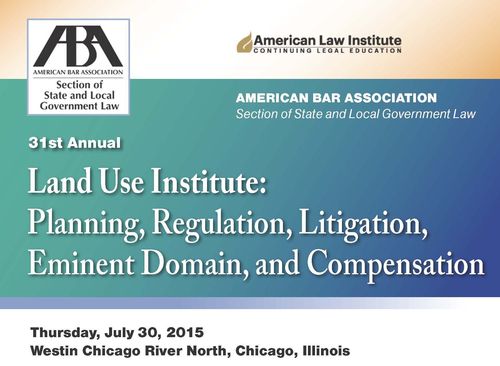
The Land Use Institute, a program that for many years has been planned by co-chairs Frank Schnidman and Gideon Kanner, has found a new home with the American Bar Association’s Section of State and Local Government Law as the main sponsor. It also has a new Planning co-chair, Dean Patty Salkin of Touro Law School, who has stepped in for Professor Kanner.

This program is designed for attorneys, professional planners, and government officials involved in land use planning, zoning, permitting, property development, conservation and environmental protection, and related litigation. It not only addresses and analyzes the state-of-the-art efforts by government to manage land use and development, but also presents the key issues faced by property owners and developers in obtaining necessary governmental approvals.

This year, the one-day program is being held in conjunction with the ABA Annual Meeting in Chicago. It will be held on Thursday, July 30, 2015

Continue Reading Land Use Institute: Planning, Regulation, Litigation, Eminent Domain, and Compensation – 31st Annual Conference, Chicago, July 30, 2015

We were involved with this issue in the days leading up to the initiative election, and we represent an amicus party in this case, so we will post the court’s order without comment.

The title of this post tells you what you want to know. 

Order Determining that the County of Maui GMO Ordinance is Preempted and Exceeds the County’s Authorit…

Continue Reading Federal Court: Maui County GMO Regulation Ordinance Preempted by Federal And State Law

131996

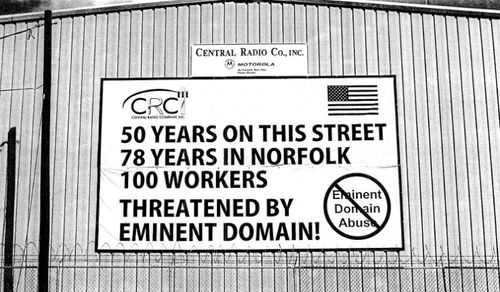
In this Order, the Supreme Court has granted the cert petition in the case we’ve been following about the anti-eminent domain sign in Norfolk, Virginia. The Court vacated the Fourth Circuit judgment and sent the case back down for consideration in light of the recent ruling in Reed v. Town of Gilbert. Here’s the text of the Order:

CENTRAL RADIO COMPANY, ET AL. V. NORFOLK, VA

The motion of Six Law Professors, et al. for leave to file a brief as amici curiae is granted. The motion of Neighborhood Enterprises, Inc., et al. for leave to file a brief as amici Curiae is granted. The petition for a writ of certiorari is granted. The judgment is vacated, and the case is remanded to the United States Court of Appeals for the Fourth Circuit for further consideration in light of Reed v. Town of Gilbert, 576 U. S.

Continue Reading SCOTUS GVR’s Anti-Eminent Domain Sign Case

One for you muni law types (and for future students of Admin Law to assist them with writing their outlines). In Ruggles v. Yagong, No. SCWC-13-0000117 (June 25, 2015), a divided Hawaii Supreme Court refined the test for determining when a municipal ordinance or charter provision is preempted by state law.

The court clarified that the two part Richardson test is a disjunctive and not conjunctive standard, and if the plaintiff can show either that the local law covers the same subject as a comprehensive state statute intended to be uniform statewide, or the local measure conflicts with state law, it is beyond the power of the municipality to adopt. Until Ruggles, there was a little ambiguity about whether a plaintiff needed to show both. No longer. Plaintiff wins if she can show either. 

To the unfamiliar, state law preemption can seem like a result-driven exercise since it

Continue Reading HAWSCT On Preemption: Local Weed No-Enforcement Initiative Conflicts With State Criminal Law (And That’s Enough)

Everyone is distracted today by the too-big-to-fail “Obamacare” ruling by the 6-3 Supreme Court (or, as Justice Scalia called it “SCOTUScare“), in which the Court concluded that the vibe of a statute matters more than its actual language, and the Court’s ruling in the “disparate impact” fair housing case (speaking of which, we wish the Court would apply the same standards to pretext in eminent domain), and we certainly wouldn’t want to divert your attention from that thrilling enterprise, so we’ll keep it brief with this post. 

In Teitlebaum v. South Florida Water Mgmt District, No. 3D14-0963 (June 24, 2015), the Florida District Court of Appeals held that there’s no such thing as condemnation blight in an inverse condemnation case. Teitlebaum and her neighbors among them have owned 3,550 acres of Ag-zoned land on the edge of the Everglades for decades, “apparently hoping that the land

Continue Reading Florida App: Inverse Plaintiffs Must First Show A Wipeout Taking Before “Condemnation Blight” Considered