


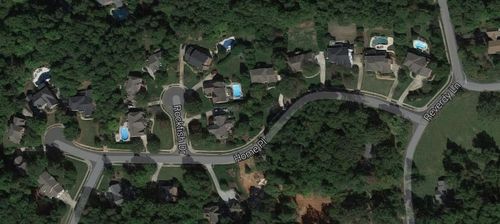
Wright_home_place

In Town of Matthews v. Wright, No. COA14-943 (Apr. 21, 2015), the North Carolina Court of Appeals invalidated a taking, the stated purpose of which was to make a portion of a private road into a public street. 

A taking to open a private road to the public? That sure does sound like a public use or purpose, no? And had the court of appeals stopped there and not delved deeper, and had the case not had the history which it did, the result might have been different. 

The facts which led the court to that conclusion are worth reading for yourself, but here’s the summary: the homes of the Wrights and five neighbors are located on a dead-end street, Home Place, which connects to the public street system at Revedery Lane. Home Place was originally a private street, but the Town believed there was an implied dedication, and treated

Continue Reading NC App: No Public Use Or Benefit When Town, Fueled By Improper Motive, Condemned Private Street To Make It Public

The first sign that the opinion wasn’t going the way of the Golden State Water Company — a private utility that provides water to the City of Ojai, California — was right there in the first paragraphs, which contain the one-two punch of labeling the company both a monopolist, and one that price gouges about California’s most sensitive subject these days, water.

The opinion is infused with the flavor that Golden State positively deserved to have its property taken by eminent domain:

Monopolists have long been unpopular in this country. When King George III’s choke hold on government led to intolerable levels of taxation, he was forced to divest his holdings. At the end of the nineteenth century, Congress passed the Sherman Antitrust Act with only a single dissenting vote. (26 Stat. 209, as amended, 15 U.S.C. §§ 1-7.) Introducing his landmark bill, Senator Sherman summed up the prevailing sentiment:

Continue Reading Cal App: Municipality Free To Form Community Facilities District To Take Over Water Utility

Here’s the latest from the Hawaii Supreme Court on the joinder of parties under Rule 19, where there’s a claim that an absent party is “indispensable” and thus the case should be dismissed. Bottom line is that an absentee should be joined if its presence is needed, and the “indispensable” determination only needs to be undertaken if the party can’t be joined. In other words, dismissal is the last resort. 

We won’t go into the details of Kellberg v. Yuen, No. SCWC-12-0000266 (Apr. 15, 2015), because we represent the plaintiff-respondent. So we will leave it to others to dissect the opinion for any civil procedure gems and practical tips. But read the opinion if you want to understand the details for yourself. 

This is the second time that this case has gone to the Supreme Court, the first trip resulting in a published opinion clarifying when an order

Continue Reading HAWSCT Clarifies Joinder Of Indispensable Parties

Here’s the property owners’ brief in opposition to the DOT’s request for the North Carolina Supreme Court to review the court of appeals’ opinion in Kirby v. N.C. Dep’t of Transportation, No. OA14-184 (Feb. 17, 2015).

The court concluded that the Map Act — which gives the DOT the ability to designate hundreds of parcels for future highway use and prevent their development in the meantime for the avowed purpose of keeping the future acquisition price low — effected a taking. The court remanded the case for a calculation of the compensation owed to each property owner.    

The DOT’s brief argues the Map Act is just a police power regulation, and to force it to actually buy the properties now would make it, you know, just too expensive to build highways. The property owners’ brief responds:

While the NCDOT certainly has police powers to regulate its right of way

Continue Reading Property Owners’ Brief In NC “Map Act” Takings Case: Depressing Acquisition Price Precondemnation Is An Exercise Of The Eminent Domain Power

Grasping_hand

To put on your to-buy, to-read list: lawprof Ilya Somin‘s forthcoming book about the Kelo case and the aftermath, available on June 5, 2015. (We’re in the process of organizing some book talk events with Prof Somin in the fall, and if you have suggestions for venues or want to host one, let us know.) 

Pre-order from Amazon here. The reviews are very good:

“Somin’s thorough rebuttal of the constitutional reasoning and philosophical implications of the Supreme Court’s Kelo decision demonstrates why that ruling was a constructive disaster: It was so dreadful it has provoked robust defenses of the role of private property in sustaining Americans’ liberty.”
 

(George F. Will, journalist and Pulitzer Prize winner)

“By dint of his uncommon thoroughness, Ilya Somin has become the leading and most persuasive critic of the Supreme Court’s ill-fated 2005 Kelo decision.  His close examination of the case’s factual backdrop

Continue Reading New Book Forthcoming: “The Grasping Hand: Kelo v. City of New London & The Limits Of Eminent Domain” by Ilya Somin

Last week, the California Supreme Court heard oral arguments in California Building Industry Assn. v. City of San Jose, No. S212072, the case which challenges San Jose’s “inclusionary housing” requirement.

The Court of Appeal held that under rational basis review (and not heightend scrutiny) San Jose’s affordable housing exaction might survive because it was designed to promote the development of affordable housing, and not to mitigate the impacts of market priced housing. California Building Industry Ass’n v. City of San Jose, 216 Cal.App.4th 137 (6th District June 6, 2013). The California Supreme Court agreed to hear the following issues:

What standard of judicial review applies to a facial constitutional challenge to inclusionary housing ordinances that re quire set asides or in – lieu fees as a condition of approving a development permit? (See San Remo Hotel L.P. v. City & County of San Francisco (2002) 27 Cal.4th 643

Continue Reading California Supreme Court Considering “Inclusionary Housing” Fee

Here’s one that just rolled in, from the Iowa Supreme Court. In Clarke County Reservoir Comm’n v. Edwin D. & Deloris A. Robins Revocable Trust, No. 14-0774 (Apr. 10, 2015), the court held that the Commission did not have the power of eminent domain because several of its members were private actors. The court also concluded that the post-judgment withdrawal of those members did not moot the property owner’s appeal.

Property owners are entitled to strict compliance with legal requirements when a government entity wields the power of eminent domain. These legal requirements help protect against abuse of the eminent domain power. We strictly construe statutes delegating the power of eminent domain and note the absence of a clear legislative authorization for a joint public-private entity to condemn private property.

For the reasons elaborated below, we hold a 28E commission with members lacking the power of eminent domain cannot

Continue Reading Iowa: “Liberty Requires Accountability” – Delegation Of Eminent Domain Power Strictly Construed, And Commission With Private Members Could Not Take Property

In AFT Michigan v. State of Michigan, No. 148748 (Apr. 8, 2015), the Michigan Supreme Court upheld a state statute which mandated a 3% reduction in public school employees’ salaries (to fund a failing school employee retiree health care system), and concluded it was not a taking because it was a voluntary giving by the employees. They were not required after all, to provide the 3% contribution, and could avoid the reduction and maintain their present salary levels by opting out of their own publicly-funded retirement health care.

There’s a lot more to the statute and the unanimous opinion of course — including a rejection of a Contracts Clause claim — but the heart of the takings analysis starts on page 21:

Voluntary healthcare contributions do not violate Const 1963, art 10, § 2 and US Const, Ams V and XIV because, as a general proposition, the government does

Continue Reading Michigan: Voluntary “Giving” By Public School Employees To Fund Failing Retiree Health Benefits Is Not A Taking

Earlier, we posted the cert petition in Hillcrest Property, LLP v. Pasco County, No. 12-846 (cert. petition filed Jan. 15, 2015), which asks the Supreme Court to review the Eleventh Circuit’s decision throwing out Hillcrest’s facial substantive due process challenge to the county’s “Right of Way Preservation Ordinance.” The ordinance allows the county to land bank for future road corridors by means of an exaction that doesn’t come anywhere near to passing muster under NollanDolanKoontz

Although the District Court held the ordinance unconstitutional and is “both coercive and confiscatory in nature and constitutionally offensive in both content and operation,” the Eleventh Circuit concluded that the mere enactment of the ordinance started the four-year statute of limitations clock running on a facial challenge, and that Hillcrest had waited too long to file its complaint. 

Hillcrest’s petition asks whether a facial claim is even subject to the statute

Continue Reading On Facial Challenges, Exactions, Standing, And Statutes Of Limitations: Final Cert Briefs In SCOTUS Substantive Due Process Case

Williamson County gives everyone grief, and if you needed any more proof, here it is.  

In A Forever Recovery, Inc. v. Township of Pennfield, No. 13-2657 (Apr. 2, 2015), an unpublished opinion from the Sixth Circuit, the court upheld the district court’s award of attorneys’ fees and costs to a property owner who brought a takings claim in Michigan state court, only to see the defendant, the Township of Pennfield, remove the case to federal court and then move to dismiss the claim six days later, asserting it was not ripe under Williamson County

The district court rightly remanded the case back to state court, and held the Township liable for fees and costs under the removal statute which shifts fees in cases where the defendant doesn’t have an “objectively reasonable basis for seeking removal.” The court held that the Township removed only to delay the case

Continue Reading 6th Cir Schadenfreude Alert: Municipality Liable For Fees And Costs For Removing Takings Claim From State Court