A few years ago, in Gallenthin Realty Development, Inc. v Borough of Paulsboro, 191 N.J. 344 (2007), the New Jersey Supreme Court held that in order to target property for redevelopment as “blighted,” the government must show that it is in such condition that it “negatively affects surrounding areas” by promoting conditions that can develop into blight. In that case, the targeted property was mostly undeveloped wetlands, and the “blight” of which it stood accused was the owner’s failure to put it to a more intensive economic use. But that was not sufficient to support a blight finding, and the court held that the government must have done more than simply recited the standards for blight redevelopment, and declare they were met. 

We were going to do a complete write-up of the New Jersey court’s latest foray into blight and redevelopment, 62-64 Main Street LLC v. City of Hackensack

Continue Reading New Jersey: When Designating Blight, Baby Can Be Tossed Without First Showing The Bathwater’s Dirty

It’s not often that we say a law review article is a “must-read.” But this one definitely is, especially for all you regulatory takings mavens: David L. Callies, Through a Glass Clearly: Predicting the Future in Land Use Takings Law, 54 Washburn L. Rev. 43 (2014). A pdf of the article is posted here

From the Introduction:

The subject of takings—the government taking of an interest in real property, either through eminent domain or through the exercise of the police power—has been the subject of continuous litigation for nearly a century. The past ten years have been particularly fruitful, as litigants struggle with the meaning and extent of the Fifth Amendment’s Public Use Clause and the extent to which the overzealous exercise of the police power can sufficiently deprive a landowner of rights in property so that the property has been “taken” by regulation, ever since Justice Holmes

Continue Reading New Law Review Article Worth Reading: “Through a Glass Clearly: Predicting the Future in Land Use Takings Law”

Here’s the letter request which we sent today to the California Court of Appeal, Second Division, asking the court to publish its recent opinion in Brost v. City of Santa Barbara, No. B246153 (Mar. 25, 2015). In our post about the case, we wrote “we hope there’s a motion to publish and that the court grants it. This case should be citeable as precedent.”

But as a colleague reminded us, a request to publish an opinion isn’t limited to just the parties to the case, and the California Rules of Court provide that “any person” may ask the court to publish an unpublished opinion, and we certainly fit that description. So today, we — along with our colleagues at Owners’ Counsel of America — wrote to the court that the Brost decision is significant (among other reasons) because it correctly applies the futility exception to takings ripeness, and

Continue Reading Recent California Court Of Appeal Regulatory Takings Opinion Should Be Published

PBN_rail

The cover story in Pacific Business News‘ recent edition, “Honolulu rail transit’s eminent domain” is worth reading. Most importantly, the PBN staff created maps which show how much property is targeted for acquisition, and where it is located, precisely. Yes, the full story is behind a partial paywall, but as we said last week, if you are in Honolulu you really should be a PBN subscriber. Plus, there are a few quotes from our side in the piece:

  • “’Eminent domain cases are rare in Hawaii,’” Thomas said. ‘Hardly anyone has a living memory — not the landowners, judges, lawyers or even the government officials — they can draw from when there are this many takings.'”
  • “However, this could hurt property owners who choose to sell later, as they’ll have to disclose the illegal status of their building. Future owners may be confronted with the cost of


Continue Reading Pacific Business News Details The Rail’s Impact On Honolulu Property

IMG_1534

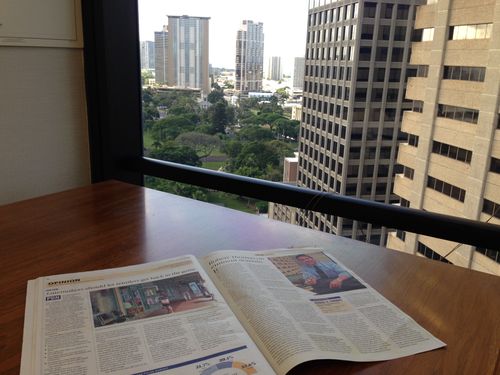
We can’t reproduce the entire interview, and the link to the online version is behind a partial paywall, but here are the highlights of a recent interview, where A. Kam Napier, the Editor-in- Chief of Pacific Business News, came by and chatted with us about eminent domain, property rights, and the Honolulu rail project.  

  • Robert H. Thomas thinks it’s no accident that the Fifth Amendment in the Bill of Rights protects not only the right to due process for people accused of a crime but also the same rights for people who own property the government would like to take. The right of the people to be secure in their private property was that essential to the Founders.
  • “’The Kelo decision was a direct result of the Midkiff decision, where essentially any public purpose that the government advances is going to be enough [to take the


Continue Reading Pacific Business News Report On Eminent Domain And The Honolulu Rail

A couple of noteworthy conferences upcoming, one in-person, the other a “webinar” format:

  • The first is “Kelo: A Decade Later” at the U. Connecticut Law School, Friday, March 20, 2015, from 8:30 am – 4:30 pm. The conference promises to “look back at the decision and its repercussions,” and includes the lawyers for Ms. Kelo and the City of New London. “The conference will then explore the role of eminent domain in government planning generally. What role does and should eminent domain play in economic development?  What is the impact of post-Kelo changes to state law?  Does eminent domain have distinctive impacts on low income communities?  Leading scholars and practitioners in law, planning, sociology, and economics will explore these questions.” We note that our Connecticut Owners’ Counsel colleague Dwight Merriam is one of those “leading practitioners,” and will be moderating a panel entitled “Eminent Domain and Economic Development”


Continue Reading Upcoming Conferences – Kelo In Connecticut, APA And The ESA

Frequent readers know that we just love the Australian comedy film “The Castle,” which tells the tale of one man’s legal fight to save his family’s home from the abusive exercise of eminent domain power. (See “Kelo Down Under,” our review.) The case is played for laughs and in the end, the homeowner naturally prevails, the private benefit is quashed by Australia’s High Court, and all’s well that ends well.

Those of us who practice this kind of law understand that real life doesn’t always — or even often — work out the way it does in the movies: the good guys may not always prevail, and even when things are looking up, the road ahead may be filled with many unexpected bumps and turns. 

So it is in “Leviathan,” the latest film from Russia’s Andrey Zvyagintsev.

Not that we would expect

Continue Reading Movie Review: Leviathan – “The Castle” Gone Bad

We can’t hear or read the word “plethora” without thinking of the “¡Three Amigos!” scene with Jefe and El Guapo, so when the California Court of Appeal “apologize[d] for the plethora of statutory citations and footnotes” (in a footnote!) in the latest opinion about the fallout and intragovernmental battle over the money in the wake of the “Great Dissolution” of California’s redevelopment agencies, we naturally had to post the video.

Bottom line: the agreements which the County entered into as the successor to the county redevelopment agency “are ‘enforceable obligations’ of a former redevelopment agency that continue to be payable out of property taxes before distribution of the remainder to the taxing entities.” Slip op. at 2. 

County of Sonoma v. Cohen, No. C075120 (Cal. App. Mar. 12, 2015)


Continue Reading Cal App: “A Plethora of Statutory Citations And Footnotes” In The Latest Redevelopment Chapter

Here’s the amici brief of the National Association of Home Builders, the National Association of Realtors, the National Association of Independent Business Small Business Legal Center, and others in the case we’ve been following out of the federal courts in Florida about a county’s “right of way preservation” ordinance (which is somewhat similar, but perhaps worse in some ways than North Carolina’s Map Act).

As you might recall, the federal district court held that the ordinance — which allows the county to land bank for future road corridors by means of an exaction is “both coercive and confiscatory in nature and constitutionally offensive in both content and operation” — violated Hillcrest’s due process rights. Yes, the Takings Clause was part of the mix in that it was Hillcrest’s right to just compensation that the county wrongfully interfered with (see Nollan, Dolan, and Koontz), but this was

Continue Reading Amici Brief: Didn’t Lingle Tell Us That Due Process And Takings Are Distinct Claims?

Railcoming

If you didn’t have a chance to attend last week’s community meeting on the Honolulu rail project and property rights at Farrington High School, we’ve posted the audio clips, which include the big picture, the current status, and a series of frequently asked questions.

  • FAQ’s and background (including “The Numbers: How Much Land, How Much Money, How Much Time?,” “Key Terms in Eminent Domain,” “The ‘Dear Owner’ Letter,” “Appraisals From an Eminent Domain Perspective,” “Business Losses, Lost Profits, and Business Interruptions,” “Relocation Benefits,” and more)
  • KITV video report

Continue Reading Honolulu Rail FAQ’s (And Answers) From Last Week’s Community Meeting