Here’s one for the regulatory takings mavens, because it has just about every conceivable issue: ripeness, res judicata (yes, arugment was that the complaint was filed both too early and too late), RookerFeldman, the Tax Injunction Act, and an analysis of whether the property owner’s complaint stated a claim for relief under the Takings Clause. 

At issue in Coleman v, District of Columbia, No. 13-1456 (D. D.C. Sep. 30, 2014) was the District’s statutory provision which allowed it to place a lien on properties whose owners do not pay their full property tax bill, and then sell the property at auction if the lien is not satisfied. So far so good – this scheme isn’t that much different from similar provisions in virtually every state. The problem with DC’s system is that “the law permits the taking of not only the amount of delinquent taxes, plus any

Continue Reading Federal Court: DC’s Tax Sale Statute May Be A Taking
If that title doesn’t grab you, nothing will. Here’s the description of an upcoming program from the American Planning Association that looks awfully interesting:  

The Planning and Law Division of the American Planning Association is pleased to host the upcoming webcast Sex, Guns & Drugs:  Planning for Controversial Land Useson Wednesday, October 22nd from 1:00 to 2:30 PM CST. Registration is $20 for PLD members, $40 for nonmembers, and $45 for webinar registration plus a Planning and Law Division membership. Presented by Daniel J. Bolin and Gregory W. Jones of Ancel Glink, this webcast will explore if and where controversial businesses belong in communities.

The U.S. Constitution guarantees freedom of expression, freedom of religion, and the right to bear arms. But it’s not that simple. Businesses that rely on these constitutional guarantees continue to generate controversy in communities across the country. To compound matters, state legislatures from Arizona to Massachusetts have been busy granting new — and in many cases, previously unheard of — rights to marijuana and firearm retailers.This has rapidly drawn planners and zoning practitioners into the debate over how these businesses best fit into their communities, and whether their communities are legally obligated to accommodate these uses in the first place. Spend an hour learning about the issues and regulatory strategies from around the country. 

Webcast—Sex, Guns & Drugs:  Planning for Controversial Land Uses

October 22, 2014

1:00 – 2:30 PM CST

More information here

, including registration. 
Continue Reading Upcoming Webcast: “Sex, Guns, And Drugs: Planning For Controversial Land Uses”

Ah, Williamson County. We’ve ranted about it before, so we won’t do so here (again). But takings mavens know that a property owner must meet two tests before she can raise a takings claim against a state or local government in federal court: the state or local government must have reached a final decision on the uses to which her property may be put, and she must seek (and be denied) just compensation via state procedures.

We’ve always viewed both parts of the test as very “takings-specific” and not really applicable to other areas. The rationale supporting the final decision requirement is that a court really can’t tell whether property has been “taken” until it understands what uses may be allowed by the state or local government. Absent such a decision, the government may allow some economically beneficial use. Similarly, the state procedures test rationale is that a

Continue Reading 2d Cir Extends Williamson County Ripeness “Final Decision” Requirement To ADA Claims

You mght read the headline of this post and naturally say to yourself, “well, that’s obvious.” But to the Eleventh Circuit in Kentner v. City of Sanibel, 750 F.3d 1274 (11th Cir. 2014), it wasn’t.

In that case, the court concluded that riparian rights are not “fundamental rights” protected by the Due Process Clause from arbitrary and capricious government action, in this case, a ban on the construction of docks and piers (except, apparently, city-owned docks and piers). The court concluded that riparian rights are not “fundamental” rights because they are merely “state-created” rights.

After we read it, the court’s rationale was so inexplicable we asked aloud, “[i]f you can figure out the court’s logic about why riparian rights are not fundamental, and what is a ‘state-created’ right (in contrast to a state-created right created by legislative act, or why the legislature’s hand triggers greater scrutiny than mere

Continue Reading New Cert Petition: Isn’t Property A Fundamental Right?

Here’s a very important case from the Pennsylvania Supreme Court (Middle District). The question before the court in Reading Area Water Auth. v. Schuylkill River Greenway Ass’n , No. J-13-2014 (Sep. 24, 2014) was this:

The primary question raised is whether a municipal authority may exercise its eminent domain powers to condemn an easement over privately-owned land, where the sole purpose of the easement is to supply a private developer with land to install sewer drainage facilities needed for a proposed private residential subdivision.

Slip op. at 1. 

Short answer: no.

The Schuylkill River Greenway Association, true to its name, intends to build a public walking and recreational trail on land it owns along the bank of the river in conjunction with Bern Township. Unfortunately (for the Association), the property next to their is slated for development into an “adult residential subdivision,” and it needed access to the river’s water. We

Continue Reading Pennsylvania: No Public Use To Condemn, When “Sole Purpose” Of Taking Benefits Private Developer

Like love, takings claims can often be found in some very unusual places. And (like love) unfortunately, those claims are not always successful.

When we think of “takings,” things like eminent domain condemning land, inverse condemnation (of land) by flood waters, and cases like that spring to mind first. Even when regulatory takings are involved, the conventional view at least starts with claims about land, and although the Supreme Court hasn’t come out and said it, the argument has been made that the takings and exaction/unconstitutional conditions doctrines are reserved for claims involving land. 

But not always so. 

Here are three recent decisions where property rights and takings came up in situations you might not have expected.

Takings and Labor Law

The first is from the U.S. Court of Appeals for the Seventh Circuit. In Sweeney v. Pence, No. 13-1264 (7th Cir. Sep. 2, 2014), the court held that

Continue Reading Lookin For Takings In All The Wrong(?) Places

EM Hauulaeminent_domain_abuse

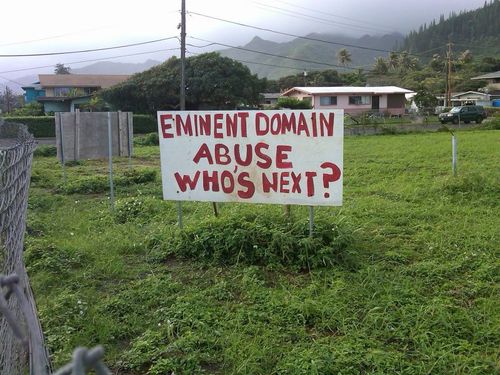
Remember that case which we posted about earlier, in which the City and County of Honolulu condemned an undeveloped lot in rural Oahu for a fire station, but has been met with staunch resistance by the property owners? Not only did we post on the case, but it made national waves, also.

The City filed an eminent domain action in state court, and obtained a writ of immediate possession. After that, the City removed the eminent domain protest signs the owners had maintained on the property. The owners objected, filing a complaint in U.S. District Court alleging that the City went on the property and posted a “removal notice” under the City’s newly-adopted “Bill 54,” an ordinance allowing the City to seize property “stored” on public property provided it “tags” it 24 hours in advance, and that the removal was retaliation for the signs’ content.

The complaint alleges that the

Continue Reading Hawaii Federal Court: “Quick-Take” In Eminent Domain May Not Give Condemnor Exclusive Possession

2010-03-24 15.24.40
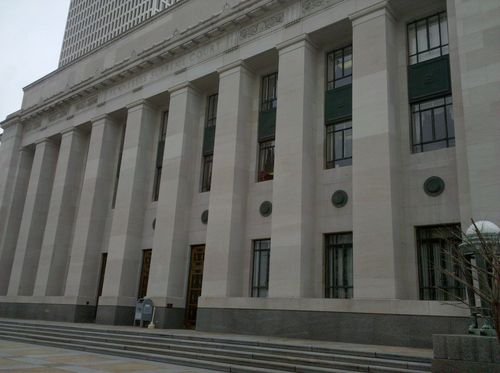
Tennessee Supreme Court, Nashville

In Phillips v. Montgomery County, No. M2012-00737-SC-R11-CV (Aug. 18, 2014), the Tennessee Supreme Court held that a property owner could recover under the state’s inverse condemnation statute, Tenn. Code Ann. § 29-16-123, for a regulatory taking:

We hold that, like the Takings Clause of the United States Constitution, article I, section 21 of the Tennessee Constitution encompasses regulatory takings and that the Property Owners’ complaint is sufficient to allege a state constitutional regulatory taking claim, for which they may seek compensation under Tennessee’s inverse condemnation statute, Tennessee Code Annotated section 29-16-123.

Slip op. at 12.

That’s all well and good, and we applaud the court for doing so. But wait a minute, you say, that statute and this issue sure sound familiar.

Indeed they do. This is the same statute which the U.S. Supreme Court, in Williamson County Regional Planning Comm’n v. Hamilton Bank

Continue Reading Tennessee Finally Recognizes Regulatory Takings Cause Of Action – A Quarter Century After The US Supreme Court Wrongly Assumed It Did

Pasadena, California, in addition to loving roses, apparently loves trees.

The city owns 60,000 street trees, and as the City Arborist testified in City of Pasadena v. Superior Court, No. B255800 (Aug. 14, 2014), “the City catalogued these trees in a database, that he ‘headed an urban tree maintenance program,’ and that ‘[t]he City strives to enhance the quality of life through the promotion, protection, and balanced management of … trees.'” Slip op. at 9.

One day, however, one of those trees fell on the home insured by Mercury Casualty Company. 

Mercury paid the homeowner, then looked to the City for damages in subrogation, asserting nuisance and inverse condemnation. Under California law, inverse condemnation liability arises when property is injured by a public project or improvement in which the defendant substantially planned, approved, constructed, or operated. As the court noted:

The sole issue here is whether the

Continue Reading Cal App: City-Owned Tree Might Be A “Public Improvement” Supporting Inverse Condemnation Claim

9780199322541_450After a couple of days detouring to election law, today we’re back to our usual programming.

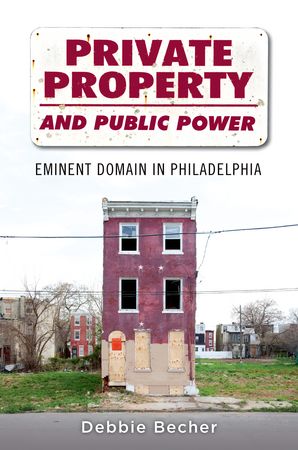
We caught wind of an upcoming book (September 2014), “Private Property and Public Power: Eminent Domain in Philadelphia,” by Barnard College Professor Deborah Becher. “Her book—the first comprehensive study of a city’s eminent domain acquisitions—explores how and why Philadelphia took properties for private redevelopment between 1992 and 2007.” Sounds intriguing. More information about the book here.

Here’s an interview with Professor Becher about the book and her study, which lists some of her more controversial — and debatable — conclusions. Highlights:

  • “The problem is that pundits and activists present the transfer of ownership to a new private owner as the fundamental problem. They say that if government were to take property for a school, a highway, or a public park, abuse wouldn’t be an issue, and that all takings for new


Continue Reading Upcoming Book: Private Property and Public Power – Eminent Domain in Philadelphia