


Here are all of the amici briefs in support of the property owners/petitioners in Kurtz v. Verizon New York, Inc., No. 14-439 (cert. petition filed Oct. 14, 2014).

That’s the case in which the Second Circuit threw out a complaint on Williamson County ripeness grounds. Odd thing was that the court held that a procedural due process claim was not ripe under Williamson County‘s exhaustion of state remedies prong. But as we wrote here (and in our amicus brief for NFIB Small Business Legal Center), Williamson County is built on a takings-specific rationale: a federal takings claim is not ripe for federal court review until just compensation has been denied by the state (including a state court).


Continue Reading Amici Briefs In SCOTUS Due Process Ripeness Case – The End For Williamson County?
We’ve been over this territory before:

And now, in an effort to convince New York City to go down the lets-take-underwater-mortgages-by-eminent-domain path, Cornell lawprof Robert Hockett, whose brainchild this is, has published “‘We Don’t Follow, We Lead’: How New York City Will Save Mortgage Loans by Condemning Them” (Nov. 29, 2014) in the Yale Law Journal Forum. From the piece’s Introduction:

Many cities across the nation have begun to consider exercising their eminent

Continue Reading Yet Another Effort To Justify Taking Mortgages By Eminent Domain

The Hawaii Supreme Court has issued a lengthy opinion in a case we’ve been following, DW Aina Lea Development, LLC v. Bridge Aina Lea, LLC, No. SCAP-13-0000091 (Nov. 25, 2014). 

The litigation is a series of two lawsuits that originated in state court in the Third Circuit (Big Island), one an original jurisdiction civil rights lawsuit, the other an administrative appeal, the latter being the case in which the Supreme Court just ruled.

The essence of the plaintiff’s allegations is that the State Land Use Commission wrongfully amended the land use boundaries from “urban” back to to “agriculture.” Many years earlier, the LUC had amended the boundary to urban on the condition that the owner provide a certain number of affordable units by 2006. In 2008, the developer had not fully done so and the LUC ordered it to show cause why the land classification should not revert to

Continue Reading HAWSCT: Land Use Comm’n Can’t Rescind A Re-zoning Via Truncated Procedures

There’s still time to register for tomorrow’s American Planning Association (Planning and Law Division)’s webinar, Fair Housing, Affordable Housing, and Local Planning and Zoning: Understanding the Obligations and Reducing Your Community’s Legal Risk. Here’s the description:

The Planning and Law Division of the American Planning Association is pleased to host the upcoming webcast Fair Housing, Affordable Housing, and Local Planning and Zoning: Understanding the Obligations and Reducing Your Community’s Legal Risk on Tuesday, November 25th from 2:00 to 3:30 PM EST. Registration is $20 for PLD members, $40 for nonmembers, and $45 for webinar registration plus a Planning and Law Division membership. Presented by Don Elliot of Clarion Associates and Brian Connolly of Otten, Johnson, Robinson, Neff & Ragonetti, this webcast explores the connection between local land use regulation and the federal Fair Housing Act.  

Register hereContinue Reading Upcoming APA Webinar On Affordable Housing

The Hawaii Supreme Court has issued a unanimous opinion in Friends of Makakilo v. D.R. Horton-Schuler Homes, LLC, No. SCAP-13-0002408 (Oct. 30, 2014), holding that there’s not really such thing as a “cross appeal” in administratve appeals (at least in the sense that “cross appeal” is usually used in appellate procedure).  

Quick facts: D.R. Horton petitioned the state Land Use Commission for a boundary amendment (aka a rezoning). Three parties intervened and sought and were granted a “contested case.” The LUC concluded that D.R. Horton was entitled to the boundary amendment. Thirty days later, two of the three intervenors filed a notice of appeal under the Hawaii Administrative Procedures Act, Haw. Rev. Stat. § 91-14, which gives circuit (trial) courts jurisdiction over appeals by any person aggrieved by an agency’s decision in a contested case. The HAPA gives those parties 30 days to file.

Thirteen days after the appeal

Continue Reading HAWSCT: No “Cross-Appeal” In Administrative Appeals

Today, on behalf of the National Federation of Independent Business Small Business Legal Center, we filed this amicus brief in Kurtz v. Verizon New York, Inc., No. 14-439 (cert. petition filed Oct. 14, 2014). The cert petition, filed on Kurtz’s behalf by the Institute for Justice, is posted here

That’s the case in which the Second Circuit threw out a complaint on Williamson County ripeness grounds. Odd thing was that the court held that a procedural due process claim was not ripe under Williamson County‘s exhaustion of state remedies prong. But wait, you say, Williamson County is based on a takings-specific rationale: a federal takings claim is not ripe for federal court review until just compensation has been denied by the state (inclulding a state court). That’s what our brief says, too: 

For nearly 30 years, Williamson County’s state remedies requirement has required federal courts to

Continue Reading New Amicus Brief: Overrule Williamson County! (At Least The State Exhaustion Requirement)

Here’s what caught our eye today:

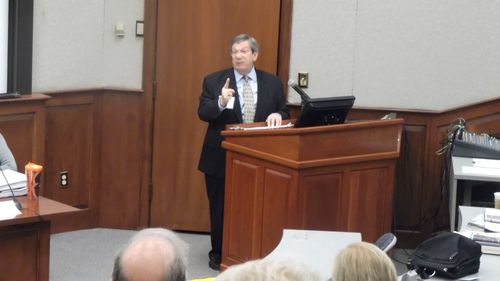
  • Last evening, we attended lawprof Gregory S. Alexander‘s talk at the U. Hawaii Law School, “Five Easy Pieces: Recurrent Themes in American Property Law.” You know it’s not a real academic talk until the speaker uses the words “normative” and “neologism,” and Professor Alexander did not disappoint. But seriously, it was a thought-provoking hour, focused on our favorite topic, property law. A video was made, and hopefully the law school will post it on line so you can watch. We’ll link to it when they do. 
  • Va. high court to look at Beach eminent domain appeal,” from the Hampton Roads newspaper, about a case which the Virginia Supreme Court just accepted. The case was triggered when the trial court refused to allow the jury to hear evidence of the DOT’s first appraisal and deposit, which was higher than its final appraisal


Continue Reading Thursday Round-Up: “Five Easy Pieces” Talk, Re-appraisals, Foie Gras Ban Lives, Kelo In China, Kelo Movie

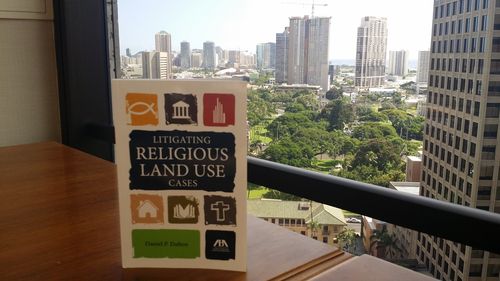
20141104_135324

A big thank you to our friend and colleague from Detroit, Dan Dalton, who sent us a recently-published book which he authored, “Litigating Religious Land Use Cases.” 

This book discusses how to litigate such a religious land use case on behalf of a religious entity pursuant to the Religious Land Use and Institutionalized Persons Act (“RLUIPA”)  and the First Amendment. While the First Amendment dates to the founding days of the United States, RLUIPA is a much more recent federal law that can serve as an effective tool in protecting the property interests of religious organizations.

A must-have for any land use lawyer (even if you don’t focus on religious land use cases, or don’t represent religious organizations in such cases), Dan’s book is a great overview of the applicable law, and a primer on the various causes-of-action that can pop up in these type of controversies.

Continue Reading New Book: Litigating Religious Land Use Cases (Dan Dalton)

  DSCF2208

You can’t have rights without advocates.”

                              – Michael Berger

We’re at the William and Mary Law School in Williamsburg, Virginia today for the 11th Brigham-Kanner Property Rights Conference. As we’ve noted earlier, Michael Berger is this year’s B-K Prize honoree, for his career contributions to property law and his “scholarly work and accomplishments [which] affirm that property rights are fundamental to protecting individual and civil rights.”

The list of past recipients is an All-Star roster of property scholars and jurists, including lawprofs Frank Michelman, Richard Epstein, James Ely, Carol Rose, Thomas Merrill, and Supreme Court Justice Sandra Day O’Connor (the latter perhaps more for where she ended up in her Supreme Court career than where she started). See the plaque on the Law School’s wall for the complete list of

Continue Reading 2014 Brigham-Kanner Property Rights Conference Report: Honoring Michael Berger

Update: San Francisco is going to appeal.

It cost a lot to live in San Francisco, these days. A whole lot, whether you own, or rent

If you’re a renter, however, you should hope and pray that your landlord wants out of the rental business. Because under a San Francisco ordinance, property owners who rent their properties but then decide they don’t want to continue to do so must get a permit from the City in order to quit. Another requirement of the ordinance is that the owner pay cash to a displaced tenant — a lump sum “relocation payment” of 24 times “the difference between the units’ current monthly rent and an amount that purports to be the fair market value of a comparable unit in San Francisco, as calculated by a schedule developed by the Controller’s Office.” 

The Levins wanted out of the rental business, and

Continue Reading Federal Court: San Francisco’s Housing Exaction Violates Nollan-Dolan-Koontz